
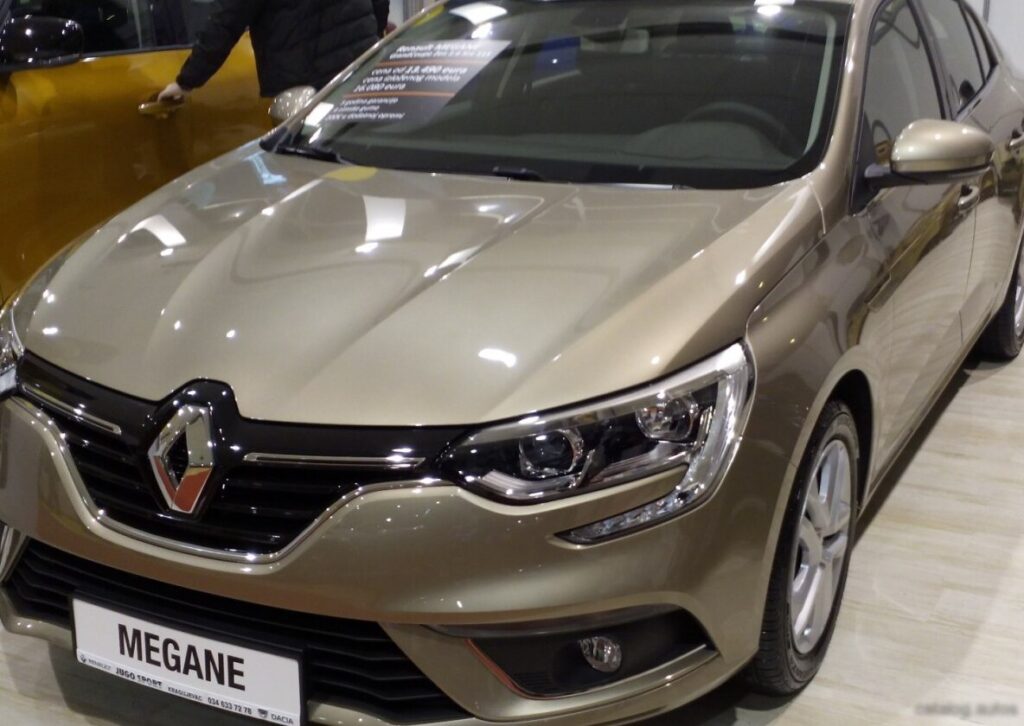
The Renault Megane Grand Coupe 1.5 dCi (110 hp) was a popular variant of Renault’s compact sedan, produced from 2016 to 2021. Positioned as a fuel-efficient and practical option within the fourth generation Megane range (based on the Renault-Nissan CMF-C/D platform), it aimed to appeal to buyers prioritizing economy and everyday usability. This model offered a balance between performance and running costs, making it a common choice in European markets. The Grand Coupe body style, essentially a sedan with a coupe-like sloping roofline, provided a more stylish alternative to the traditional hatchback version.
The heart of the Megane Grand Coupe 1.5 dCi was Renault’s K9K 656 engine, a 1.5-liter inline-four cylinder diesel engine. This engine utilized a common rail direct fuel injection system, delivering fuel at high pressure directly into the combustion chamber for improved efficiency and reduced emissions. It was turbocharged and intercooled, enhancing power output and torque. The engine featured a single overhead camshaft (SOHC) valvetrain with two valves per cylinder. The 110 horsepower output was achieved at 4000 rpm, while peak torque of 260 Nm (191.77 lb-ft) was available from just 1750 rpm. This relatively low-end torque delivery contributed to good drivability in urban and highway conditions. The engine was paired with a six-speed manual transmission, which was the standard offering for this variant. While an automatic transmission was available on other Megane models, it was not offered with the 1.5 dCi 110 hp engine.
Driving the 1.5 dCi Grand Coupe provided a comfortable and economical experience. Acceleration from 0 to 100 km/h (0-62 mph) took approximately 11.6 seconds, and top speed was rated at 190 km/h (118 mph). Compared to the more powerful gasoline engines available in the Megane range, the 1.5 dCi offered significantly less outright performance. However, its strength lay in its fuel efficiency. Combined fuel consumption was rated at 3.7 l/100 km (63.6 US mpg), making it an attractive option for high-mileage drivers. The six-speed manual transmission provided precise gear changes, and the engine’s torque allowed for relaxed cruising at highway speeds. The gear ratios were tuned for maximizing fuel economy rather than outright acceleration.
The 1.5 dCi Grand Coupe typically came equipped with a reasonable level of standard features. Base models included air conditioning, power windows, a basic audio system, and steel wheels with hubcaps. Higher trim levels, such as the Dynamique and Intens, added features like alloy wheels, a touchscreen infotainment system with navigation, automatic climate control, rear parking sensors, and cruise control. Interior upholstery was typically cloth, with options for leather seats on higher trims. The dashboard layout was functional and modern, with a focus on ergonomics. Optional extras included a panoramic sunroof, upgraded audio systems, and various driver-assistance features.
The Megane Grand Coupe 1.5 dCi utilized a standard front-wheel-drive configuration. The front suspension consisted of MacPherson struts, while the rear suspension employed a semi-independent twist beam setup. Front brakes were ventilated discs measuring 280×24 mm, providing adequate stopping power. Rear brakes were solid discs measuring 260×8 mm. The car was equipped with ABS (Anti-lock Braking System) as standard. Steering was provided by an electric power steering system, offering light and precise control. Tire sizes varied depending on the trim level, ranging from 205/55 R16 to 225/40 R18.
Critics generally praised the Megane Grand Coupe 1.5 dCi for its fuel efficiency and comfortable ride. However, some noted that the engine could feel underpowered, particularly when fully loaded or tackling steep hills. The manual transmission was well-received, but some reviewers expressed a desire for an automatic option. Compared to the 1.2 TCe gasoline engine, the 1.5 dCi offered superior fuel economy but less performance. The 1.5 dCi was also more refined and quieter than the higher-output diesel variants, such as the 1.6 dCi. Reliability was generally good, with the K9K engine proving to be a durable and long-lasting unit.
| Engine Model/Code | K9K 656 |
| Engine Displacement | 1461 cm3 (89.16 cu. in.) |
| Number of Cylinders | 4, Inline |
| Cylinder Bore | 76 mm (2.99 in.) |
| Piston Stroke | 80.5 mm (3.17 in.) |
| Valves per Cylinder | 2 |
| Fuel Injection System | Diesel Commonrail |
| Engine Aspiration | Turbocharger, Intercooler |
| Maximum Power | 110 Hp @ 4000 rpm |
| Maximum Torque | 260 Nm (191.77 lb.-ft.) @ 1750 rpm |
| Fuel Consumption (Urban) | 4.2 l/100 km (56 US mpg) |
| Fuel Consumption (Extra Urban) | 3.4 l/100 km (69.2 US mpg) |
| Fuel Consumption (Combined) | 3.7 l/100 km (63.6 US mpg) |
| CO2 Emissions | 95 g/km |
| Acceleration 0-100 km/h | 11.6 sec |
| Maximum Speed | 190 km/h (118.06 mph) |
| Kerb Weight | 1320 kg (2910.1 lbs.) |
| Fuel Tank Capacity | 49 l (12.94 US gal) |
| Transmission | 6-speed Manual |
Today, the Renault Megane Grand Coupe 1.5 dCi (110 hp) remains a relatively common sight on used car markets. The K9K engine is known for its durability and relatively low maintenance costs, making it a sensible choice for budget-conscious buyers. However, potential buyers should be aware of the potential for diesel particulate filter (DPF) issues, particularly on vehicles that have primarily been used for short journeys. Overall, the 1.5 dCi Grand Coupe represents a practical and economical option in the used compact sedan segment, offering a good balance of fuel efficiency, comfort, and reliability.

