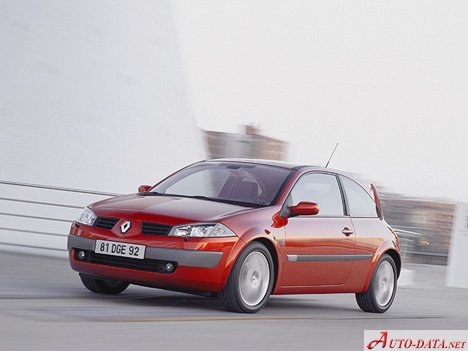
The Renault Megane II Coupe 1.4 16V (82 Hp) represents a specific and entry-level iteration of the second-generation Renault Megane, a prominent compact car produced by the French automaker Renault. Launched in 2003 and manufactured through 2005, this particular model was part of the highly successful Megane II lineup, which garnered significant acclaim, including being named European Car of the Year in 2003. While the Megane II offered a diverse range of body styles, including hatchback, sedan, and convertible, the three-door coupe variant was designed to appeal to buyers seeking a sportier aesthetic and a more dynamic driving experience within the C-segment market. Primarily aimed at the European market, where compact cars dominate sales charts, the Renault Megane II Coupe 1.4 16V (82 Hp) was positioned as an accessible option, balancing economical operation with modern design. Its distinct styling, particularly the groundbreaking “bustle-back” rear design, set it apart from many of its contemporaries and became a hallmark of the Megane II generation. This article will delve into the specific characteristics, performance metrics, and market context of this particular powertrain and body style combination, offering an expert perspective on its role within Renault’s extensive portfolio and the broader European automotive landscape.
Powertrain & Engine Architecture
At the heart of the Renault Megane II Coupe 1.4 16V (82 Hp) lies a naturally aspirated, 1.4-liter (1390 cm3 or 84.82 cu. in.) inline four-cylinder engine, designated by the internal code K4J. This powerplant features a DOHC (Double Overhead Camshaft) valvetrain with four valves per cylinder, a common and efficient setup for its era. Fuel delivery is handled by a multi-port manifold injection system, ensuring precise fuel metering for optimal combustion. With a compression ratio of 10:1, the engine was designed to run on readily available gasoline (petrol).
The K4J engine is a member of Renault’s K-series, known for its relative simplicity and durability. The multi-point fuel injection system utilizes individual injectors for each cylinder, controlled by the engine control unit (ECU) to optimize fuel delivery based on various sensor inputs. The valvetrain employs hydraulic lifters, reducing the need for frequent valve adjustments. The engine’s block is constructed from cast iron, providing robust structural integrity, while the cylinder head is made of aluminum alloy to reduce weight.
This specific iteration of the Megane II Coupe produces 82 horsepower (Hp) at 6000 rpm, delivering a power output of approximately 59 Hp per liter of displacement. Torque peaks at 124 Newton-meters (Nm), which translates to 91.46 lb.-ft., available at a relatively accessible 3750 rpm. Power is sent to the front wheels via a standard five-speed manual transmission, a configuration typical for compact cars of this period, emphasizing driver engagement and fuel efficiency. While an automatic transmission was offered on other Megane II variants, it was not paired with the 1.4 16V engine.
Driving Characteristics
The 1.4-liter engine in the Megane II Coupe 1.4 16V (82 Hp) was not engineered for outright blistering performance, but it provided adequate propulsion for daily driving and urban commuting. The five-speed manual transmission is well-matched to the engine’s characteristics, allowing drivers to keep the engine in its optimal power band. The gear ratios are relatively long, prioritizing fuel efficiency over rapid acceleration. First gear is geared for smooth take-offs, while fifth gear is designed for comfortable cruising on highways.
Compared to higher-output versions of the Megane II, such as those equipped with the 1.6 16V or 2.0 16V engines, the 1.4 16V feels noticeably less powerful. Acceleration is slower, and overtaking maneuvers require more planning. However, the 1.4 16V offers a more relaxed driving experience, particularly in city traffic, where its lighter throttle response and lower fuel consumption are advantageous. Compared to the diesel variants (like the 1.5 dCi), the 1.4 16V provides a smoother, quieter driving experience, albeit with less low-end torque.
The steering is light and precise, making it easy to maneuver in tight spaces. The suspension provides a comfortable ride, absorbing bumps and imperfections in the road surface effectively. However, the handling is not as sharp or engaging as that of the more powerful Megane II models, which typically featured stiffer suspension setups.
Equipment & Trim Levels
The Renault Megane II Coupe 1.4 16V (82 Hp) was typically offered in a base trim level, focusing on providing essential features at an affordable price point. Standard equipment generally included power steering, central locking, electric front windows, and a basic audio system. Safety features such as ABS (Anti-lock Braking System) and driver and passenger airbags were also standard.
Interior upholstery was typically cloth, with a simple and functional dashboard design. Optional extras available for this trim included air conditioning, alloy wheels, a CD player, and rear electric windows. Higher trim levels of the Megane II Coupe, such as the Expression and Dynamique, offered more luxurious features, including automatic climate control, leather upholstery, and a more advanced audio system. However, these trims were typically equipped with more powerful engines.
The overall interior ambiance of the 1.4 16V model was practical and well-built, reflecting Renault’s commitment to quality and ergonomics. The seats provided adequate support for both short and long journeys, and the cabin offered sufficient space for passengers and luggage.
Chassis & Braking
The Renault Megane II Coupe 1.4 16V (82 Hp) utilized a front-wheel-drive chassis with an independent McPherson strut suspension at the front and a torsion beam axle at the rear. This suspension setup provided a good balance between ride comfort and handling, making it suitable for a variety of driving conditions. The torsion beam rear axle is a cost-effective solution that minimizes weight and complexity.
Braking was handled by ventilated discs at the front and solid discs at the rear, providing adequate stopping power for the vehicle’s weight and performance. ABS (Anti-lock Braking System) was standard, enhancing braking performance and stability, particularly on slippery surfaces. The braking system was designed to provide a progressive and predictable feel, allowing drivers to maintain control during emergency braking maneuvers.
The steering system employed a power-assisted rack and pinion setup, offering light steering effort for easy maneuverability. The steering ratio was optimized for a balance between responsiveness and stability. The vehicle’s tires were typically 195/65 R15 or 205/55 R16, providing adequate grip and ride comfort.
Market Reception & Comparison
Critics generally viewed the Renault Megane II Coupe 1.4 16V (82 Hp) as a competent and economical compact car. Its strengths included its stylish design, comfortable ride, and good fuel efficiency. However, its relatively modest performance was often cited as a weakness, particularly when compared to more powerful rivals. The 1.4 16V engine was considered adequate for daily commuting and urban driving, but it lacked the punch needed for spirited driving or long-distance highway journeys.
In terms of fuel economy, the 1.4 16V model offered competitive figures, achieving around 34.1 US mpg on the combined cycle. This made it an attractive option for budget-conscious buyers. Reliability was generally good, with the K4J engine proving to be a durable and dependable unit. However, some owners reported minor issues with the electrical system and the cooling fan.
Compared to other trims in the Megane II lineup, the 1.4 16V was the most affordable option, making it accessible to a wider range of buyers. The 1.6 16V and 2.0 16V models offered significantly more performance, but they came at a higher price. The diesel variants (1.5 dCi) provided excellent fuel economy and strong low-end torque, but they were generally more expensive to purchase and maintain.
Technical Specifications
| Category | Specification |
| Brand | Renault |
| Model | Megane II Coupe |
| Type (Engine) | 1.4 16V (82 Hp) |
| Production Start | 2003 |
| Production End | 2005 |
| Body Type | Coupe, 3 Doors, 5 Seats |
| Fuel Type | Petrol (Gasoline) |
| Engine Model/Code | K4J |
| Engine Layout | Front, Transverse |
| Engine Displacement | 1390 cm3 (1.4 Liters / 84.82 cu. in.) |
| Number of Cylinders | 4, Inline |
| Valvetrain | DOHC, 4 valves per cylinder |
| Engine Aspiration | Naturally aspirated |
| Fuel Injection System | Multi-port manifold injection |
| Compression Ratio | 10:1 |
| Cylinder Bore x Piston Stroke | 79.5 mm x 70 mm (3.13 in. x 2.76 in.) |
| Power | 82 Hp @ 6000 rpm |
| Torque | 124 Nm @ 3750 rpm (91.46 lb.-ft. @ 3750 rpm) |
| Acceleration 0-60 mph | 12.8 sec |
| Maximum Speed | 106.25 mph (171 km/h) |
| Fuel Consumption (Combined) | 6.9 l/100 km (34.1 US mpg) |
| Fuel Consumption (Urban) | 9.2 l/100 km (25.6 US mpg) |
| Fuel Consumption (Extra Urban) | 5.6 l/100 km (42 US mpg) |
| CO2 Emissions | 162 g/km |
| Emission Standard | Euro 3 |
| Drivetrain Architecture | Front-wheel drive, Internal Combustion Engine |
| Gearbox | 5 gears, manual transmission |
| Front Suspension | Independent type McPherson |
| Rear Suspension | Torsion beam |
| Front Brakes | Ventilated discs |
| Rear Brakes | Disc |
| Assisting Systems | ABS (Anti-lock braking system) |
| Steering Type | Steering rack and pinion, Electric Power Steering |
| Tires Size | 195/65 R15; 195/55 R16; 205/50 R17 |
| Wheel Rims Size | 6.5J x 15; 6.5J x 16; 6.5J x 17 |
| Length | 4209 mm (165.71 in.) |
| Width | 1777 mm (69.96 in.) |
| Height | 1458 mm (57.4 in.) |
| Wheelbase | 2625 mm (103.35 in.) |
| Kerb Weight | 1145 kg (2524.29 lbs.) |
Legacy
The Renault Megane II Coupe 1.4 16V (82 Hp) is remembered as a competent and stylish compact car that offered a compelling blend of design, safety, and economy for its time. The K4J engine, while not a performance leader, proved to be a reliable and durable unit, capable of providing years of service with proper maintenance. In the used car market today, these models are generally affordable and represent a good value for buyers seeking a practical and economical vehicle.
However, potential buyers should be aware of the vehicle’s age and mileage. Common issues to look out for include wear and tear on the suspension components, corrosion, and potential problems with the electrical system. Regular maintenance, including oil changes, coolant flushes, and brake inspections, is essential to ensure the vehicle’s continued reliability. Despite its age, the Megane II Coupe 1.4 16V remains a popular choice for those seeking a stylish and economical compact car with a touch of French flair.