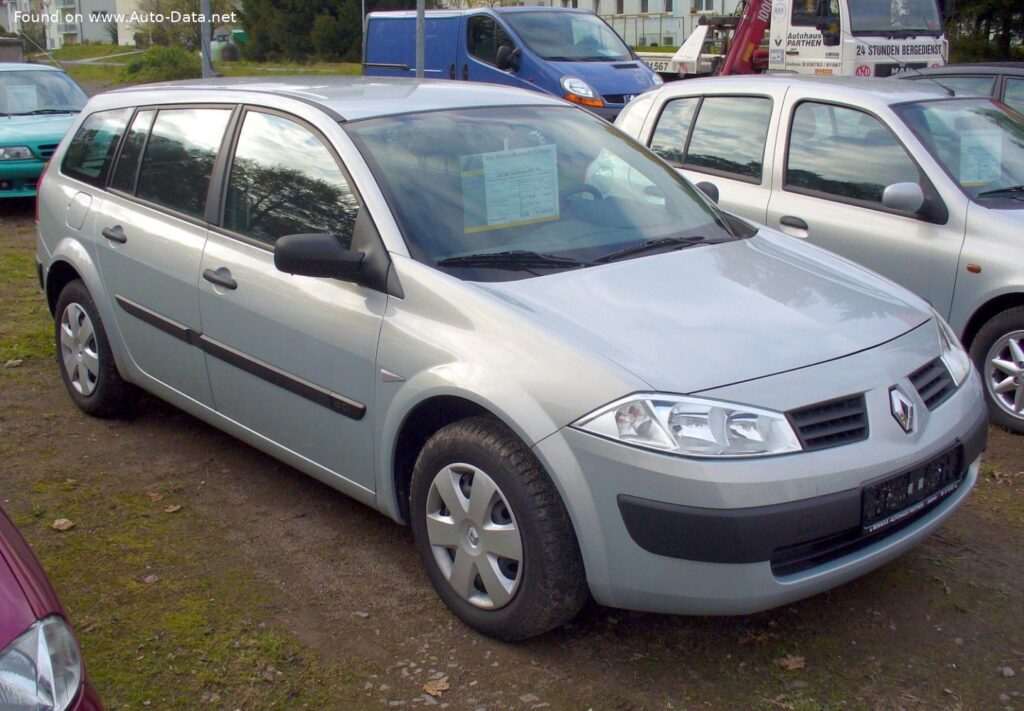
The Renault Megane II Grandtour 1.5 dCi (101 Hp), produced between 2004 and 2005, represents a significant offering in the highly competitive European C-segment. As a station wagon (known as an estate in Europe), this particular variant of the second-generation Megane was designed to blend practicality, fuel efficiency, and a comfortable driving experience for families and professionals alike. While never officially sold in the United States, the Megane II Grandtour played a crucial role in Renault’s strategy to dominate the compact family car market across Europe, offering a compelling alternative to rivals with its distinctive styling and a strong emphasis on diesel powertrain technology, a hallmark of European automotive preferences during this era. This model specifically highlights the widespread adoption of efficient, small-displacement diesel engines that were becoming increasingly sophisticated and powerful.
Powertrain & Engine Architecture
At the heart of the Renault Megane II Grandtour 1.5 dCi (101 Hp) lies Renault’s venerable K9K engine, a 1.5-liter (1461 cm³ or 89.16 cu. in.) inline-four turbodiesel unit. This powertrain architecture, featuring a front, transverse engine layout and front-wheel drive, was engineered for optimal packaging and efficiency. The engine delivers a respectable 101 horsepower at 4000 rpm, which, when considering its displacement, translates to a healthy 69.1 horsepower per liter. More critically for a diesel, it generates a robust 200 Newton meters (147.51 lb.-ft.) of torque at a low 1900 rpm. This ample low-end torque is characteristic of diesel engines and is vital for strong acceleration and effortless cruising, particularly when the vehicle is loaded or towing.
The K9K engine employs a common rail direct fuel injection system, coupled with a turbocharger and intercooler, to maximize combustion efficiency and power output while adhering to Euro 3 emission standards. With two valves per cylinder and an OHC (Overhead Camshaft) valvetrain, the engine prioritized reliability and fuel economy. The engine utilizes a Bosch EDC15C3 engine control unit (ECU) to manage fuel injection, turbo boost, and other critical parameters. The turbocharger is typically a Garrett GT15, providing a balance between responsiveness and efficiency. The fuel injection system operates at pressures up to 1600 bar, ensuring fine atomization of the fuel for cleaner combustion. The engine’s block is constructed from cast iron for durability, while the cylinder head is made from aluminum alloy to reduce weight.
Driving Characteristics
The Renault Megane II Grandtour 1.5 dCi (101 Hp) offered a driving experience geared towards comfort and efficiency rather than outright performance. The 101 horsepower and 147.51 lb-ft of torque provided adequate acceleration for everyday driving, but it wasn’t a particularly quick vehicle. Acceleration from 0 to 60 mph was approximately 12.4 seconds, and top speed was around 110.6 mph. The engine’s peak torque, available from 1900 rpm, meant that the car felt responsive in everyday driving situations, such as overtaking or climbing hills. However, it did require downshifting to access its full potential. Compared to higher-output versions of the Megane II, such as the 1.9 dCi or the gasoline-powered 2.0L engine, the 1.5 dCi felt noticeably slower. The five-speed manual transmission, common in this variant, was well-matched to the engine’s characteristics, providing smooth and precise gear changes. The automatic transmission option, while offering convenience, slightly diminished performance and fuel economy due to its less efficient power transfer.
The suspension setup, consisting of independent McPherson struts at the front and a torsion beam at the rear, prioritized ride comfort over sporty handling. The car felt stable and predictable in corners, but it wasn’t particularly engaging to drive. The electric power steering provided light and easy steering, making it ideal for urban driving. Overall, the driving experience was refined and comfortable, making it a suitable choice for long-distance journeys and daily commutes.
Equipment & Trim Levels
The Renault Megane II Grandtour 1.5 dCi (101 Hp) typically occupied a mid-range position in the Megane II lineup. Standard equipment generally included air conditioning, power windows, central locking, a CD player, and ABS brakes. Safety features such as driver and passenger airbags were also standard. The interior upholstery was typically cloth, with a dark color scheme. Higher trim levels, such as the Expression or Dynamique, added features like alloy wheels, automatic headlights and rain sensors, a trip computer, and upgraded audio systems. Optional extras included a sunroof, leather upholstery, and a navigation system. The dashboard layout was functional and user-friendly, with clearly labeled controls and a straightforward instrument cluster. The Grandtour’s primary appeal lay in its spacious interior and large cargo area, making it a practical choice for families.
Chassis & Braking
The chassis of the Renault Megane II Grandtour 1.5 dCi (101 Hp) was based on the Renault-Nissan C platform. The front suspension utilized independent McPherson struts with a stabilizer bar, while the rear suspension employed a torsion beam. This configuration provided a good balance between ride comfort and handling. The braking system consisted of ventilated disc brakes at the front and solid disc brakes at the rear. ABS (Anti-lock Braking System) was standard, enhancing braking performance and stability. The steering system was an electric power-assisted rack and pinion system, offering light and precise steering. The tires were typically 205/50 R17, providing adequate grip and ride comfort. The car’s weight distribution was relatively balanced, contributing to its stable handling characteristics. The torsion beam rear suspension, while cost-effective, limited the car’s handling capabilities compared to more sophisticated independent rear suspension setups.
Market Reception & Comparison
The Renault Megane II Grandtour 1.5 dCi (101 Hp) received generally positive reviews from European automotive critics. It was praised for its fuel efficiency, spacious interior, and comfortable ride. However, some critics noted that the engine lacked outright power and that the handling wasn’t particularly sporty. Compared to other trims in the Megane II lineup, the 1.5 dCi offered the best fuel economy but the lowest performance. The 1.9 dCi, with its higher power output, provided more spirited acceleration, while the gasoline-powered engines offered a smoother and more refined driving experience. In terms of reliability, the K9K engine proved to be generally robust, although some owners reported issues with the turbocharger and fuel injectors. Fuel economy was a major selling point, with the 1.5 dCi achieving around 51.1 US mpg in combined driving. This made it a particularly attractive option for drivers who covered long distances or were concerned about fuel costs. Compared to rivals like the Volkswagen Golf Variant and Ford Focus Turnier, the Megane II Grandtour offered a compelling combination of practicality, efficiency, and value for money.
Technical Specifications
| Category | Specification |
| General Information | |
| Brand | Renault |
| Model | Megane |
| Generation | Megane II Grandtour |
| Type (Engine) | 1.5 dCi (101 Hp) |
| Start of Production | 2004 year |
| End of Production | 2005 year |
| Powertrain Architecture | Internal Combustion Engine |
| Body type | Station wagon (estate) |
| Seats | 5 |
| Doors | 5 |
| Performance Specs | |
| Fuel consumption (economy) – urban | 5.6 l/100 km (42 US mpg) |
| Fuel consumption (economy) – extra urban | 4.1 l/100 km (57.4 US mpg) |
| Fuel consumption (economy) – combined | 4.6 l/100 km (51.1 US mpg) |
| CO2 emissions | 121 g/km |
| Fuel Type | Diesel |
| Acceleration 0 – 60 mph | 12.4 sec (Calculated) |
| Acceleration 0 – 100 km/h | 13.1 sec |
| Maximum speed | 178 km/h (110.6 mph) |
| Emission standard | Euro 3 |
| Weight-to-power ratio | 12.2 kg/Hp (81.8 Hp/tonne) |
| Weight-to-torque ratio | 6.2 kg/Nm (161.9 Nm/tonne) |
| Engine Specs | |
| Power | 101 Hp @ 4000 rpm |
| Power per liter | 69.1 Hp/l |
| Torque | 200 Nm (147.51 lb.-ft.) @ 1900 rpm |
| Engine layout | Front, Transverse |
| Engine Model/Code | K9K |
| Engine displacement | 1461 cm³ (89.16 cu. in.) |
| Number of cylinders | 4 |
| Engine configuration | Inline |
| Cylinder Bore | 76 mm (2.99 in.) |
| Piston Stroke | 80.5 mm (3.17 in.) |
| Compression ratio | 18.8:1 |
| Number of valves per cylinder | 2 |
| Fuel injection system | Diesel Commonrail |
| Engine aspiration | Turbocharger, Intercooler |
| Valvetrain | OHC |
| Engine oil capacity | 4.5 l (4.76 US qt) |
| Coolant | 6.5 l (6.87 US qt) |
| Space, Volume and Weights | |
| Kerb Weight | 1235 kg (2722.71 lbs) |
| Max. weight | 1815 kg (4001.39 lbs) |
| Max load | 580 kg (1278.68 lbs) |
| Trunk (boot) space – minimum | 520 l (18.36 cu. ft.) |
| Trunk (boot) space – maximum | 1600 l (56.5 cu. ft.) |
| Fuel tank capacity | 60 l (15.85 US gal) |
| Max. roof load | 80 kg (176.37 lbs) |
| Permitted trailer load with brakes (12%) | 1300 kg (2866.01 lbs) |
| Permitted trailer load without brakes | 650 kg (1433 lbs) |
| Permitted towbar download | 75 kg (165.35 lbs) |
| Dimensions | |
| Length | 4500 mm (177.17 in.) |
| Width | 1777 mm (69.96 in.) |
| Width including mirrors | 2026 mm (79.76 in.) |
| Height | 1467 mm (57.76 in.) |
| Wheelbase | 2686 mm (105.75 in.) |
| Front track | 1518 mm (59.76 in.) |
| Rear (Back) track | 1514 mm (59.61 in.) |
| Front overhang | 842 mm (33.15 in.) |
| Rear overhang | 972 mm (38.27 in.) |
| Minimum turning circle (turning diameter) | 11 m (36.09 ft.) |
Legacy
The Renault Megane II Grandtour 1.5 dCi (101 Hp) has left a lasting legacy as a practical, efficient, and affordable family vehicle. Its robust K9K engine, while not the most powerful, proved to be generally reliable, and many examples are still on the road today. In the used car market, these models are often sought after by buyers looking for a fuel-efficient and spacious station wagon. The 1.5 dCi engine’s reputation for longevity and low running costs makes it an attractive option for those on a budget. However, potential buyers should be aware of potential issues with the turbocharger and fuel injectors, and regular maintenance is essential to ensure continued reliability. The Megane II Grandtour 1.5 dCi remains a testament to the era when diesel engines were at their peak of popularity in Europe, offering a compelling combination of practicality, efficiency, and affordability.