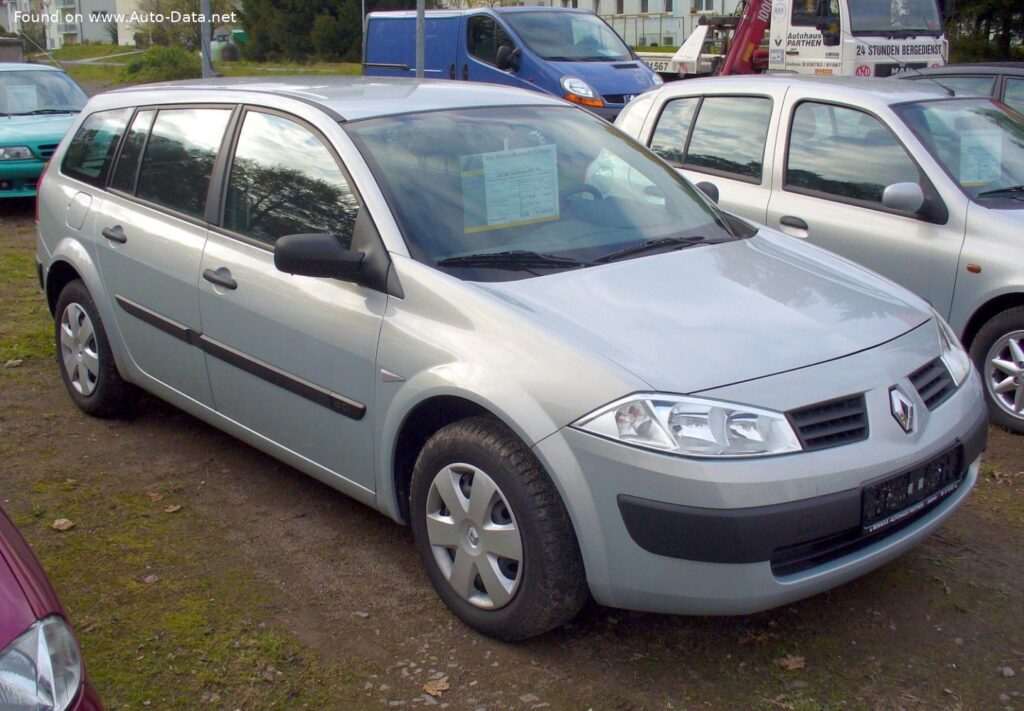
The Renault Megane II Grandtour 1.5 dCi (101 Hp) Automatic, produced between 2004 and 2005, represents a significant chapter in the history of compact family vehicles in Europe. As a member of the second-generation Megane lineup, this model built upon the innovative design and practical functionality of its predecessors, while pushing boundaries with its distinctive styling and a focus on efficiency, a hallmark of European automotive engineering. The Megane II generation, launched in 2002, was globally recognized for its unconventional “bustle-back” rear end on the hatchback and its strong emphasis on safety, earning a groundbreaking five-star Euro NCAP rating.
The 1.5 dCi Automatic: Positioning in the Megane II Range
While never officially sold in the United States, the Renault Megane II Grandtour played a crucial role in the competitive European C-segment, offering a compelling blend of space, comfort, and economical operation. The “Grandtour” designation signified its station wagon (estate) body style, catering to families and individuals who required greater cargo capacity than the standard hatchback or sedan, without sacrificing the maneuverability and fuel efficiency of a compact car. The 1.5 dCi engine, a popular diesel choice, underscored Renault’s commitment to delivering practical, low-running-cost vehicles for its primary markets across the continent. This particular variant occupied the entry to mid-range position within the Megane II Grandtour lineup. It offered a more affordable option compared to the higher-powered gasoline engines and the more expensive trim levels, making it accessible to a broader customer base.
Powertrain & Engine Architecture
At the heart of the 2004-2005 Renault Megane II Grandtour 1.5 dCi (101 Hp) Automatic lies Renault’s well-regarded K9K diesel engine. This 1.5-liter (1461 cm³ or 89.16 cu. in.) inline-four powerplant was designed with a focus on fuel economy and usable torque. The engine features a common rail direct fuel injection system, combined with a turbocharger and intercooler, to optimize combustion efficiency and power delivery. The K9K engine utilizes a single overhead camshaft (OHC) valvetrain with two valves per cylinder. The common rail system, operating at very high pressures, allows for precise control of fuel injection timing and quantity, maximizing power and minimizing emissions.
The engine produces a respectable 101 horsepower at 4000 rpm, which, while not designed for outright speed, provides ample motivation for a family station wagon. More significant for daily driving is its torque output: 200 Nm (147.51 lb.-ft.) available at a low 1900 rpm. This strong low-end torque is characteristic of modern diesel engines and contributes to the vehicle’s effortless feel in city traffic and its ability to maintain speed on inclines without frequent downshifts. Paired with a 4-speed automatic transmission, the powertrain architecture drives the front wheels, prioritizing ease of use and efficiency. This automatic transmission, while not offering the latest technology, was a popular choice for drivers seeking convenience, particularly in urban environments.
Driving Characteristics
The driving experience in the Megane II Grandtour 1.5 dCi Automatic is characterized by its relaxed and efficient nature. The 4-speed automatic transmission, while lacking the responsiveness of more modern gearboxes, provides smooth shifts and contributes to the vehicle’s ease of use. The strong low-end torque of the K9K engine means that the car feels surprisingly sprightly around town, with minimal need for aggressive throttle inputs. Compared to the manual transmission versions of the same engine, the automatic offers less driver engagement but greater convenience. Against higher-output versions, such as the 1.9 dCi or the gasoline engines, the 1.5 dCi Automatic is noticeably slower in acceleration and lacks the same level of overall performance. However, it compensates with significantly better fuel economy and a more relaxed driving experience. The gear ratios are optimized for fuel efficiency rather than outright performance, resulting in a comfortable cruising speed on highways but slower acceleration when overtaking.
Equipment & Trim Levels
The Renault Megane II Grandtour 1.5 dCi Automatic typically came equipped with a reasonable level of standard features for its class and price point. These included power windows, central locking, an air conditioning system, and an audio system with CD player. Interior upholstery was typically cloth, with a dark color scheme. Dashboard configuration was functional and straightforward, prioritizing usability over elaborate design. Optional extras available for this trim included alloy wheels, a sunroof, rear parking sensors, and upgraded audio systems. Higher trim levels offered additional features such as automatic headlights and rain-sensing wipers, but these were not typically standard on the base 1.5 dCi Automatic model.
Chassis & Braking
The Megane II Grandtour utilized an independent McPherson type front suspension and a torsion beam rear suspension, tuned for a comfortable ride and stable handling. This suspension setup provided a good balance between ride comfort and handling precision, making it suitable for both urban driving and longer journeys. Braking was handled by ventilated discs at the front and disc brakes at the rear, complemented by an Anti-lock Braking System (ABS) for enhanced safety. The electric power steering system provided light and responsive steering, particularly beneficial for urban maneuvering and parking. The vehicle rode on 205/50 R17 tires mounted on 6.5J x 17-inch wheel rims, contributing to both its aesthetic appeal and road holding. The rear brakes on some base models may have been drums instead of discs, depending on the specific market and trim level.
Market Reception & Comparison
Critics generally viewed the Renault Megane II Grandtour 1.5 dCi Automatic as a practical and economical choice in the European C-segment. Its strengths lay in its fuel efficiency, spacious interior, and comfortable ride. However, some reviewers noted that the 4-speed automatic transmission felt dated compared to the more advanced transmissions offered by some competitors. Fuel economy was a major selling point, with a combined rating of 40.6 US mpg (5.8 l/100 km), which was highly competitive for its era. In terms of reliability, the K9K engine proved to be generally robust, although, like any diesel engine, it required regular maintenance and careful fuel selection. Compared to the higher-output trims, the 1.5 dCi Automatic offered a more affordable entry point into the Megane II Grandtour range, but at the expense of performance. Compared to rivals like the Volkswagen Golf Variant, the Megane II Grandtour offered a more distinctive design and a slightly lower price point, while the Golf often boasted a more refined interior and a wider range of available options.
Technical Specifications
| Category | Specification |
| Brand | Renault |
| Model | Megane |
| Generation | Megane II Grandtour |
| Type (Engine) | 1.5 dCi (101 Hp) Automatic |
| Start of production | 2004 year |
| End of production | 2005 year |
| Powertrain Architecture | Internal Combustion engine |
| Body type | Station wagon (estate) |
| Seats | 5 |
| Doors | 5 |
| Fuel consumption (economy) – urban | 7.7 l/100 km (30.5 US mpg) |
| Fuel consumption (economy) – extra urban | 4.7 l/100 km (50 US mpg) |
| Fuel consumption (economy) – combined | 5.8 l/100 km (40.6 US mpg) |
| CO2 emissions | 153 g/km |
| Fuel Type | Diesel |
| Acceleration 0 – 60 mph | 14.3 sec |
| Acceleration 0 – 100 km/h | 15.1 sec |
| Maximum speed | 174 km/h (108.12 mph) |
| Emission standard | Euro 3 |
| Weight-to-power ratio | 12.7 kg/Hp |
| Weight-to-torque ratio | 6.4 kg/Nm |
| Power | 101 Hp @ 4000 rpm |
| Power per liter | 69.1 Hp/l |
| Torque | 200 Nm @ 1900 rpm (147.51 lb.-ft. @ 1900 rpm) |
| Engine layout | Front, Transverse |
| Engine Model/Code | K9K |
| Engine displacement | 1461 cm³ (1.5 liters, 89.16 cu. in.) |
| Number of cylinders | 4 |
| Engine configuration | Inline |
| Cylinder Bore | 76 mm (2.99 in.) |
| Piston Stroke | 80.5 mm (3.17 in.) |
| Compression ratio | 18.8:1 |
| Number of valves per cylinder | 2 |
| Fuel injection system | Diesel Commonrail |
| Engine aspiration | Turbocharger, Intercooler |
| Valvetrain | OHC |
| Engine oil capacity | 4.5 l (4.76 US qt) |
| Coolant | 6.8 l (7.19 US qt) |
| Kerb Weight | 1285 kg (2832.94 lbs.) |
| Max. weight | 1865 kg (4111.62 lbs.) |
| Trunk (boot) space – minimum | 520 l (18.36 cu. ft.) |
| Trunk (boot) space – maximum | 1600 l (56.5 cu. ft.) |
| Fuel tank capacity | 60 l (15.85 US gal) |
Legacy
The Renault Megane II Grandtour 1.5 dCi Automatic has proven to be a relatively reliable vehicle in the used car market. The K9K engine, while requiring regular maintenance, is known for its durability. Common issues include wear and tear on the turbocharger and potential problems with the fuel injectors. The 4-speed automatic transmission, while generally reliable, may exhibit some wear and tear over time. Today, these vehicles are often found as affordable and practical transportation options, particularly for those seeking a fuel-efficient and spacious station wagon. Its enduring appeal lies in its combination of practicality, affordability, and the inherent robustness of the K9K diesel engine. While not a performance icon, the Megane II Grandtour 1.5 dCi Automatic remains a testament to Renault’s commitment to delivering functional and economical vehicles for the European market.