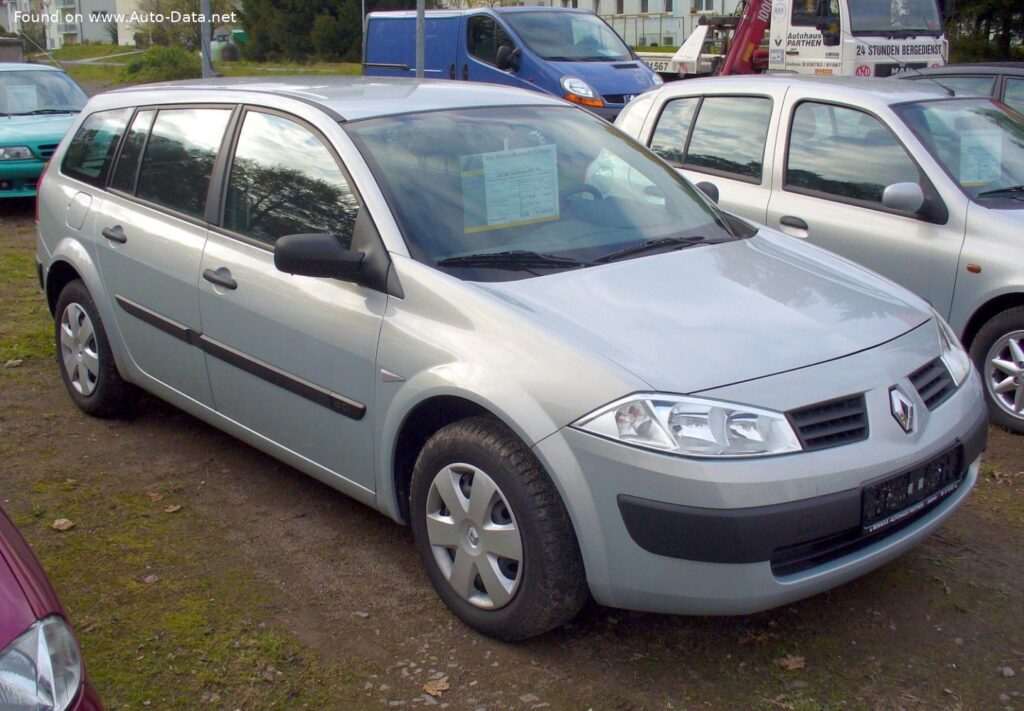
The Renault Megane II Grandtour 1.6 16V (112 Hp) represents a crucial offering in the European compact segment, specifically tailored for families and individuals prioritizing practicality, space, and a comfortable driving experience. As part of the second generation of the Megane lineup (Megane II), which was globally acclaimed for its distinctive styling and advanced features upon its introduction in 2002, the Grandtour variant extended its appeal by adopting a station wagon body style. This particular iteration, featuring the 1.6-liter 16-valve engine with 112 horsepower, was produced for the 2005 model year, offering a balanced proposition of performance and fuel efficiency for its target market.
Positioning and Market Context
While Renault models are not widely sold in the United States today, the Megane II Grandtour played a significant role in the highly competitive European C-segment. It vied for market share against formidable rivals like the Ford Focus Wagon, Opel Astra Caravan, and Peugeot 307 SW. Renault’s strategy with the Megane II series was to push boundaries in design, safety, and interior packaging, and the Grandtour capitalized on these strengths by adding substantial cargo capacity and enhanced versatility, making it a popular choice for long-distance travel and daily family duties across the continent. The 1.6 16V Grandtour occupied a mid-range position within the Megane II lineup, serving as a more affordable and fuel-efficient alternative to the higher-performance 2.0-liter and diesel variants.
Powertrain & Engine Architecture
At the heart of this particular Renault Megane II Grandtour model lies a naturally aspirated 1.6-liter (1598 cm³) 16-valve inline-four cylinder petrol engine, designated by the internal code K4M. This powerplant was a well-regarded unit in Renault’s lineup, known for its robust design and reliable performance. Delivering a respectable 112 horsepower at 6000 rpm, it provided sufficient motivation for the compact station wagon, enabling confident highway cruising and adequate acceleration for urban environments. The engine’s power per liter stood at 70.1 Hp/l, indicating an efficient use of its displacement for power output.
The K4M engine utilizes a multi-point fuel injection system, delivering fuel directly to the intake ports. It features a double overhead camshaft (DOHC) valvetrain, optimizing airflow for improved performance and efficiency. The engine’s block is constructed from cast iron for durability, while the cylinder head is made of aluminum alloy to reduce weight. Power was sent to the front wheels via a smooth-shifting 5-speed manual transmission, a common and reliable setup for vehicles in this class during the mid-2000s. The transmission was chosen for its simplicity, durability, and cost-effectiveness, aligning with the overall positioning of this variant as a practical and affordable family vehicle.
Driving Characteristics
In real-world conditions, the Megane II Grandtour 1.6 16V offered a comfortable and predictable driving experience. While not particularly sporty, it provided adequate acceleration for everyday driving situations. The 5-speed manual transmission allowed drivers to effectively manage the engine’s powerband, although the relatively low horsepower output meant frequent downshifting was necessary when overtaking or climbing hills. Compared to the higher-output 2.0-liter versions, the 1.6-liter engine felt less responsive, particularly at higher speeds. However, it offered significantly better fuel economy. The gear ratios were tuned for efficiency rather than outright performance, prioritizing smooth cruising and reduced fuel consumption. The engine’s torque curve, peaking at 4200 rpm, provided sufficient pulling power for most driving scenarios, but lacked the low-end grunt of the diesel alternatives.
Equipment & Trim Levels
The Renault Megane II Grandtour 1.6 16V typically came equipped with a reasonable level of standard features. These included power windows, central locking, power steering, an adjustable steering column, and a basic audio system. Interior upholstery was typically cloth, with a durable and practical finish. Air conditioning was often included as standard, or available as an optional extra. Higher trim levels, such as the “Expression” or “Dynamique” variants, added features like alloy wheels, fog lights, a more advanced audio system with CD player, and automatic climate control. Optional extras available for this trim included a sunroof, leather upholstery, and parking sensors. The dashboard configuration was functional and ergonomically designed, with clear instrumentation and easy-to-reach controls.
Chassis & Braking
The Megane II Grandtour featured an independent McPherson strut front suspension and a torsion beam rear suspension. This setup provided a comfortable ride quality, absorbing road imperfections effectively, which was a hallmark of Renault vehicles. The torsion beam rear suspension was a cost-effective solution that provided adequate handling characteristics for a family-focused vehicle. Braking was handled by ventilated discs at the front and solid discs at the rear, augmented by an Anti-lock Braking System (ABS) for enhanced safety and control during emergency stops. The electric power steering system offered light and precise control, making urban maneuvers and parking effortless with a minimum turning circle of 36.09 feet. Standard tire options included 195/65 R15 or 205/55 R16, mounted on 6.5J x 15 or 6.5J x 16 wheel rims, respectively, contributing to both comfort and grip.
Market Reception & Comparison
Critics generally viewed the Renault Megane II Grandtour 1.6 16V as a competent and practical family car. It was praised for its spacious interior, comfortable ride, and good fuel economy. However, some reviewers noted that the engine lacked the punch of its rivals, particularly when fully loaded. Fuel economy was a strong point, with a combined rating of 33.6 US mpg (7 liters per 100 km). Compared to the 2.0-liter petrol and 1.9 dCi diesel variants, the 1.6-liter engine offered lower running costs but sacrificed performance. The diesel version, in particular, provided significantly more torque and better fuel economy, making it a popular choice for long-distance drivers. In terms of reliability, the K4M engine was generally considered to be robust and dependable, although regular maintenance was essential to prevent issues.
Technical Specifications
| Category | Specification |
| General Information | |
| Brand | Renault |
| Model | Megane |
| Generation | Megane II Grandtour |
| Type (Engine) | 1.6 16V (112 Hp) |
| Start of Production | 2005 year |
| End of Production | 2005 year |
| Powertrain Architecture | Internal Combustion engine |
| Body Type | Station wagon (estate) |
| Seats | 5 |
| Doors | 5 |
| Performance Specs | |
| Fuel Consumption (Economy) – Urban | 9.3 l/100 km (25.3 US mpg) |
| Fuel Consumption (Economy) – Extra Urban | 5.7 l/100 km (41.3 US mpg) |
| Fuel Consumption (Economy) – Combined | 7 l/100 km (33.6 US mpg) |
| CO2 Emissions | 166 g/km |
| Fuel Type | Petrol (Gasoline) |
| Acceleration 0 – 60 mph | 10.7 sec |
| Maximum Speed | 190 km/h (118.06 mph) |
| Emission Standard | Euro 4 |
| Engine Specs | |
| Power | 112 Hp @ 6000 rpm |
| Power per liter | 70.1 Hp/l |
| Torque | 152 Nm @ 4200 rpm (112.11 lb.-ft. @ 4200 rpm) |
| Engine Layout | Front, Transverse |
| Engine Model/Code | K4M |
| Engine Displacement | 1598 cm3 (97.52 cu. in. / 1.6 Liters) |
| Number of Cylinders | 4 |
| Engine Configuration | Inline |
| Cylinder Bore | 79.5 mm (3.13 in.) |
| Piston Stroke | 80.5 mm (3.17 in.) |
| Compression Ratio | 10:1 |
| Number of Valves per Cylinder | 4 |
| Fuel Injection System | Multi-port manifold injection |
| Engine Aspiration | Naturally aspirated engine |
| Valvetrain | DOHC |
| Space, Volume and Weights | |
| Kerb Weight | 1220 kg (2689.64 lbs.) |
| Max. Weight | 1795 kg (3957.3 lbs.) |
| Max Load | 575 kg (1267.66 lbs.) |
| Trunk (boot) space – minimum | 520 l (18.36 cu. ft.) |
| Trunk (boot) space – maximum | 1600 l (56.5 cu. ft.) |
| Fuel Tank Capacity | 60 l (15.85 US gal) |
| Max. Roof Load | 80 kg (176.37 lbs.) |
| Dimensions | |
| Length | 4500 mm (177.17 in.) |
| Width | 1777 mm (69.96 in.) |
| Height | 1467 mm (57.76 in.) |
| Wheelbase | 2686 mm (105.75 in.) |
Legacy
The Renault Megane II Grandtour, and the K4M engine in particular, has proven to be a relatively reliable powertrain in the long term. While age and mileage inevitably lead to wear and tear, the engine is known for its durability and relatively simple construction, making it easier and more affordable to maintain. In the used car market today, these vehicles are often available at very affordable prices, making them an attractive option for budget-conscious buyers. However, potential buyers should be aware of the age-related issues that may arise, such as corrosion and wear on suspension components. Overall, the Megane II Grandtour 1.6 16V remains a practical and dependable choice for those seeking a spacious and comfortable station wagon at a reasonable price.