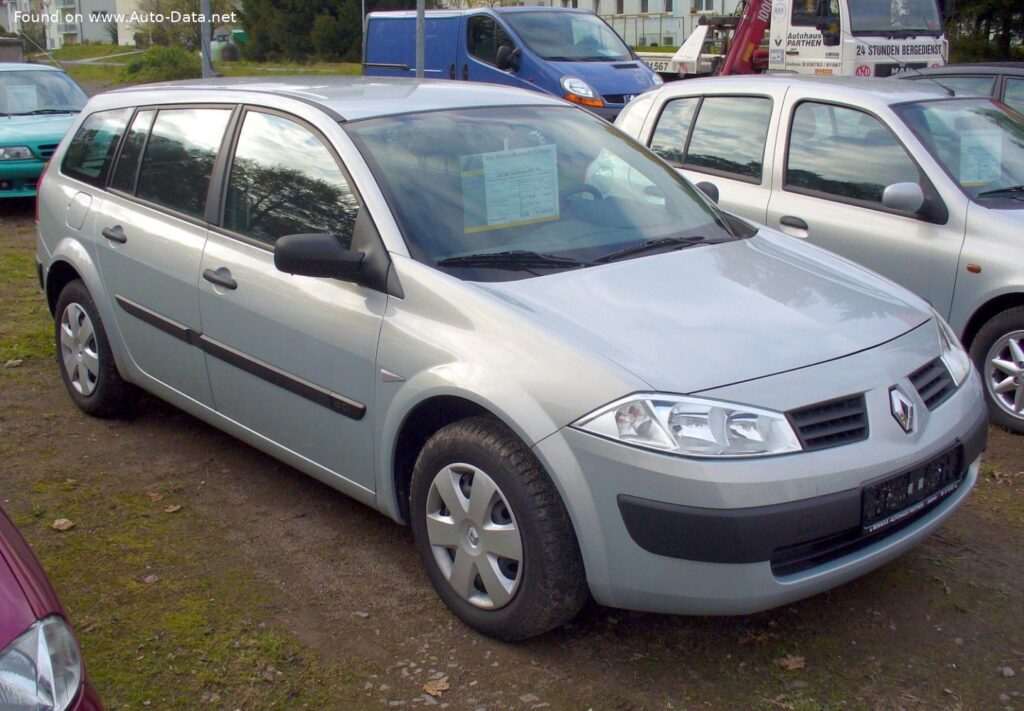
The Renault Megane II Grandtour 1.6 16V (112 Hp) Automatic represents a significant offering within the compact segment, specifically tailored for the European market’s demand for practical and versatile family vehicles. Introduced as part of the second generation Megane lineup, the Grandtour, or estate/station wagon variant, debuted in 2003, following the successful launch of the distinctive Megane II hatchback in 2002. The specific 1.6 16V (112 Hp) Automatic configuration, offered for the 2005 model year, combined a reliable powertrain with the enhanced cargo capacity that made the Grandtour a popular choice among families and professionals requiring ample space.
During its production run, the Megane II Grandtour was celebrated for its blend of innovative design, comfort, and safety, characteristics that Renault had increasingly prioritized. While never officially sold in the United States, the Megane II Grandtour played a crucial role in Europe, competing in a fiercely contested segment dominated by homegrown and international brands. This particular variant, with its 112 horsepower engine and automatic transmission, aimed to provide a comfortable and unpretentious driving experience, emphasizing ease of use and practicality over outright performance. It embodied Renault’s vision for a modern, accessible family car, packed with features designed for everyday utility.
Powertrain & Engine Architecture
At the heart of the Renault Megane II Grandtour 1.6 16V (112 Hp) Automatic lies Renault’s venerable K4M engine, a 1.6-liter (1598 cm³) naturally aspirated inline four-cylinder unit. This engine, featuring a DOHC (Double Overhead Camshaft) valvetrain with four valves per cylinder, was engineered for a balance of efficiency and smooth power delivery. It produced a respectable 112 horsepower at 6000 rpm, which was competitive for its class at the time, offering sufficient grunt for daily driving and highway cruising. Torque output stood at 112.11 lb.-ft. (152 Nm) at 4200 rpm, ensuring decent pulling power, especially when carrying passengers or cargo.
The K4M engine utilizes a multi-point fuel injection system, delivering fuel directly to the intake ports. This system, coupled with a 10:1 compression ratio, optimizes combustion for both efficiency and responsiveness. The engine’s design prioritized reliability and ease of maintenance, making it a popular choice for fleet operators and private buyers alike. The automatic transmission paired with this engine is a four-speed unit, a common configuration for European vehicles of this era. While not offering the sophistication of modern transmissions with more gears, it provided smooth, if not particularly quick, shifts, contributing to a relaxed driving experience. The transmission is electronically controlled, offering adaptive shift patterns based on driving conditions.
Driving Characteristics
The 1.6L 16V Automatic powertrain in the Megane II Grandtour delivers a driving experience geared towards comfort and ease of use. Acceleration from 0 to 60 mph takes approximately 12.5 seconds, and the top speed is around 111.85 mph. Compared to the more powerful 2.0L 16V variants or the diesel options, the 1.6L Automatic is noticeably slower, particularly during overtaking maneuvers. However, the automatic transmission eliminates the need for constant gear changes, making it ideal for urban driving and long highway journeys.
The four-speed automatic transmission’s gear ratios are optimized for fuel efficiency and smooth cruising. First gear provides adequate launch power, while the higher gears allow for relaxed highway driving. The transmission doesn’t offer a sport mode or manual shift capability, further emphasizing its focus on convenience. The engine’s torque curve is relatively flat, providing usable power across a wide range of engine speeds. This makes the car feel responsive in everyday driving situations, even if it lacks the outright punch of more powerful engines. The overall driving experience is best described as refined and predictable, prioritizing comfort over sporty handling.
Equipment & Trim Levels
The 1.6 16V Automatic variant of the Megane II Grandtour typically occupied a mid-range position within the lineup. Standard equipment included power windows, central locking, air conditioning, and an audio system with CD player. Safety features such as ABS (Anti-lock Braking System) and front airbags were also standard. Interior upholstery was typically cloth, with a focus on durability and practicality. The dashboard layout was functional and user-friendly, with clearly labeled controls.
Optional extras available for this trim level included alloy wheels, rear parking sensors, a sunroof, and upgraded audio systems. Higher trim levels offered features such as leather upholstery, automatic climate control, and rain-sensing wipers. The Grandtour’s spacious interior and large cargo area were key selling points, regardless of trim level. The rear seats could be folded down to create a larger cargo space, further enhancing the car’s versatility. The overall equipment level was competitive for its price point, offering a good balance of features and value.
Chassis & Braking
The Megane II Grandtour 1.6 16V Automatic utilizes a McPherson strut suspension setup at the front, providing a comfortable ride and predictable handling. The rear suspension employs a torsion beam axle, a cost-effective solution that offers a good balance of ride quality and stability. The suspension is tuned for comfort, absorbing bumps and imperfections in the road surface effectively. A stabilizer bar is fitted to both the front and rear axles to reduce body roll during cornering.
The braking system consists of ventilated discs at the front and solid discs at the rear. ABS (Anti-lock Braking System) is standard, enhancing braking performance and stability, particularly on slippery surfaces. The braking system provides adequate stopping power for everyday driving conditions. The steering is electrically assisted, offering light and precise control. Tire sizes typically ranged from 195/65 R15 to 205/55 R16, depending on the specific trim level and optional equipment.
Market Reception & Comparison
Critics generally viewed the Renault Megane II Grandtour 1.6 16V Automatic as a practical and comfortable family car. It was praised for its spacious interior, comfortable ride, and good fuel economy. However, it was also criticized for its relatively slow acceleration and lack of sporty handling. Compared to the more powerful 2.0L variants, the 1.6L Automatic offered less performance but was more affordable and fuel-efficient.
Fuel economy was a strong point for this variant, with a combined fuel consumption of 30.5 US mpg (7.7 l/100 km). This made it an attractive option for drivers who prioritized fuel efficiency. Reliability was generally good, with the K4M engine proving to be a durable and dependable unit. However, some owners reported minor issues with the automatic transmission. Compared to the diesel variants, the 1.6L gasoline engine offered a smoother and quieter driving experience but lacked the diesel’s superior fuel economy and low-end torque.
Technical Specifications
| Category | Specification |
| Brand | Renault |
| Model | Megane II Grandtour |
| Generation | Megane II Grandtour |
| Type (Engine) | 1.6 16V (112 Hp) Automatic |
| Production Year | 2005 |
| Body Type | Station wagon (estate) |
| Seats | 5 |
| Doors | 5 |
| Fuel Consumption (Urban) | 22 US mpg (10.7 l/100 km) |
| Fuel Consumption (Extra Urban) | 39.2 US mpg (6 l/100 km) |
| Fuel Consumption (Combined) | 30.5 US mpg (7.7 l/100 km) |
| CO2 Emissions | 184 g/km |
| Fuel Type | Petrol (Gasoline) |
| Acceleration 0-60 mph | 12.5 seconds |
| Maximum Speed | 111.85 mph (180 km/h) |
| Emission Standard | Euro 4 |
| Power | 112 Hp @ 6000 rpm |
| Torque | 112.11 lb.-ft. @ 4200 rpm (152 Nm) |
| Engine Layout | Front, Transverse |
| Engine Model/Code | K4M |
| Engine Displacement | 1.6 liters (1598 cm³ / 97.52 cu. in.) |
| Number of Cylinders | 4, Inline |
| Valves per Cylinder | 4 |
| Compression Ratio | 10:1 |
| Fuel Injection System | Multi-port manifold injection |
| Engine Aspiration | Naturally aspirated |
| Valvetrain | DOHC |
| Engine Oil Capacity | 5.07 US qt (4.8 l) |
| Coolant Capacity | 6.87 US qt (6.5 l) |
| Kerb Weight | 2777.82 lbs. (1260 kg) |
| Max. Weight | 4056.51 lbs. (1840 kg) |
| Max Load | 1278.68 lbs. (580 kg) |
| Trunk Space (Min/Max) | 18.36 – 56.5 cu. ft. (520 – 1600 l) |
| Fuel Tank Capacity | 15.85 US gal (60 l) |
| Length | 177.17 in (4500 mm) |
| Width | 69.96 in (1777 mm) |
| Width (incl. mirrors) | 79.76 in (2026 mm) |
| Height | 57.76 in (1467 mm) |
| Wheelbase | 105.75 in (2686 mm) |
| Minimum Turning Circle | 36.09 ft (11 m) |
| Drive Wheel | Front-wheel drive |
| Transmission | 4 gears, automatic |
| Front Suspension | Independent type McPherson |
| Rear Suspension | Torsion |
| Front Brakes | Ventilated discs |
| Rear Brakes | Disc |
| Assisting Systems | ABS (Anti-lock braking system) |
| Steering Type | Steering rack and pinion |
| Power Steering | Electric Steering |
| Tire Sizes | 195/65 R15; 205/55 R16 |
Legacy
The Renault Megane II generation, including the Grandtour, left a notable legacy in the European compact car market. It was a critical model for Renault, building on the success of its predecessor and pushing boundaries in design and safety. The Megane II Grandtour, in particular, carved out a strong niche as a highly practical and family-friendly station wagon. Its reputation was built on several pillars: exceptional safety, comfortable ride quality, and impressive versatility.
The K4M engine, used in this variant, is known for its durability and relatively low maintenance costs. While not a high-performance engine, it has proven to be a reliable workhorse for many years. In the used car market today, the Megane II Grandtour 1.6 16V Automatic represents an affordable and practical option for buyers seeking a spacious and comfortable family car. Its age means that maintenance costs may be higher than newer vehicles, but its simplicity and proven reliability make it a viable choice for those on a budget. The car’s enduring appeal lies in its ability to provide a comfortable and practical driving experience without breaking the bank.