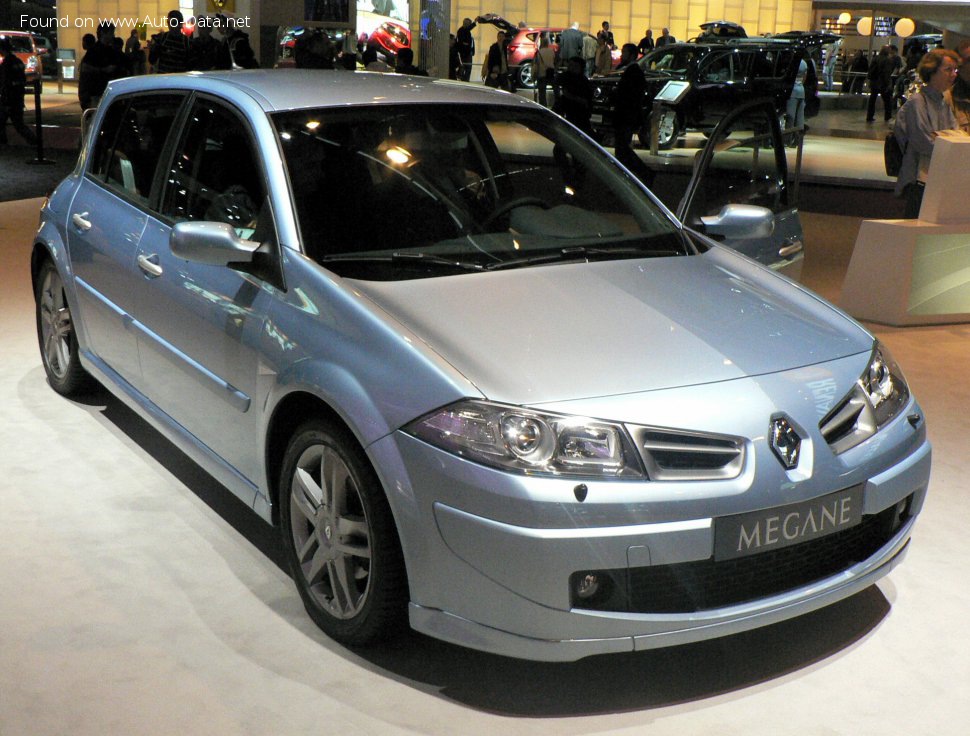
The Renault Megane II (Phase II, 2006) 1.5 dCi (86 Hp) represents a significant iteration of Renault’s popular C-segment (compact car) offering, specifically the facelifted version of the second-generation Megane. Produced between 2006 and 2008, this particular model, with its 1.5-liter dCi diesel engine, was a cornerstone of Renault’s strategy in the highly competitive European market. While never officially sold in the United States, the Megane II played a crucial role across Europe, Asia, and other global markets, embodying French automotive design and engineering with a strong emphasis on efficiency, practicality, and safety. This Phase II update brought subtle refinements to the distinctive Megane II design, enhancing its appeal and keeping it competitive against rivals from Volkswagen, Ford, and Opel.
The Megane II, initially launched in 2002, garnered attention for its bold, unconventional styling, particularly the “bustle-back” rear design of the hatchback variants. The Phase II refresh aimed to modernize the aesthetics and introduce technological updates, ensuring the vehicle remained fresh and relevant. The 1.5 dCi (86 Hp) engine variant, in particular, was tailored for cost-conscious buyers and fleet operators, offering an impressive blend of fuel economy and adequate performance for daily commuting and longer journeys across the European continent. It perfectly captured the spirit of accessible, efficient motoring that defined much of the European compact segment during the mid-2000s.
Engine & Performance
At the heart of this Renault Megane II (Phase II, 2006) model is the renowned K9K Turbo diesel engine, a 1.5-liter (1461 cm3 or 89.16 cu. in.) inline four-cylinder unit. This engine was a staple for Renault and its alliance partners, known for its robust design and excellent fuel efficiency. Equipped with a common rail direct fuel injection system and a turbocharger with an intercooler, it delivered 86 horsepower at 3750 rpm. More importantly for a diesel of its era, it produced a healthy 147.51 lb.-ft. of torque at a low 1900 rpm, providing strong pulling power for its size and contributing to a relaxed driving experience, especially in urban environments.
Power was transmitted to the front wheels via a smooth-shifting 5-speed manual transmission, a common and reliable setup for compact cars of this period. This powertrain allowed the Megane II 1.5 dCi to accelerate from 0 to 60 mph in a respectable 12.1 seconds and achieve a maximum speed of 108.12 mph. However, its true strength lay in its economy. The combined fuel consumption was an impressive 52.3 US mpg (4.5 liters per 100 km), with extra-urban figures reaching 58.8 US mpg (4 liters per 100 km). With CO2 emissions of just 120 g/km, the vehicle met the Euro 4 emission standard, underscoring its environmentally conscious design for the time. This efficiency made it a highly attractive option amidst rising fuel prices and increasing environmental awareness in Europe.
Design & Features
The Renault Megane II (Phase II, 2006) retained the distinctive five-door hatchback body style that had become a hallmark of the second generation. While the overall silhouette remained, the Phase II update typically included revised headlights, taillights, bumpers, and grille designs, giving it a fresher, more contemporary look. With a length of 165.71 inches, a width of 69.96 inches (79.76 inches including mirrors), and a height of 57.4 inches, the Megane II hatchback offered a compact footprint suitable for European city driving while providing ample interior space for five occupants. The wheelbase measured 103.35 inches, contributing to a stable ride and generous cabin room.
Inside, the Megane II was known for its comfortable seating and user-friendly cabin layout. While specific interior features are not detailed in the raw data, typical amenities for a mid-range compact car in 2006 would include power-assisted steering, electric windows, and air conditioning. Safety was a strong point for the Megane II, which was one of the first cars in its class to achieve a 5-star Euro NCAP safety rating. Standard safety features included an Anti-lock Braking System (ABS) with ventilated discs at the front and disc brakes at the rear, providing confident stopping power. The suspension system comprised an independent McPherson strut setup at the front and a torsion beam axle at the rear, a common and effective combination for achieving a balance between ride comfort and handling dynamics.
Practicality was another key aspect of the Megane II. The hatchback offered a versatile cargo area, with a minimum trunk space of 11.65 cubic feet (330 liters), expandable to a generous 42.02 cubic feet (1190 liters) with the rear seats folded down. A 15.85 US gallon (60 liters) fuel tank provided a substantial cruising range, further enhancing its suitability for long-distance travel. The vehicle also demonstrated decent towing capabilities, with a permitted trailer load of 2866.01 lbs. (1300 kg) with brakes, making it a versatile family vehicle.
Renault Megane II Technical Specifications
| Category | Specification |
| General Information | |
| Brand | Renault |
| Model | Megane |
| Generation | Megane II (Phase II, 2006) |
| Type (Engine) | 1.5 dCi (86 Hp) |
| Start of production | 2006 year |
| End of production | 2008 year |
| Powertrain Architecture | Internal Combustion engine |
| Body type | Hatchback |
| Seats | 5 |
| Doors | 5 |
| Performance Specs | |
| Fuel consumption (economy) – urban | 5.5 l/100 km (42.8 US mpg) |
| Fuel consumption (economy) – extra urban | 4 l/100 km (58.8 US mpg) |
| Fuel consumption (economy) – combined | 4.5 l/100 km (52.3 US mpg) |
| CO2 emissions | 120 g/km |
| Fuel Type | Diesel |
| Acceleration 0 – 60 mph | 12.1 sec |
| Maximum speed | 174 km/h (108.12 mph) |
| Emission standard | Euro 4 |
| Weight-to-power ratio | 13.9 kg/Hp, 72 Hp/tonne |
| Weight-to-torque ratio | 6 kg/Nm, 167.4 Nm/tonne |
| Engine Specs | |
| Power | 86 Hp @ 3750 rpm |
| Power per liter | 58.9 Hp/l |
| Torque | 200 Nm @ 1900 rpm (147.51 lb.-ft. @ 1900 rpm) |
| Engine layout | Front, Transverse |
| Engine Model/Code | K9K Turbo |
| Engine displacement | 1461 cm3 (89.16 cu. in.) |
| Number of cylinders | 4 |
| Engine configuration | Inline |
| Cylinder Bore | 76 mm (2.99 in.) |
| Piston Stroke | 80.5 mm (3.17 in.) |
| Compression ratio | 18.8:1 |
| Number of valves per cylinder | 2 |
| Fuel injection system | Diesel Commonrail |
| Engine aspiration | Turbocharger, Intercooler |
| Valvetrain | OHC |
| Engine oil capacity | 4.5 l (4.76 US qt) |
| Coolant | 5.3 l (5.6 US qt) |
| Space, Volume and Weights | |
| Kerb Weight | 1195 kg (2634.52 lbs.) |
| Max. weight | 1745 kg (3847.07 lbs.) |
| Max load | 550 kg (1212.54 lbs.) |
| Trunk (boot) space – minimum | 330 l (11.65 cu. ft.) |
| Trunk (boot) space – maximum | 1190 l (42.02 cu. ft.) |
| Fuel tank capacity | 60 l (15.85 US gal) |
| Max. roof load | 80 kg (176.37 lbs.) |
| Permitted trailer load with brakes (12%) | 1300 kg (2866.01 lbs.) |
| Permitted trailer load without brakes | 650 kg (1433 lbs.) |
| Permitted towbar download | 75 kg (165.35 lbs.) |
| Dimensions | |
| Length | 4209 mm (165.71 in.) |
| Width | 1777 mm (69.96 in.) |
| Width including mirrors | 2026 mm (79.76 in.) |
| Height | 1458 mm (57.4 in.) |
| Wheelbase | 2625 mm (103.35 in.) |
Legacy and Market Positioning
The Renault Megane II (Phase II, 2006), particularly with the 1.5 dCi (86 Hp) engine, cemented its position as a highly significant player in the European compact car segment. It competed fiercely with established rivals such as the Volkswagen Golf, Ford Focus, Opel Astra (Vauxhall Astra in the UK), and Peugeot 307. What set the Megane II apart was its distinctive styling, which, while polarizing for some, offered a refreshing alternative to the more conservative designs of its German competitors. Beyond aesthetics, it delivered a compelling package of ride comfort, a feature often associated with French automobiles, combined with competitive practicality and a strong emphasis on safety.
The 1.5 dCi engine variant was instrumental in appealing to a broad demographic, from young families seeking an economical daily driver to fleet managers prioritizing low running costs and environmental compliance. Renault’s dCi engines, including this K9K unit, were at the forefront of diesel technology for mass-market vehicles, offering impressive fuel economy and reduced emissions at a time when diesel power was booming in Europe. This helped establish Renault’s reputation for producing efficient, reliable diesel powertrains.
Historically, the Megane II played a vital role in Renault’s global strategy, demonstrating the brand’s ability to innovate in design and engineering within the compact segment. Its strong safety credentials, highlighted by a groundbreaking 5-star Euro NCAP rating early in its lifecycle, significantly influenced consumer expectations for safety in the class. While never making its way to North American showrooms, the Megane II’s legacy is one of a successful, distinctive, and highly efficient compact car that catered precisely to the demands of its primary markets, leaving an indelible mark on the European automotive landscape of the mid-2000s. Its combination of unique styling, practical features, and economical diesel power made it a quintessential European compact car.