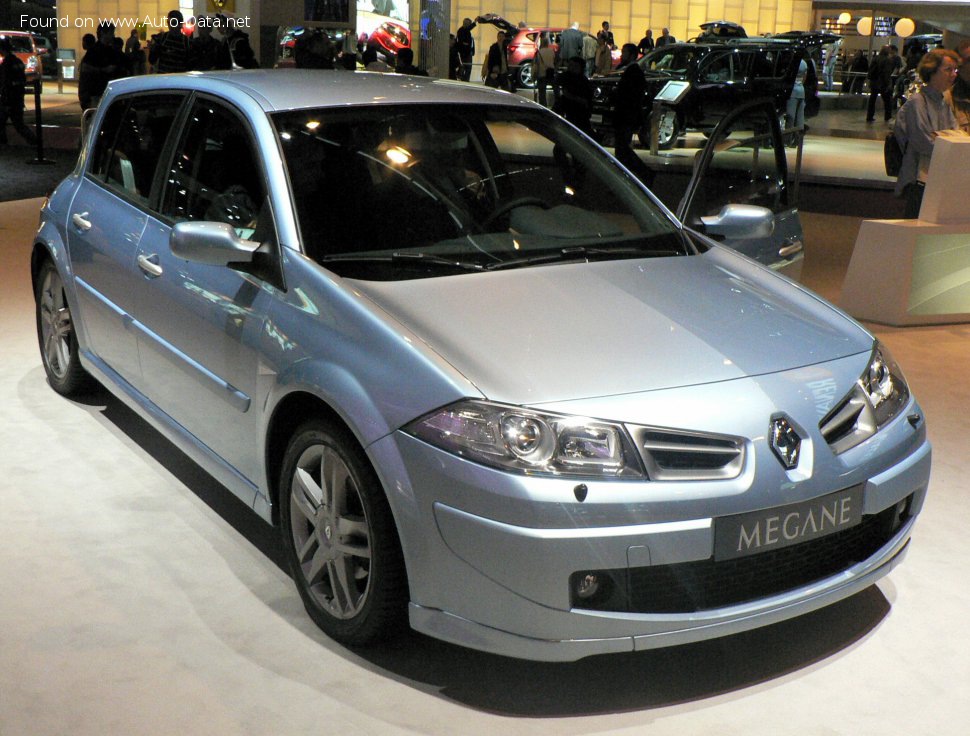
The Renault Megane II, specifically the Phase II model from 2006, represents a significant chapter in the history of the compact car segment in Europe. As a prominent contender in the highly competitive C-segment, the Renault Megane II was renowned for its bold, often polarizing, design language and its emphasis on comfort and practicality. This particular variant, the 2.0 16V (135 Hp) hatchback, offered a blend of everyday usability with a respectable level of performance, making it a popular choice for families and individuals across the continent.
The Renault Megane II: A European Compact Car
First introduced in 2002, the second generation of the Megane marked a radical departure from its predecessor, embracing a more avant-garde aesthetic that included its distinctive “bustle-back” rear styling. The Phase II refresh, launched in 2006, brought subtle but important updates, refining the original design and incorporating minor mechanical and interior improvements to keep the model competitive until its replacement in 2008. While never officially sold in the United States, the Megane II played a crucial role in shaping the European automotive landscape, embodying Renault’s commitment to innovation in both design and technology for its class.
Engine & Performance: The F4R Powertrain
At the heart of the 2006 Renault Megane II (Phase II) 2.0 16V model lies a robust and well-proven powertrain. This variant is equipped with Renault’s F4R engine, a 2.0-liter (1998 cm3 or 121.93 cu. in.) naturally aspirated inline-four cylinder unit. Engineered with a Double Overhead Camshaft (DOHC) valvetrain and four valves per cylinder, this engine was designed for a balance of smooth operation and responsive power delivery. The F4R engine produces 135 horsepower at 5500 RPM, translating to 67.6 horsepower per liter, which was competitive for a naturally aspirated engine of its size in its era.
Torque output stands at 191 Nm (140.87 lb.-ft.) at 3750 RPM, providing ample pulling power for daily driving and highway cruising. Power is sent to the front wheels via a precise 6-speed manual transmission, offering the driver greater control and contributing to both performance and fuel efficiency. In terms of outright performance, the Renault Megane II 2.0 16V could accelerate from 0 to 60 mph in a respectable 8.7 seconds, with a top speed of 124.27 mph (200 km/h). These figures positioned it well within its segment, offering a more spirited driving experience than many of its entry-level competitors.
Fuel economy was also a strong point for its class, with a combined cycle rating of 8 liters per 100 kilometers, or approximately 29.4 US mpg. Urban consumption was rated at 21.6 US mpg, while extra-urban driving could achieve an impressive 36.8 US mpg, highlighting its efficiency on longer journeys. The engine met the Euro 4 emission standard, demonstrating Renault’s commitment to environmental considerations at the time.
Design & Features: A Distinctive Hatchback
The Renault Megane II’s design was its most defining characteristic. The 5-door hatchback body style, measuring 165.71 inches in length, 69.96 inches in width (79.76 inches including mirrors), and 57.4 inches in height, presented a compact yet surprisingly spacious package. The distinctive rear end, often referred to as a “bustle-back” or “bubble-butt,” was a polarizing element, but it certainly made the Megane stand out from its more conservatively styled rivals. This design choice also contributed to a generous trunk space, ranging from 11.65 cubic feet with all seats up to a substantial 42.02 cubic feet with the rear seats folded down, offering excellent versatility for a compact car.
Inside, the Megane II prioritized comfort and user-friendliness. The cabin was designed to be airy and ergonomic, with controls logically placed for ease of use. Seating for five adults was standard, and the car offered a comfortable ride quality, a hallmark of Renault vehicles. Key features for the 2006 model year included standard power steering (electric for efficiency), and a comprehensive safety package. The inclusion of Anti-lock Braking System (ABS) with ventilated discs at the front and disc brakes at the rear ensured confident stopping power. The independent McPherson strut front suspension and torsion beam rear suspension provided a good balance between ride comfort and handling dynamics, making it well-suited for varied European road conditions.
The Phase II refresh brought subtle refinements to the exterior, such as revised headlights and taillights, and updated grille designs, which softened some of the more radical aspects of the original design. Interior updates included improved materials and finishes, enhancing the perceived quality and comfort. Standard tire size was 205/55 R16 on 6.5J x 16-inch wheel rims, providing a good compromise between grip and ride comfort.
Technical Specifications
| Category | Specification |
| Brand | Renault |
| Model | Megane II (Phase II, 2006) |
| Type (Engine) | 2.0 16V (135 Hp) |
| Production Start | 2006 |
| Production End | 2008 |
| Powertrain Architecture | Internal Combustion Engine, Front-wheel drive |
| Body Type | Hatchback, 5 Doors, 5 Seats |
| Fuel Consumption (Urban) | 10.9 l/100 km (21.6 US mpg) |
| Fuel Consumption (Extra Urban) | 6.4 l/100 km (36.8 US mpg) |
| Fuel Consumption (Combined) | 8 l/100 km (29.4 US mpg) |
| CO2 Emissions | 191 g/km |
| Fuel Type | Petrol (Gasoline) |
| Acceleration 0-60 mph | 8.7 sec |
| Maximum Speed | 200 km/h (124.27 mph) |
| Emission Standard | Euro 4 |
| Weight-to-Power Ratio | 9.2 kg/Hp (108.9 Hp/tonne) |
| Weight-to-Torque Ratio | 6.5 kg/Nm (154 Nm/tonne) |
| Power | 135 Hp @ 5500 rpm |
| Power per liter | 67.6 Hp/l |
| Torque | 191 Nm @ 3750 rpm (140.87 lb.-ft. @ 3750 rpm) |
| Engine Layout | Front, Transverse |
| Engine Model/Code | F4R |
| Engine Displacement | 1998 cm3 (2.0 liters / 121.93 cu. in.) |
| Number of Cylinders | 4 (Inline configuration) |
| Cylinder Bore | 82.7 mm (3.26 in.) |
| Piston Stroke | 93 mm (3.66 in.) |
| Compression Ratio | 9.8:1 |
| Valves per Cylinder | 4 |
| Fuel Injection System | Multi-port manifold injection |
| Engine Aspiration | Naturally aspirated |
| Valvetrain | DOHC |
| Engine Oil Capacity | 5.4 l (5.71 US qt) |
| Coolant Capacity | 6.5 l (6.87 US qt) |
| Kerb Weight | 1240 kg (2733.73 lbs.) |
| Max. Weight (GVWR) | 1790 kg (3946.27 lbs.) |
| Max Load | 550 kg (1212.54 lbs.) |
| Trunk Space (Min) | 330 l (11.65 cu. ft.) |
| Trunk Space (Max) | 1190 l (42.02 cu. ft.) |
| Fuel Tank Capacity | 60 l (15.85 US gal) |
| Length | 4209 mm (165.71 in.) |
| Width | 1777 mm (69.96 in.) |
| Width (incl. mirrors) | 2026 mm (79.76 in.) |
| Height | 1458 mm (57.4 in.) |
| Wheelbase | 2625 mm (103.35 in.) |
| Tires Size | 205/55 R16 |
Legacy and Market Impact of the Renault Megane II
The Renault Megane II was a critical success for the French automaker, particularly in its home market of Europe. Its distinctive design, while controversial to some, helped it stand out in a crowded segment dominated by more conservative designs like the Volkswagen Golf, Ford Focus, and Opel Astra (Vauxhall Astra in the UK). Its bold styling, coupled with a strong emphasis on comfort, safety, and innovative features for its class (such as the keyless entry and start system, “Renault Card”), contributed to its widespread appeal.
The 2.0 16V (135 Hp) variant, in particular, offered a compelling package for buyers seeking a blend of practicality and performance without venturing into the hot hatch territory. It was seen as a refined and capable daily driver, suitable for both city commutes and longer road trips. The Megane II earned numerous accolades during its production run, including the prestigious European Car of the Year award in 2003, underscoring its significant impact on the automotive industry.
Its strong sales performance across Europe solidified Renault’s position as a leader in the compact segment. The Megane II’s legacy is defined by its willingness to challenge conventional automotive design, its commitment to occupant comfort and safety (often achieving high Euro NCAP ratings), and its role as a practical and efficient family car. Even after production ceased in 2008, the Megane II continued to be a common sight on European roads, a testament to its durability and enduring appeal. It paved the way for future generations of the Megane, which continued to evolve but retained some of the core values of innovation and distinctive styling established by this memorable second iteration.