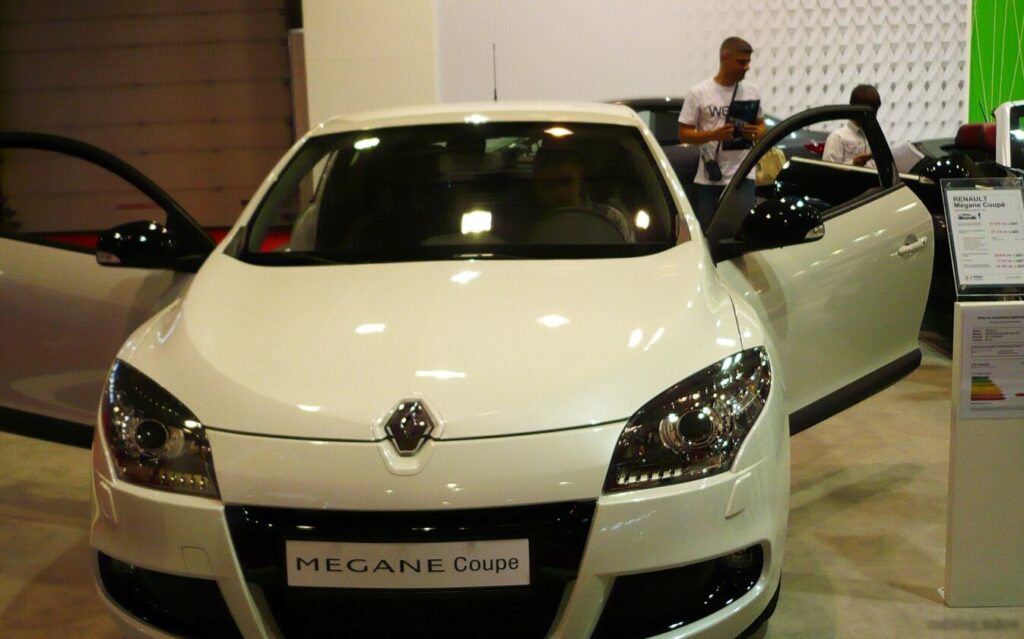
The Renault Megane III CC (Phase III, 2014) represents a distinctive chapter in the compact car segment, particularly within the European market. As a Coupe-Cabriolet (CC), this vehicle offered the versatile appeal of both an open-top convertible and a secure, quiet coupe, thanks to its innovative retractable hardtop roof. Originating from the French automaker Renault, this specific iteration belongs to the third generation of the Megane lineup, receiving a significant “Phase III” facelift for the 2014 model year, which refined its aesthetics and updated its technological offerings.
While never officially sold in the United States, the Megane CC carved out a niche in Europe for consumers desiring a stylish, four-seat convertible that could also serve as a practical daily driver. This particular variant, equipped with the 1.5 dCi (110 horsepower) diesel engine and an EDC (Efficient Dual Clutch) automatic transmission, epitomized the European automotive ethos of combining efficiency, comfort, and a touch of flair. Produced from 2014 to 2016, this model was a testament to Renault’s commitment to offering diverse body styles and powertrain options to cater to a broad range of preferences in its primary markets.
Renault Megane III CC (Phase III, 2014): An Overview
The Megane III, launched in 2008, was Renault’s entry in the competitive C-segment, aiming to provide a modern and versatile alternative to established rivals. The Coupe-Cabriolet version, introduced later, added a dimension of open-air enjoyment. The Phase III update in 2014 wasn’t a complete redesign, but rather a comprehensive refresh focusing on styling, interior enhancements, and technological upgrades. These changes aimed to maintain the Megane CC’s appeal in a rapidly evolving market. The vehicle’s success was largely confined to Europe, where the demand for compact convertibles remained relatively strong, and diesel engines were favored for their fuel efficiency.
Engine & Performance
Under the hood of the Renault Megane III CC (Phase III, 2014) lies Renault’s well-regarded K9K 1.5-liter dCi (direct common-rail injection) diesel engine. This powertrain, renowned for its balance of efficiency and usable torque, was a cornerstone of Renault’s offerings across various models in Europe. In this application, the inline four-cylinder engine delivers 110 horsepower at 4000 rpm, a respectable output for its displacement. More significantly, it produces a robust 177.01 lb.-ft. (240 Nm) of torque from a low 1750 rpm, providing excellent tractability and effortless cruising capabilities.
The engine’s architecture features a front, transverse layout with two valves per cylinder and a compression ratio of 15.2:1. It benefits from a turbocharger and intercooler, which are crucial for maximizing power output and efficiency from a smaller displacement diesel unit. Fuel is delivered via a sophisticated Commonrail injection system, and the engine is equipped with a particulate filter to meet the Euro 5b emission standard, reflecting its commitment to environmental performance for its era.
Power is channeled to the front wheels through a 6-speed EDC (Efficient Dual Clutch) automatic transmission. This modern gearbox offers smooth and rapid shifts, contributing to both driving comfort and fuel economy. While not designed as a performance powerhouse, the Megane CC 1.5 dCi offers adequate acceleration, achieving 0-60 mph in a calculated 12.5 seconds, with a top speed of 118.06 mph (190 km/h). Where this powertrain truly shines is in its fuel efficiency. The 1.5 dCi unit delivered impressive figures, with a combined fuel economy rating of 49-48 US mpg (4.8-4.9 l/100 km). Urban driving saw consumption figures of 41.3-40.6 US mpg, while extra-urban cruising could achieve an outstanding 56-53.5 US mpg. These figures, coupled with CO2 emissions ranging from 124-128 g/km, underscore the Megane CC’s appeal as an economical choice for long-distance European travel and daily commuting. The vehicle’s kerb weight of 3527.4 lbs (1600 kg) results in a weight-to-power ratio of 14.5 kg/Hp, indicating a balanced approach to performance and efficiency for a compact convertible.
Design & Features
The Renault Megane III CC (Phase III, 2014) is defined by its Coupe-Cabriolet body type, featuring a sophisticated two-piece retractable glass hardtop. This design allows the vehicle to transform from a stylish, secure coupe into an open-air convertible in a matter of seconds, offering versatility that soft-top convertibles often lack in terms of security and all-weather comfort. The “Phase III” update brought subtle but effective cosmetic enhancements, including a redesigned front fascia with a larger Renault logo, revised headlights, and updated bumpers, aligning its appearance with the contemporary Renault design language.
With a length of 176.57 inches (4485 mm) and a width of 71.3 inches (1811 mm), the Megane CC maintains a compact footprint suitable for European city driving and parking. Its sleek profile, whether the roof is up or down, is complemented by available wheel sizes ranging from 16-inch to 18-inch alloys (205/55 R16, 205/50 R17, 225/40 R18), contributing to its sporty yet elegant stance. The vehicle’s drag coefficient (Cd) of 0.310 is indicative of its aerodynamically refined shape.
Inside, the Megane CC offers seating for four occupants, though the rear seats are, typical of convertibles, best suited for shorter journeys or smaller passengers. The interior design reflects Renault’s focus on ergonomics and modern aesthetics. Key features for the 2014 model year would have included a refined dashboard layout, updated infotainment systems, and quality materials. Comfort was a priority, with features such as automatic climate control and supportive seating. Practicality is a strong suit for a hardtop convertible, offering a respectable trunk space. With the roof up, the cargo capacity expands to 14.73 cubic feet (417 liters). When the roof is stowed, the trunk volume is reduced to 7.45 cubic feet (211 liters), still providing enough room for smaller bags or groceries. The fuel tank capacity of 15.85 US gallons (60 liters) further enhances its long-distance touring capabilities, especially when combined with its excellent diesel fuel economy. In terms of driving dynamics, the Megane CC features an independent McPherson type front suspension and a semi-independent rear suspension with coil springs, designed to provide a comfortable ride while maintaining predictable handling. Braking is handled by ventilated discs at the front and drum brakes at the rear, supported by an Anti-lock Braking System (ABS). An electric power steering system ensures light and responsive steering, making it easy to maneuver in urban environments with a minimum turning circle of 35.93 feet (10.95 meters).
Technical Specifications
| Category | Specification |
| Brand | Renault |
| Model | Megane |
| Generation | Megane III CC (Phase III, 2014) |
| Type (Engine) | 1.5 dCi (110 Hp) EDC |
| Start of Production | 2014 |
| End of Production | 2016 |
| Powertrain Architecture | Internal Combustion engine |
| Body type | Coupe – Cabriolet |
| Seats | 4 |
| Doors | 2 |
| Fuel consumption (economy) – urban | 5.7-5.8 l/100 km (41.3 – 40.6 US mpg) |
| Fuel consumption (economy) – extra urban | 4.2-4.4 l/100 km (56 – 53.5 US mpg) |
| Fuel consumption (economy) – combined | 4.8-4.9 l/100 km (49 – 48 US mpg) |
| CO2 emissions | 124-128 g/km |
| Fuel Type | Diesel |
| Acceleration 0 – 60 mph | 12.5 sec |
| Acceleration 0 – 100 km/h | 13.2 sec |
| Maximum speed | 118.06 mph (190 km/h) |
| Emission standard | Euro 5 b |
| Weight-to-power ratio | 14.5 kg/Hp (68.8 Hp/tonne) |
| Weight-to-torque ratio | 6.7 kg/Nm (150 Nm/tonne) |
| Power | 110 Hp @ 4000 rpm |
| Power per liter | 75.3 Hp/l |
| Torque | 177.01 lb.-ft. (240 Nm) @ 1750 rpm |
| Engine layout | Front, Transverse |
| Engine Model/Code | K9K |
| Engine displacement | 1.5 l (1461 cm3 / 89.16 cu. in.) |
| Number of cylinders | 4 |
| Engine configuration | Inline |
| Cylinder Bore | 2.99 in. (76 mm) |
| Piston Stroke | 3.17 in. (80.5 mm) |
| Compression ratio | 15.2:1 |
| Number of valves per cylinder | 2 |
| Fuel injection system | Diesel Commonrail |
| Engine aspiration | Turbocharger, Intercooler |
| Kerb Weight | 3527.4 lbs (1600 kg) |
| Max. weight | 4429.09 lbs (2009 kg) |
| Trunk (boot) space – minimum | 7.45 cu. ft. (211 l) |
| Trunk (boot) space – maximum | 14.73 cu. ft. (417 l) |
| Fuel tank capacity | 15.85 US gal (60 l) |
| Length | 176.57 in. (4485 mm) |
| Width | 71.3 in. (1811 mm) |
| Height | 56.46 in. (1434 mm) |
Legacy and Market Impact
The Renault Megane III CC (Phase III, 2014) played a significant role in the European compact convertible market during its production run. Its primary appeal stemmed from its dual nature as both a practical coupe and an enjoyable open-top cruiser, a versatility that resonated with a broad spectrum of buyers. In a market where fuel efficiency and lower emissions were increasingly prioritized, especially for daily drivers, the 1.5 dCi engine offered a compelling package. It allowed drivers to enjoy the benefits of a stylish convertible without the typical fuel economy penalties often associated with gasoline-powered equivalents.
In Europe, the Megane CC faced competition from other popular hardtop convertibles such as the Peugeot 308 CC and the Volkswagen Eos. While each offered its unique styling and brand appeal, the Megane CC distinguished itself with its distinctive French design flair, comfortable ride, and the proven reliability and economy of its K9K dCi engine. The inclusion of the EDC dual-clutch automatic transmission further enhanced its appeal, offering a smooth and modern driving experience that was a step above traditional automatics or manual-only options in some rivals.
The reputation of the Megane CC was generally positive, particularly for its value proposition. It offered a sophisticated retractable hardtop, decent passenger comfort for a convertible, and excellent running costs, making it an accessible entry into the convertible lifestyle. Its historical significance lies in its contribution to the trend of affordable, practical hardtop convertibles that gained traction in Europe in the 2000s and early 2010s. For many, it represented a sensible yet stylish choice, capable of handling diverse weather conditions thanks to its solid roof, while still offering the thrill of open-air motoring when the sun shone.
Although the market for compact hardtop convertibles eventually waned in favor of SUVs and more conventional body styles, the Renault Megane III CC (Phase III, 2014) remains a testament to Renault’s ingenuity and its ability to deliver vehicles tailored to specific market demands. It successfully blended practicality, economy, and a dash of driving enjoyment, cementing its place as a memorable and relevant model within its segment in the European automotive landscape.