The Renault Megane III Coupe RS Trophy, specifically the Phase III model produced between 2015 and 2016, represents the pinnacle of Renault Sport’s engineering prowess within the third-generation Megane lineup. As a high-performance compact coupe, it was not officially sold in the United States, cementing its status as a coveted European and international market specialty. This limited-production model, known for its aggressive styling, track-focused dynamics, and potent turbocharged engine, quickly established itself as a benchmark in the fiercely competitive “hot hatch” segment, albeit in a coupe body style. It built upon the already formidable reputation of the Megane RS, pushing boundaries in front-wheel-drive performance and setting new standards for driver engagement.
The Megane III RS Trophy was a testament to Renault Sport’s philosophy of delivering exhilarating performance without compromising everyday usability. Designed for enthusiasts who sought a visceral driving experience, it combined a powerful engine with a finely tuned chassis, making it a formidable contender on both road and track. Its relatively short production run underscores its exclusivity and desirability among performance car aficionados worldwide, particularly those in markets where it was available.
Engine & Performance: The Heart of the Renault Megane III Coupe RS Trophy
At the core of the Renault Megane III Coupe RS Trophy lies a highly optimized 2.0-liter (1998 cm3 or 121.93 cu. in.) inline-four turbocharged engine, designated as the F4R 874. This powerhouse was engineered to deliver an impressive 273 horsepower at 5500 rpm, translating to a remarkable 136.6 horsepower per liter. The engine’s robust torque output of 360 Nm (265.52 lb.-ft.) is available across a broad rev range, specifically between 3000 and 5000 rpm, ensuring strong, linear acceleration through the gears. This wide torque band, characteristic of a well-tuned turbocharger with an intercooler, minimized turbo lag and provided responsive power delivery.
Power is channeled to the front wheels via a precise 6-speed manual transmission, a choice that underscored the car’s driver-centric philosophy. This setup allowed the Megane RS Trophy to achieve a blistering 0 to 60 mph acceleration in a mere 5.7 seconds (0-100 km/h in 6 seconds), placing it firmly in the territory of much more expensive sports cars. Its top speed was electronically limited to 255 km/h (158.45 mph), a figure that speaks volumes about its aerodynamic efficiency and raw power.
Despite its performance credentials, Renault Sport also paid attention to efficiency, achieving a combined fuel consumption of 7.5 liters per 100 km (31.4 US mpg). Its CO2 emissions stood at 174 g/km, adhering to the Euro 5 emission standard, which was respectable for a vehicle of its performance caliber at the time. The engine’s layout is front, transverse, contributing to the car’s balanced weight distribution and agile handling characteristics. With a compression ratio of 8.6:1 and a multi-port manifold injection system, the F4R 874 engine proved to be a durable and highly tunable unit, further enhancing its appeal to enthusiasts.
Design & Features: Form Meets Function
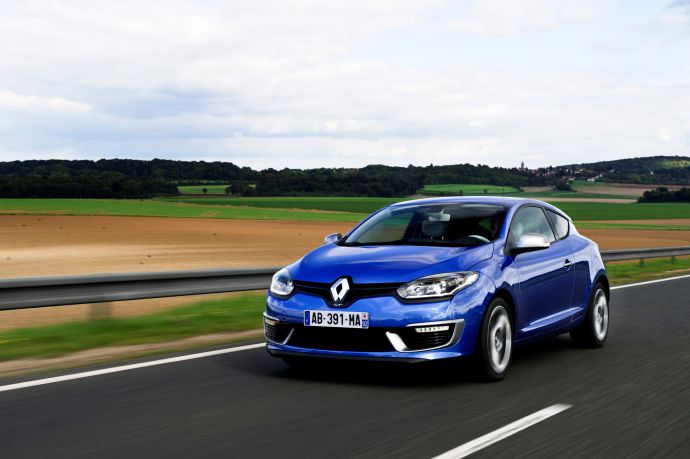
The design of the Renault Megane III Coupe RS Trophy is an unmistakable declaration of its performance intent. As a 3-door coupe with seating for five, it maintains the fundamental shape of the Megane III Coupe but is significantly enhanced with Renault Sport’s signature styling cues. Its aggressive stance is characterized by a wider track, flared wheel arches, and a distinctive front bumper with an integrated blade-like spoiler, often finished in a contrasting color. The rear features a prominent diffuser and a centrally mounted exhaust pipe, further emphasizing its sporty character.
Dimensionally, the Megane RS Trophy measures 169.25 inches (4299 mm) in length, 72.76 inches (1848 mm) in width (80.2 inches or 2037 mm including mirrors), and 56.5 inches (1435 mm) in height. Its wheelbase of 103.78 inches (2636 mm) contributes to both stability and agility. The performance-oriented nature is also evident in its choice of wheels and tires, typically featuring 18-inch or 19-inch alloy wheels shod with high-performance tires (225/40 R18 or 235/35 R19), providing exceptional grip.
Beyond aesthetics, the RS Trophy was engineered for superior handling. It featured a specialized chassis, often referred to as the “Cup Chassis,” which included stiffer springs, dampers, and an anti-roll bar. This, combined with a limited-slip differential (LSD), allowed for maximum traction and reduced understeer during aggressive cornering. The braking system comprised large ventilated discs at the front and disc brakes at the rear, complemented by ABS (Anti-lock Braking System) for confident stopping power. The steering system, a rack and pinion type, was tuned for precise feedback, connecting the driver intimately with the road. Inside, the cabin typically featured bolstered sport seats, unique RS badging, and a performance-oriented instrument cluster, all designed to enhance the driving experience.
Renault Megane III Coupe RS Trophy: Technical Specifications
| Category | Specification |
| General Information | |
| Brand | Renault |
| Model | Megane |
| Generation | Megane III Coupe (Phase III, 2014) |
| Type (Engine) | RS Trophy 2.0 (273 Hp) |
| Start of Production | 2015 |
| End of Production | 2016 |
| Powertrain Architecture | Internal Combustion engine |
| Body Type | Coupe |
| Seats | 5 |
| Doors | 3 |
| Performance Specs | |
| Fuel Consumption (Urban) | 9.8 l/100 km (24 US mpg) |
| Fuel Consumption (Extra Urban) | 6.2 l/100 km (37.9 US mpg) |
| Fuel Consumption (Combined) | 7.5 l/100 km (31.4 US mpg) |
| CO2 Emissions | 174 g/km |
| Fuel Type | Petrol (Gasoline) |
| Acceleration 0 – 60 mph | 5.7 sec |
| Acceleration 0 – 100 km/h | 6 sec |
| Maximum Speed | 255 km/h (158.45 mph) |
| Emission Standard | Euro 5 |
| Weight-to-Power Ratio | 5.1 kg/Hp (198 Hp/tonne) |
| Weight-to-Torque Ratio | 3.8 kg/Nm (261.1 Nm/tonne) |
| Engine Specs | |
| Power | 273 Hp @ 5500 rpm |
| Power per Liter | 136.6 Hp/l |
| Torque | 360 Nm (265.52 lb.-ft.) @ 3000-5000 rpm |
| Engine Layout | Front, Transverse |
| Engine Model/Code | F4R 874 |
| Engine Displacement | 1998 cm3 (121.93 cu. in.) |
| Number of Cylinders | 4 |
| Engine Configuration | Inline |
| Cylinder Bore | 82.7 mm (3.26 in.) |
| Piston Stroke | 93 mm (3.66 in.) |
| Compression Ratio | 8.6:1 |
| Number of Valves per Cylinder | 4 |
| Fuel Injection System | Multi-port manifold injection |
| Engine Aspiration | Turbocharger, Intercooler |
| Engine Oil Capacity | 5.4 l (5.71 US qt) |
| Coolant Capacity | 6.5 l (6.87 US qt) |
| Space, Volume and Weights | |
| Kerb Weight | 1379 kg (3040.17 lbs.) |
| Max. Weight | 1835 kg (4045.48 lbs.) |
| Max Load | 456 kg (1005.31 lbs.) |
| Trunk (boot) Space – Minimum | 344 l (12.15 cu. ft.) |
| Trunk (boot) Space – Maximum | 991 l (35 cu. ft.) |
| Fuel Tank Capacity | 60 l (15.85 US gal) |
| Max. Roof Load | 80 kg (176.37 lbs.) |
| Dimensions | |
| Length | 4299 mm (169.25 in.) |
| Width | 1848 mm (72.76 in.) |
| Width Including Mirrors | 2037 mm (80.2 in.) |
| Height | 1435 mm (56.5 in.) |
| Wheelbase | 2636 mm (103.78 in.) |
| Front Track | 1588 mm (62.52 in.) |
| Rear (Back) Track | 1545 mm (60.83 in.) |
| Front Overhang | 860 mm (33.86 in.) |
| Rear Overhang | 803 mm (31.61 in.) |
| Ride Height (Ground Clearance) | 120 mm (4.72 in.) |
| Minimum Turning Circle | 11.35 m (37.24 ft.) |
| Drivetrain, Brakes and Suspension Specs | |
| Drivetrain Architecture | The Internal combustion engine (ICE) drives the front wheels of the vehicle. |
| Drive Wheel | Front wheel drive |
| Number of Gears and Type of Gearbox | 6 gears, manual transmission |
| Front Brakes | Ventilated discs |
| Rear Brakes | Disc |
| Assisting Systems | ABS (Anti-lock braking system) |
| Steering Type | Steering rack and pinion |
| Tires Size | 225/40 R18; 235/35 R19 |
| Wheel Rims Size | 18; 19 |
Legacy and Market Impact
The Renault Megane RS series, and particularly the Megane III Coupe RS Trophy, carved out an indelible legacy as one of the most capable front-wheel-drive performance cars of its era. Its reputation was significantly bolstered by its record-breaking performances at the legendary Nürburgring Nordschleife. The Megane III RS Trophy, in its various iterations, repeatedly claimed and reclaimed the title for the fastest front-wheel-drive production car around the ‘Ring, a feat that resonated deeply with enthusiasts globally and underscored Renault Sport’s engineering prowess. This achievement not only provided bragging rights but also served as a tangible demonstration of its superior chassis dynamics, powerful engine, and effective limited-slip differential.
In the European market, the Megane RS Trophy competed fiercely against a strong contingent of hot hatches and performance coupes. Its primary rivals included the Volkswagen Golf GTI (and later the Golf R, though AWD), the Ford Focus ST (and the more potent, albeit AWD, Focus RS), the Honda Civic Type R, and the SEAT Leon Cupra. What often set the Megane RS Trophy apart was its uncompromising focus on driver involvement and track performance, often at the expense of some everyday comfort, which was a deliberate choice by Renault Sport. Its “Cup Chassis” and mechanical limited-slip differential were often cited as key differentiators, providing a raw and engaging driving experience that many competitors struggled to match in a front-wheel-drive package.
The Megane III RS Trophy’s impact extended beyond its sales figures. It solidified Renault Sport’s position as a serious player in the performance car arena, demonstrating that a front-wheel-drive platform could deliver supercar-baiting performance and handling. It became a collector’s item almost immediately, especially the limited-run Trophy versions, due to their exclusivity and performance pedigree. For many, it represented the zenith of the internal combustion engine hot hatch era, a celebration of manual transmissions, mechanical grip, and an unadulterated driving experience. Its influence can still be seen in subsequent high-performance front-wheel-drive vehicles, which continue to chase the benchmarks set by this iconic French performance machine.