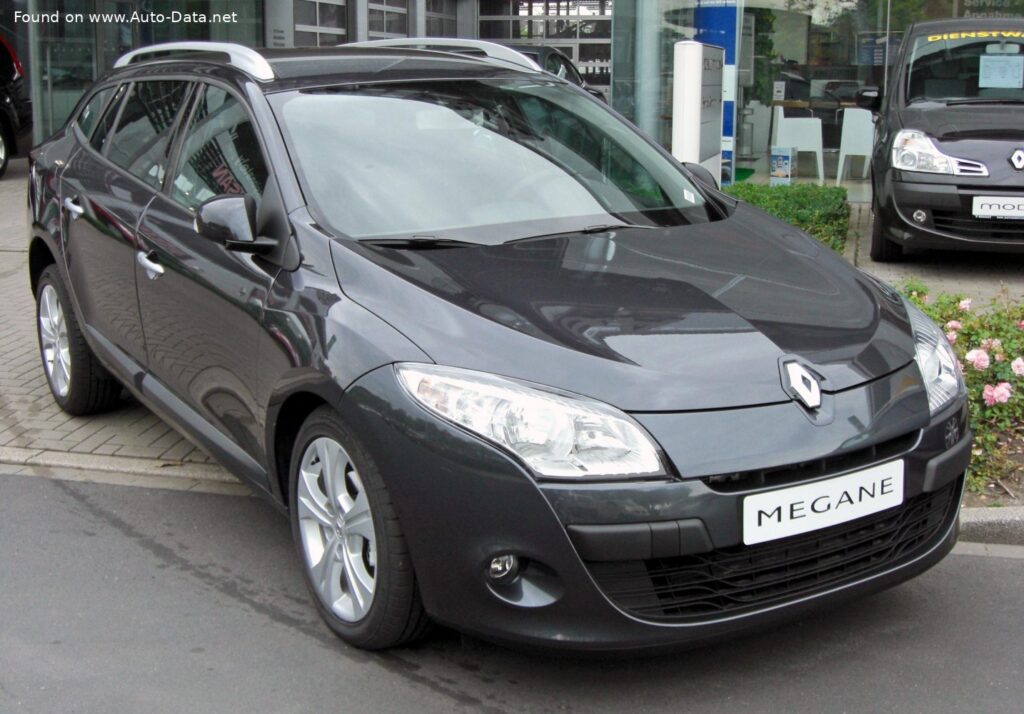
The Renault Megane III Grandtour 1.5 dCi (90 Hp) FAP represents a significant offering within the compact family car segment in Europe during its production run from 2009 to 2012. As part of the third generation of the popular Megane lineup, the Grandtour variant specifically catered to buyers seeking enhanced practicality and cargo capacity over the standard hatchback or coupe models. While not officially imported or sold in the United States, the Megane III Grandtour played a crucial role in Renault’s strategy to provide efficient, versatile, and affordable transportation to European families and businesses. This particular iteration, powered by a 1.5-liter dCi diesel engine, was lauded for its exceptional fuel economy and low emissions, making it a compelling choice in a market increasingly focused on environmental responsibility and running costs.
The Megane III generation marked a departure from the more polarizing design language of its predecessor, adopting a more conventional yet sleek aesthetic that resonated well with a broader audience. The Grandtour, or estate wagon as it’s often known in other markets, extended this appeal by offering a spacious interior and a large, flexible cargo area, positioning it as a direct competitor to other European compact wagons like the Volkswagen Golf Variant, Ford Focus Estate, and Peugeot 308 SW. Its blend of French comfort, practical design, and a highly efficient diesel powertrain made the Renault Megane III Grandtour 1.5 dCi (90 Hp) FAP a staple on European roads.
Engine & Performance of the Renault Megane III Grandtour
Under the hood, the Renault Megane III Grandtour 1.5 dCi (90 Hp) FAP featured Renault’s widely utilized K9K 834 engine, a 1.5-liter (1461 cubic centimeters or 89.16 cubic inches) inline four-cylinder diesel unit. This engine was a cornerstone of Renault’s powertrain strategy, known for its robust design, excellent fuel efficiency, and commendable reliability. Equipped with a common rail fuel injection system, a turbocharger, and an intercooler, it delivered a modest but highly effective 90 horsepower at 4000 rpm. The power per liter stood at 61.6 horsepower per liter, a respectable figure for a diesel engine focused on economy rather than outright performance.
What truly defined the performance characteristics of this powertrain was its torque output. The engine produced a healthy 200 Newton-meters (147.51 lb.-ft.) of torque, peaking at a low 1750 rpm. This early torque delivery was instrumental in providing responsive acceleration from low speeds, making the car feel sprightly in urban environments and capable on highways, despite its modest horsepower rating. The power was channeled to the front wheels via a smooth-shifting 5-speed manual transmission, a common setup for efficiency-focused vehicles of its class and era.
In terms of raw performance, the Megane III Grandtour 1.5 dCi was not designed for blistering speed. It accelerated from 0 to 60 mph in a calculated 12.3 seconds, with 0 to 100 km/h taking 12.9 seconds, and reached a maximum speed of 111.85 mph (180 km/h). These figures are indicative of a vehicle engineered for everyday usability and long-distance comfort rather than sporty pretensions. However, its true strength lay in its fuel economy. The combined fuel consumption was an impressive 4 liters per 100 kilometers, translating to an outstanding 58.8 US miles per gallon. Urban driving yielded 49 US mpg, while extra-urban (highway) driving pushed efficiency even further to 65.3 US mpg, underscoring its economical nature. Furthermore, with CO2 emissions of just 104 grams per kilometer, it met the stringent Euro 5 emission standard, reflecting its environmental consciousness.
Design & Features of the Renault Megane III Grandtour
The third-generation Renault Megane Grandtour adopted a sleek and more universally appealing design compared to its predecessor. The body type, a 5-door station wagon (estate), was meticulously crafted to maximize both aesthetics and utility. With an overall length of 179.49 inches (4559 mm), a width of 69.53 inches (1766 mm), and a height of 57.52 inches (1461 mm), the Grandtour struck a balance between a compact footprint and generous interior volume. The wheelbase of 106.42 inches (2703 mm) contributed to a stable ride and ample passenger space, particularly for rear occupants.
Inside, the Megane III Grandtour offered seating for five adults, emphasizing comfort and ergonomics, hallmarks of French automotive design. The interior was characterized by quality materials and a logical layout, with a focus on ease of use. A key feature of the Grandtour was its exceptional cargo capacity. With the rear seats in place, it boasted a minimum trunk space of 18.5 cubic feet (524 liters). When the rear seats were folded down, this expanded dramatically to a cavernous 56.33 cubic feet (1595 liters), making it highly versatile for hauling luggage, sports equipment, or even small furniture.
Safety was a priority for Renault, and the Megane III Grandtour included standard features like ABS (Anti-lock Braking System) and multiple airbags. The suspension system comprised an independent McPherson setup at the front and a torsion beam at the rear, a common and effective combination for compact cars, providing a comfortable ride quality and predictable handling. Steering was managed by an electric power-assisted rack and pinion system, offering light effort for urban maneuvering and greater stability at higher speeds. The car rode on 195/65 R15 tires mounted on 15-inch wheel rims, providing a good balance of comfort and grip. A diesel particulate filter (FAP) was standard, ensuring compliance with emission regulations and reducing harmful soot particles.
Technical Specifications
| Category | Specification |
| General Information | |
| Brand | Renault |
| Model | Megane III Grandtour 1.5 dCi (90 Hp) FAP |
| Generation | Megane III Grandtour |
| Production Years | 2009 – 2012 |
| Body Type | Station wagon (estate) |
| Seats | 5 |
| Doors | 5 |
| Performance Specifications | |
| Fuel Consumption (Urban) | 4.8 l/100 km (49 US mpg) |
| Fuel Consumption (Extra Urban) | 3.6 l/100 km (65.3 US mpg) |
| Fuel Consumption (Combined) | 4.0 l/100 km (58.8 US mpg) |
| CO2 Emissions | 104 g/km |
| Fuel Type | Diesel |
| Acceleration 0-60 mph | 12.3 sec |
| Maximum Speed | 111.85 mph (180 km/h) |
| Emission Standard | Euro 5 |
| Engine Specifications | |
| Power | 90 Hp @ 4000 rpm |
| Torque | 200 Nm (147.51 lb.-ft.) @ 1750 rpm |
| Engine Layout | Front, Transverse |
| Engine Code | K9K 834 |
| Engine Displacement | 1461 cm³ (1.5 liters / 89.16 cu. in.) |
| Number of Cylinders | 4, Inline |
| Valves per Cylinder | 2 |
| Fuel Injection System | Diesel Commonrail |
| Engine Aspiration | Turbocharger, Intercooler |
| Engine Oil Capacity | 4.5 liters (4.76 US qt) |
| Coolant Capacity | 6.5 liters (6.87 US qt) |
| Engine Systems | Particulate filter (FAP) |
| Dimensions & Weight | |
| Length | 179.49 in. (4559 mm) |
| Width | 69.53 in. (1766 mm) |
| Height | 57.52 in. (1461 mm) |
| Wheelbase | 106.42 in. (2703 mm) |
| Kerb Weight | 2755.78 lbs. (1250 kg) |
| Max. Weight (GVWR) | 3994.78 lbs. (1812 kg) |
| Max Load | 1239 lbs. (562 kg) |
| Trunk Space (min/max) | 18.5 – 56.33 cu. ft. (524 – 1595 liters) |
| Fuel Tank Capacity | 15.85 US gal (60 liters) |
| Drivetrain, Brakes & Suspension | |
| Drivetrain Architecture | Front-wheel drive |
| Transmission | 5-speed manual |
| Front Suspension | Independent McPherson |
| Rear Suspension | Torsion beam |
| Front Brakes | Ventilated discs |
| Rear Brakes | Discs |
| Assisting Systems | ABS |
| Steering Type | Electric Steering rack and pinion |
| Tire Size | 195/65 R15 |
| Wheel Rims Size | 15 inches |
Legacy & Market Impact of the Renault Megane III Grandtour
The Renault Megane III Grandtour, particularly in its 1.5 dCi (90 Hp) FAP specification, carved out a significant niche in the highly competitive European compact segment. Its legacy is primarily defined by its exceptional practicality, impressive fuel efficiency, and overall value proposition. For families and professionals across Europe, it offered a compelling alternative to SUVs or larger sedans, providing ample space without the associated higher running costs or larger footprint. Its station wagon body style was a key differentiator, appealing to those who prioritized cargo volume and versatility for daily life and vacation travel.
In the European market, the Megane III Grandtour faced stiff competition from a host of well-established rivals. Key competitors included the Ford Focus Estate, known for its engaging driving dynamics; the Volkswagen Golf Variant, revered for its build quality and strong resale value; the Opel Astra Sports Tourer, offering solid engineering; and the Peugeot 308 SW, a domestic French rival emphasizing comfort and style. Despite this formidable lineup, the Megane III Grandtour held its own by offering a distinct blend of French comfort, practical design, and the proven reliability of its K9K dCi engine.
The 1.5 dCi engine, with its impressive fuel economy of nearly 59 US mpg combined and low CO2 emissions, positioned the Megane III Grandtour as a leader in its class for efficiency. This was a critical factor for European buyers, who often face high fuel prices and emission-based taxation. Its adherence to the Euro 5 emission standard further enhanced its appeal, ensuring it remained a relevant and environmentally responsible choice during its production years. The inclusion of a diesel particulate filter (FAP) was a standard feature, highlighting Renault’s commitment to cleaner diesel technology.
While its performance figures were modest, the strong low-end torque of the diesel engine ensured a relaxed and capable driving experience, particularly suited for highway cruising. The comfortable ride and predictable handling characteristic of the Megane III further contributed to its positive reputation as a competent and agreeable daily driver. The Megane III Grandtour’s impact lies in its successful execution of a core mission: to provide a spacious, economical, and reliable family car that delivered on its promises without unnecessary frills. It represented a sensible and well-engineered choice for a broad segment of the European automotive market, solidifying Renault’s position as a key player in the compact family vehicle category for over three decades. Its design, while not revolutionary, was a mature and practical evolution that continued to influence subsequent generations of Renault’s family vehicles.