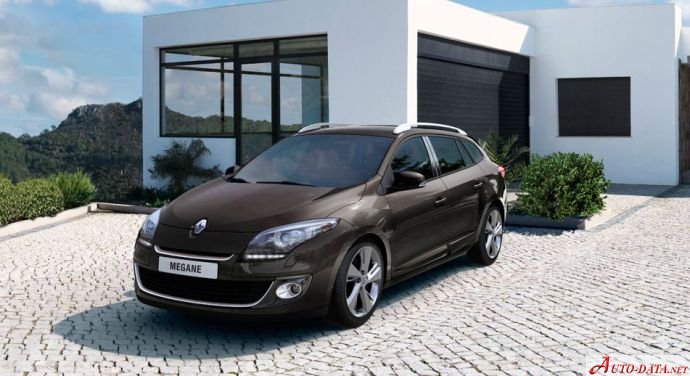
The Renault Megane III Grandtour (Phase II), produced from 2012 to 2013, represents a significant iteration of Renault’s popular compact family car. This version, specifically the 1.6 16V variant producing 110 horsepower, was primarily aimed at the European market as a practical and efficient station wagon (estate). The Megane III series, launched in 2008, aimed to elevate Renault’s presence in the competitive C-segment, offering a blend of style, technology, and affordability. The Grandtour body style, a station wagon, expanded the Megane’s appeal to families and those requiring increased cargo capacity. This Phase II update brought with it styling refinements, improved interior materials, and enhancements to the engine range, focusing on fuel efficiency and reduced emissions.
Renault Megane III Grandtour: A Detailed Overview
The Megane III Grandtour occupied a crucial position in Renault’s lineup, competing with vehicles like the Ford Focus Estate, Volkswagen Golf Variant, and Peugeot 308 SW. It was designed to offer a compelling alternative to traditional hatchbacks, providing a more versatile and spacious option without sacrificing driving dynamics. The Phase II model, with its 1.6-liter engine, was positioned as a mainstream choice, balancing performance with economy. While not officially sold in the United States, understanding its specifications and features provides insight into the European automotive landscape of the early 2010s.
Engine & Performance
The heart of the 2012 Renault Megane III Grandtour 1.6 16V is a 1.6-liter inline-four cylinder gasoline engine, designated the K4M 858. This naturally aspirated engine produces 110 horsepower at 6000 rpm and 151 Nm (111.37 lb.-ft.) of torque at 4250 rpm. The engine features multi-port fuel injection and a compression ratio of 9.7:1. Power delivery is adequate for everyday driving, with a 0-100 km/h (0-62 mph) acceleration time of 10.8 seconds. A 0-60 mph time is calculated at 10.3 seconds. The engine is coupled with a six-speed manual transmission, driving the front wheels. Maximum speed is rated at 190 km/h (118.06 mph). Fuel economy is a key strength, achieving 6.9 liters per 100 kilometers (34.1 US mpg) on a combined cycle, with 5.5 l/100km (42.8 US mpg) on the extra urban cycle and 9.4 l/100km (25 US mpg) in urban conditions. CO2 emissions are rated at 159 g/km, meeting Euro 5 emission standards.
Design & Features
The Renault Megane III Grandtour is a five-door station wagon, offering seating for five passengers. Its exterior design is characterized by Renault’s signature styling cues of the era, including a prominent front grille and sculpted body lines. The Grandtour body style extends the roofline rearward, creating a larger cargo area. The Phase II update included minor cosmetic changes, such as revised headlights and taillights, and updated interior trim. Inside, the Megane III Grandtour offers a functional and reasonably well-equipped cabin. Standard features typically included air conditioning, power windows, and a basic audio system. Safety features, crucial for family vehicles, included ABS (Anti-lock Braking System) and driver/passenger airbags. Trunk space is a significant advantage of the Grandtour model, offering 524 liters (18.5 cu. ft.) with the rear seats up and expanding to 1595 liters (56.33 cu. ft.) with the seats folded down. The vehicle’s kerb weight is 1267 kg (2793.26 lbs), with a maximum permissible weight of 1824 kg (4021.23 lbs).
Technical Specifications
| Brand | Renault |
| Model | Megane |
| Generation | Megane III Grandtour (Phase II, 2012) |
| Type (Engine) | 1.6 16V (110 Hp) |
| Start of production | 2012 |
| End of production | 2013 |
| Powertrain Architecture | Internal Combustion engine |
| Body type | Station wagon (estate) |
| Seats | 5 |
| Doors | 5 |
| Fuel consumption (urban) | 9.4 l/100 km (25 US mpg) |
| Fuel consumption (extra urban) | 5.5 l/100 km (42.8 US mpg) |
| Fuel consumption (combined) | 6.9 l/100 km (34.1 US mpg) |
| CO2 emissions | 159 g/km |
| Fuel Type | Petrol (Gasoline) |
| Acceleration 0 – 100 km/h | 10.8 sec |
| Acceleration 0 – 62 mph | 10.8 sec |
| Acceleration 0 – 60 mph | 10.3 sec |
| Maximum speed | 190 km/h (118.06 mph) |
| Emission standard | Euro 5 |
| Weight-to-power ratio | 11.5 kg/Hp |
| Weight-to-torque ratio | 8.4 kg/Nm |
| Power | 110 Hp @ 6000 rpm |
| Torque | 151 Nm @ 4250 rpm (111.37 lb.-ft. @ 4250 rpm) |
| Engine layout | Front, Transverse |
| Engine Model/Code | K4M 858 |
| Engine displacement | 1598 cm3 (97.52 cu. in.) |
| Number of cylinders | 4 |
| Engine configuration | Inline |
| Cylinder Bore | 79.5 mm (3.13 in.) |
| Piston Stroke | 80.5 mm (3.17 in.) |
| Compression ratio | 9.7:1 |
| Number of valves per cylinder | 4 |
| Fuel injection system | Multi-port manifold injection |
| Engine aspiration | Naturally aspirated engine |
| Engine oil capacity | 4.8 l (5.07 US qt | 4.22 UK qt) |
| Coolant | 5.3 l (5.6 US qt | 4.66 UK qt) |
| Kerb Weight | 1267 kg (2793.26 lbs.) |
| Max. weight | 1824 kg (4021.23 lbs.) |
| Max load | 557 kg (1227.97 lbs.) |
| Trunk (boot) space – minimum | 524 l (18.5 cu. ft.) |
| Trunk (boot) space – maximum | 1595 l (56.33 cu. ft.) |
| Fuel tank capacity | 60 l (15.85 US gal | 13.2 UK gal) |
| Max. roof load | 80 kg (176.37 lbs.) |
| Permitted trailer load with brakes (12%) | 1500 kg (3306.93 lbs.) |
| Permitted trailer load without brakes | 670 kg (1477.1 lbs.) |
| Permitted towbar download | 75 kg (165.35 lbs.) |
| Length | 4559 mm (179.49 in.) |
| Width | 1766 mm (69.53 in.) |
| Height | 1461 mm (57.52 in.) |
| Wheelbase | 2703 mm (106.42 in.) |
| Front track | 1546 mm (60.87 in.) |
| Rear (Back) track | 1547 mm (60.91 in.) |
| Number of gears and type of gearbox | 6 gears, manual transmission |
| Front suspension | Independent type McPherson |
| Rear suspension | Elastic beam |
| Front brakes | Ventilated discs |
| Rear brakes | Disc |
| Steering type | Steering rack and pinion |
| Power steering | Electric Steering |
| Tires size | 195/65 R15 |
| Wheel rims size | 6.5J x 15 |