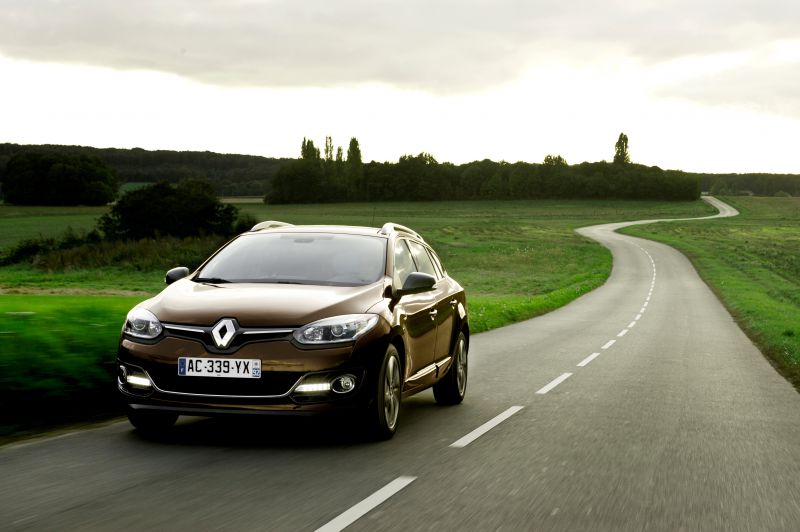
The Renault Megane III Grandtour (Phase III, 2014) 1.2 Energy TCe (115 Hp) ECO2 Start&Stop represents a significant iteration in the third generation of Renault’s popular compact family car, specifically tailored for the European market. Launched in 2014 as part of a mid-cycle refresh (Phase III) for the Megane III lineup, this model emphasized efficiency, practicality, and modern powertrain technology. As a station wagon, or “Grandtour” in Renault’s nomenclature, it catered to families and individuals prioritizing spaciousness and versatility over outright sportiness, yet still offered a refined driving experience typical of the C-segment in Europe. While not officially sold in the United States, its design and engineering philosophies reflect global trends in automotive development, focusing on downsized turbocharged engines, advanced fuel-saving technologies, and comprehensive safety features to meet stringent European regulations and consumer demands.
Renault Megane III Grandtour: A Detailed Overview
The Renault Megane III, introduced in 2008, aimed to elevate Renault’s presence in the competitive compact car segment. The Grandtour variant, the station wagon version, specifically targeted buyers needing increased cargo capacity and practicality. The Phase III update in 2014 brought styling revisions, enhanced interior features, and, crucially, the introduction of more efficient engine options like the 1.2 Energy TCe. This model was designed to appeal to a broad demographic within Europe, offering a balance of affordability, functionality, and modern technology.
Engine & Performance
At the heart of this Renault Megane III Grandtour variant lies the 1.2 Energy TCe (Turbo Control efficiency) engine, a modern, downsized gasoline unit engineered for a compelling blend of performance and fuel economy. This inline four-cylinder engine, designated H5FT, has a displacement of 1197 cubic centimeters (1.2 liters), generating 115 horsepower at 4500 rpm. Its power output per liter is 96.1 Hp/l, indicative of its advanced design featuring a turbocharger and intercooler. Torque delivery is impressive for its size, peaking at 140.14 lb.-ft. (190 Nm) at 2000 rpm, providing brisk acceleration and flexible in-gear performance.
The powertrain features a front, transverse engine layout, driving the front wheels through a 6-speed manual transmission. Performance figures reflect its practical orientation: 0 to 60 mph in 10.4 seconds (0-100 km/h in 10.9 seconds) and a maximum speed of 114.95 mph (185 km/h). Fuel efficiency is a cornerstone of the design, underscored by its ECO2 branding and standard Start&Stop system. The combined fuel economy is rated at 44.4 US mpg (5.3 l/100 km), with urban consumption at 36.2 US mpg (6.5 l/100 km) and extra-urban at 50 US mpg (4.7 l/100 km). These figures, combined with CO2 emissions of 119 g/km, meet the Euro 5 emission standard. The engine utilizes multi-port fuel injection and has a compression ratio of 10:1, optimizing combustion efficiency. Engine oil capacity is 4.86 US quarts.
Design & Features
The Renault Megane III Grandtour, in its Phase III (2014) guise, presented a sleek and functional design. Its 5-door, 5-seat station wagon body was engineered for utility without sacrificing aesthetic appeal. Measuring 179.49 inches (4559 mm) in length, 71.02 inches (1804 mm) in width (80.2 inches or 2037 mm including mirrors), and 59.96 inches (1523 mm) in height, the Grandtour offered substantial space for passengers and cargo. The 106.42-inch (2703 mm) wheelbase provided a stable ride and interior spaciousness.
A primary selling point was its versatile cargo area. With the rear seats in place, it offered 18.5 cubic feet (524 liters) of trunk space. Folding down the rear seats expanded this to 56.33 cubic feet (1595 liters). The maximum load capacity was 1227.97 lbs (557 kg), with a permissible roof load of 176.37 lbs (80 kg). Towing capabilities were robust, allowing for a trailer load with brakes (12%) of up to 3306.93 lbs (1500 kg), and 1410.96 lbs (640 kg) without brakes. The chassis featured an independent McPherson front suspension and a torsion beam rear suspension. Braking power was provided by ventilated discs at the front and disc brakes at the rear, augmented by ABS. Steering was rack and pinion with electric power steering. Available tire sizes included 195/65 R15, 205/55 R16, or 205/50 R17, mounted on 15, 16, or 17-inch wheel rims. The minimum turning circle was 36.25 feet (11.05 meters).
Technical Specifications
| Category | Specification |
| Brand | Renault |
| Model | Megane |
| Generation | Megane III Grandtour (Phase III, 2014) |
| Type (Engine) | 1.2 Energy TCe (115 Hp) ECO2 Start&Stop |
| Start of production | 2014 |
| End of production | 2016 |
| Powertrain Architecture | Internal Combustion engine |
| Body type | Station wagon (estate) |
| Seats | 5 |
| Doors | 5 |
| Fuel consumption (economy) – urban | 6.5 l/100 km (36.2 US mpg) |
| Fuel consumption (economy) – extra urban | 4.7 l/100 km (50 US mpg) |
| Fuel consumption (economy) – combined | 5.3 l/100 km (44.4 US mpg) |
| CO2 emissions | 119 g/km |
| Fuel Type | Petrol (Gasoline) |
| Acceleration 0 – 60 mph | 10.4 sec |
| Acceleration 0 – 100 km/h | 10.9 sec |
| Maximum speed | 114.95 mph (185 km/h) |
| Emission standard | Euro 5 |
| Weight-to-power ratio | 11 kg/Hp, 90.8 Hp/tonne |
| Weight-to-torque ratio | 6.7 kg/Nm, 150 Nm/tonne |
| Power | 115 Hp @ 4500 rpm |
| Power per liter | 96.1 Hp/l |
| Torque | 140.14 lb.-ft. (190 Nm) @ 2000 rpm |
| Engine layout | Front, Transverse |
| Engine Model/Code | H5FT |
| Engine displacement | 1197 cm3 (73.05 cu. in.) |
| Number of cylinders | 4 |
| Engine configuration | Inline |
| Cylinder Bore | 2.84 in. (72.2 mm) |
| Piston Stroke | 2.88 in. (73.2 mm) |
| Compression ratio | 10:1 |
| Number of valves per cylinder | 4 |
| Fuel injection system | Multi-port manifold injection |
| Engine aspiration | Turbocharger, Intercooler |
| Engine oil capacity | 4.86 US qt (4.6 l) |
| Engine systems | Start & Stop System |
| Kerb Weight | 2793.26 lbs. (1267 kg) |
| Max. weight | 4021.23 lbs. (1824 kg) |
| Max load | 1227.97 lbs. (557 kg) |
| Trunk (boot) space – minimum | 18.5 cu. ft. (524 l) |
| Trunk (boot) space – maximum | 56.33 cu. ft. (1595 l) |
| Fuel tank capacity | 15.85 US gal (60 l) |
| Max. roof load | 176.37 lbs. (80 kg) |
| Permitted trailer load with brakes (12%) | 3306.93 lbs. (1500 kg) |
| Permitted trailer load without brakes | 1410.96 lbs. (640 kg) |
| Permitted towbar download | 165.35 lbs. (75 kg) |
| Length | 179.49 in. (4559 mm) |
| Width | 71.02 in. (1804 mm) |
| Width including mirrors | 80.2 in. (2037 mm) |
| Height | 59.96 in. (1523 mm) |
| Wheelbase | 106.42 in. (2703 mm) |
| Front track | 60.87 in. (1546 mm) |
| Rear (Back) track | 60.91 in. (1547 mm) |
| Front overhang | 33.94 in. (862 mm) |
| Rear overhang | 39.13 in. (994 mm) |
| Ride height (ground clearance) | 4.72 in. (120 mm) |
| Minimum turning circle (turning diameter) | 36.25 ft. (11.05 m) |
| Drivetrain Architecture | Front wheel drive. Internal Combustion engine. |
| Drive wheel | Front wheel drive |
| Number of gears and type of gearbox | 6 gears, manual transmission |
| Front suspension | Independent type McPherson |
| Rear suspension | Torsion |
| Front brakes | Ventilated discs |
| Rear brakes | Disc |
| Assisting systems | ABS (Anti-lock braking system) |
| Steering type | Steering rack and pinion |
| Power steering | Electric Steering |
| Tires size | 195/65 R15; 205/55 R16; 205/50 R17 |
| Wheel rims size | 15; 16; 17 |
Legacy and Market Impact of the Renault Megane III Grandtour
The Renault Megane III Grandtour, particularly in its Phase III (2014) iteration, played a crucial role in Renault’s strategy within the competitive European C-segment. This segment, dominated by compact family vehicles, saw the Grandtour directly competing with established rivals such as the Volkswagen Golf Variant, Ford Focus Estate, Opel Astra Sports Tourer, and Peugeot 308 SW. Its success stemmed from a compelling combination of practical utility, comfortable ride quality, and increasingly sophisticated powertrain technology. The 1.2 Energy TCe engine, with its ECO2 and Start&Stop systems, was a testament to the industry’s shift towards downsizing and efficiency. This specific variant was highly regarded for its ability to offer gasoline performance comparable to larger, naturally aspirated engines while delivering diesel-like fuel economy and lower emissions. This made it an attractive proposition for European buyers facing rising fuel costs and stricter environmental regulations. The car’s low CO2 emissions of 119 g/km and Euro 5 compliance highlighted its environmental credentials, appealing to ecologically conscious consumers and benefiting from favorable tax regimes in many European countries. While the Renault Megane III Grandtour was never officially imported to the United States, its design and engineering philosophies had a broader impact. It showcased how European manufacturers were effectively meeting the demands for efficient, practical, and well-equipped compact vehicles. Its legacy in Europe is that of a reliable, cost-effective, and family-friendly station wagon that successfully navigated the evolving landscape of automotive technology and consumer expectations during its production run from 2014 to 2016. It served as a strong contender in its class, embodying Renault’s commitment to innovation and real-world usability for the everyday driver.