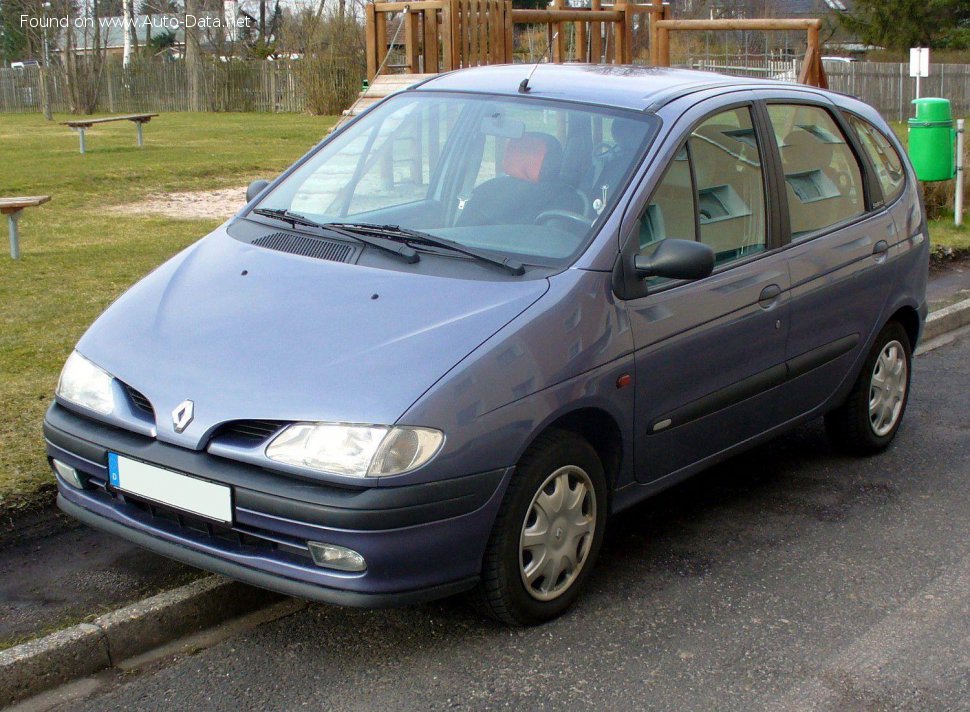
The Renault Megane Scenic 2.0 (109 Hp), produced between 1998 and 1999, represents Renault’s initial foray into the compact minivan (MPV) segment. This vehicle, based on the Megane platform, was primarily marketed in Europe as a practical and versatile family vehicle. It distinguished itself with its innovative interior packaging and focus on maximizing space within a relatively small footprint. The Scenic was a key model for Renault, establishing a strong presence in the burgeoning MPV market and paving the way for subsequent generations. While not officially sold in the United States, understanding its specifications and design provides insight into the European automotive landscape of the late 1990s.
Renault Megane Scenic 2.0: An Overview
The Megane Scenic was designed to appeal to families seeking a vehicle that offered the practicality of a larger vehicle with the maneuverability and fuel efficiency of a smaller one. It was a direct response to the growing demand for multi-purpose vehicles in Europe, where space constraints and urban driving conditions were prevalent. The Scenic’s defining feature was its modular interior, allowing for flexible seating configurations and ample cargo space. It offered a compelling alternative to traditional station wagons and larger, more expensive MPVs.
Engine & Performance
The Renault Megane Scenic 2.0 was powered by a 1.998-liter, inline-four cylinder gasoline engine, designated the F3R. This naturally aspirated engine produced 109 horsepower at 5400 rpm and 168 Nm (123.91 lb.-ft.) of torque at 4250 rpm. Power delivery was adequate for everyday driving, with a focus on usability rather than outright performance. The engine featured a multi-port fuel injection system and an overhead camshaft (OHC) valvetrain. Acceleration from 0 to 100 km/h (0-62 mph) took 11.1 seconds, while 0 to 60 mph was achieved in approximately 10.5 seconds. The vehicle had a maximum speed of 185 km/h (114.95 mph). Fuel economy figures were rated at 8.9 l/100 km (26.4 US mpg) combined, with 12 l/100 km (19.6 US mpg) in urban conditions and 7.1 l/100 km (33.1 US mpg) on the open road. The engine’s power-to-weight ratio was 11.6 kg/Hp, and the torque-to-weight ratio was 7.5 kg/Nm.
Design & Features
The Megane Scenic adopted a traditional minivan silhouette, characterized by a tall roofline and a relatively short hood. It was a five-door vehicle with seating for five passengers. The interior was the focal point of the design, emphasizing modularity and practicality. Rear seats could be folded flat or even removed entirely, creating a large, open cargo area. The dashboard was functional and ergonomically designed, with easy-to-reach controls. Safety features for the time included an Anti-lock Braking System (ABS). The vehicle’s suspension utilized independent coil springs in the front and a conventional setup in the rear. Steering was rack and pinion with hydraulic assistance. The Scenic came equipped with 14-inch wheels and 185/70 R14 tires. The trunk offered a minimum of 410 liters (14.48 cu. ft.) of space, expandable to 1800 liters (63.57 cu. ft.) with the rear seats folded down.
Technical Specifications
| Brand | Renault |
| Model | Megane |
| Generation | Megane Scenic |
| Type (Engine) | 2.0 (109 Hp) |
| Start of production | 1998 |
| End of production | 1999 |
| Powertrain Architecture | Internal Combustion engine |
| Body type | Minivan, MPV |
| Seats | 5 |
| Doors | 5 |
| Fuel consumption (urban) | 12 l/100 km (19.6 US mpg) |
| Fuel consumption (extra urban) | 7.1 l/100 km (33.1 US mpg) |
| Fuel consumption (combined) | 8.9 l/100 km (26.4 US mpg) |
| CO2 emissions | 211 g/km |
| Fuel Type | Petrol (Gasoline) |
| Acceleration 0 – 100 km/h | 11.1 sec |
| Acceleration 0 – 62 mph | 11.1 sec |
| Acceleration 0 – 60 mph | 10.5 sec |
| Maximum speed | 185 km/h (114.95 mph) |
| Weight-to-power ratio | 11.6 kg/Hp |
| Weight-to-torque ratio | 7.5 kg/Nm |
| Power | 109 Hp @ 5400 rpm |
| Torque | 168 Nm @ 4250 rpm (123.91 lb.-ft. @ 4250 rpm) |
| Engine layout | Front, Transverse |
| Engine Model/Code | F3R |
| Engine displacement | 1998 cm3 (121.93 cu. in.) |
| Number of cylinders | 4 |
| Engine configuration | Inline |
| Cylinder Bore | 82.7 mm (3.26 in.) |
| Piston Stroke | 93 mm (3.66 in.) |
| Compression ratio | 9.7:1 |
| Number of valves per cylinder | 2 |
| Fuel injection system | Multi-port manifold injection |
| Engine aspiration | Naturally aspirated engine |
| Valvetrain | OHC |
| Engine oil capacity | 6.5 l (6.87 US qt | 5.72 UK qt) |
| Coolant | 7 l (7.4 US qt | 6.16 UK qt) |
| Kerb Weight | 1260 kg (2777.82 lbs.) |
| Max. weight | 1800 kg (3968.32 lbs.) |
| Max load | 540 kg (1190.5 lbs.) |
| Trunk (boot) space – minimum | 410 l (14.48 cu. ft.) |
| Trunk (boot) space – maximum | 1800 l (63.57 cu. ft.) |
| Fuel tank capacity | 60 l (15.85 US gal | 13.2 UK gal) |
| Max. roof load | 80 kg (176.37 lbs.) |
| Permitted trailer load with brakes (12%) | 1300 kg (2866.01 lbs.) |
| Permitted trailer load without brakes | 665 kg (1466.07 lbs.) |
| Permitted towbar download | 75 kg (165.35 lbs.) |
| Length | 4134 mm (162.76 in.) |
| Width | 1719 mm (67.68 in.) |
| Height | 1675 mm (65.94 in.) |
| Wheelbase | 2580 mm (101.57 in.) |
| Front track | 1450 mm (57.09 in.) |
| Rear (Back) track | 1485 mm (58.46 in.) |
| Ride height (ground clearance) | 120 mm (4.72 in.) |
| Minimum turning circle (turning diameter) | 10.7 m (35.1 ft.) |
| Drivetrain Architecture | Front wheel drive |
| Number of gears and type of gearbox | 5 gears, manual transmission |
| Front suspension | Independent coil spring |
| Front brakes | Ventilated discs |
| Rear brakes | Drum |
| Assisting systems | ABS (Anti-lock braking system) |
| Steering type | Steering rack and pinion |
| Power steering | Hydraulic Steering |
| Tires size | 185/70 R14 |
| Wheel rims size | 14 |
The Renault Megane Scenic 2.0 (109 Hp) was a significant vehicle in Renault’s history, establishing the brand as a leader in the compact MPV segment. Its focus on practicality, versatility, and innovative interior design resonated with European families, and it remains a notable example of late-1990s automotive engineering.