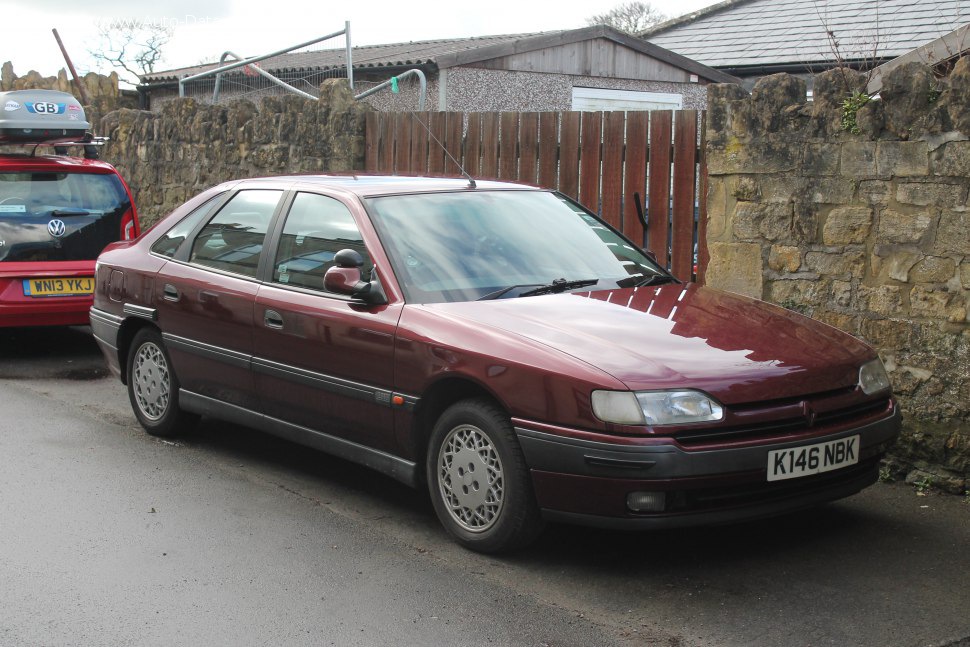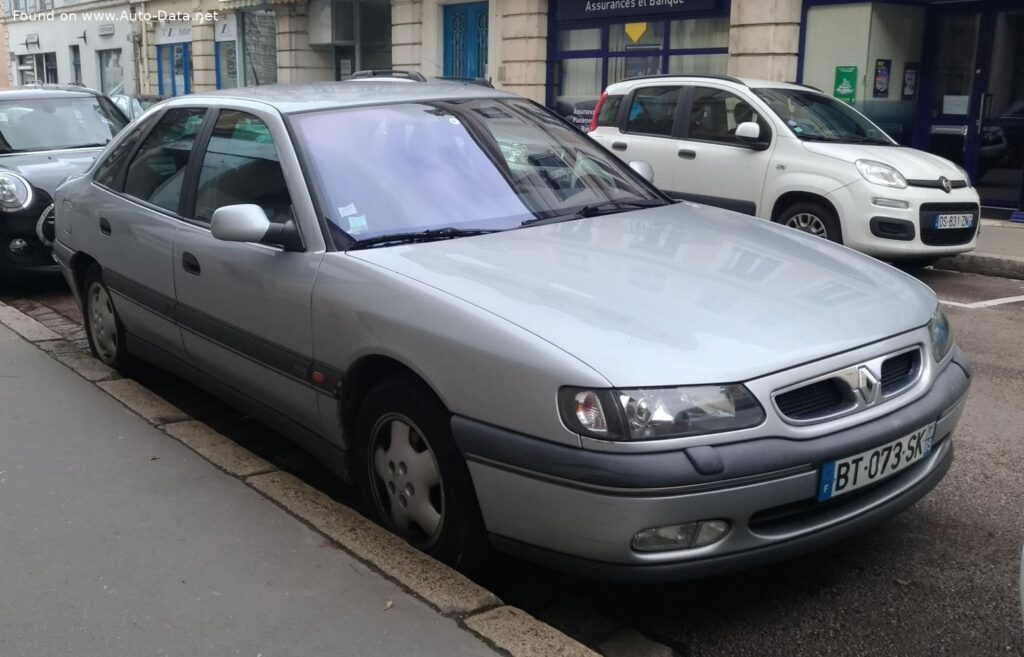
The Renault Safrane I, specifically the B54 facelift model introduced in 1996, represented Renault’s ambitious foray into the executive car segment, primarily targeting the discerning European market. Positioned as the French automaker’s flagship offering, the Renault Safrane I (B54, facelift 1996) 2.5 20V (B54F) (165 Hp) was designed to blend traditional executive comfort and spaciousness with innovative practicality, distinguishing itself from its German and even some domestic rivals. This particular variant, produced from 1996 until the model’s discontinuation in 2000, featured a robust 2.5-liter, 20-valve inline-five engine, signaling Renault’s commitment to delivering a refined and capable driving experience in a segment where sophistication and performance were paramount. While never officially sold in the United States, the Safrane’s design ethos and technical specifications offer a fascinating glimpse into European automotive engineering and market preferences of the late 20th century, emphasizing comfortable cruising, generous interior volume, and a distinctive five-door hatchback body style that offered surprising versatility for its class.
The Renault Safrane I: A European Executive Flagship
As a key player in the European executive class, the Renault Safrane I (B54, facelift 1996) aimed to provide a compelling alternative to established luxury sedans. Its role was to showcase Renault’s capabilities in creating a large, comfortable, and technologically competent vehicle. The facelift in 1996 brought a series of enhancements, both aesthetic and mechanical, intended to keep the Safrane competitive against increasingly sophisticated rivals. The design language was updated to align with Renault’s contemporary styling cues, offering a more modern and aerodynamic profile while retaining the Safrane’s characteristic spaciousness. This generation of the Safrane was celebrated for its emphasis on passenger comfort, ride quality, and a comprehensive suite of features that underscored its premium aspirations. The choice of a five-door hatchback body, rather than a more conventional sedan, was a bold move that provided exceptional practicality, distinguishing it from many of its direct competitors and catering to a market that valued both executive presence and everyday usability.
Powertrain and Performance Dynamics of the Renault Safrane I (B54, facelift 1996)
At the heart of the Renault Safrane I (B54, facelift 1996) 2.5 20V (B54F) (165 Hp) lay a meticulously engineered powertrain. The engine, designated N7U 700, was a naturally aspirated 2.5-liter (2435 cm3 or 148.59 cu. in.) inline five-cylinder unit. This configuration, less common than four or six-cylinder engines, often provided a unique balance of smoothness and character. With a DOHC (Double Overhead Camshaft) valvetrain and four valves per cylinder, this 20-valve engine was designed for efficient breathing and robust power delivery. It produced a respectable 165 HP at 6000 rpm and a solid 155.63 lb.-ft. of torque at 4600 rpm. These figures, combined with a compression ratio of 10.5:1 and a multi-port manifold injection system, allowed the Safrane to perform admirably for its class and era.
The performance metrics for this executive hatchback were quite competitive. The Safrane could accelerate from 0 to 60 mph in a brisk 8.6 seconds, reaching a maximum speed of 136.7 mph (220 km/h). This level of performance ensured confident overtaking maneuvers and comfortable high-speed cruising on European autobahns. Power was channeled to the front wheels via a precise 5-speed manual transmission, offering an engaging driving experience for those who preferred more direct control over gear selection. The powertrain architecture, with the engine mounted front, transversely, and driving the front wheels, contributed to predictable handling characteristics and efficient packaging of the spacious interior. Despite its executive stature and substantial dimensions, the Safrane I managed a favorable weight-to-power ratio of 9.1 kg/Hp, or 110.4 Hp per tonne, underscoring its capable performance envelope. Fuel economy, while not the primary focus of an executive car, was reasonable for the period, with an urban consumption of 15.9 US mpg and an extra-urban figure of 30.9 US mpg, highlighting its efficiency on longer journeys.
Design, Ergonomics, and Safety Features
The design of the Renault Safrane I (B54, facelift 1996) was characterized by its distinctive five-door hatchback body, a practical choice that belied its executive aspirations. With a length of 187.72 inches (4768 mm), a width of 71.5 inches (1816 mm), and a height of 56.5 inches (1435 mm), the Safrane commanded a significant road presence. Its generous wheelbase of 108.9 inches (2766 mm) was instrumental in providing exceptional interior space, particularly for rear passengers, making it an ideal vehicle for long-distance travel. The interior was configured for five occupants, with an emphasis on comfort and high-quality materials, typical of a European flagship. The trunk space was highly versatile, offering a minimum of 16.07 cu. ft. (455 liters) and expanding to an impressive 48.03 cu. ft. (1360 liters) with the rear seats folded, a clear advantage of its hatchback design over traditional sedans.
Beyond its spacious cabin, the Safrane featured a suspension system designed for a smooth and controlled ride. The front suspension utilized a wishbone setup, while the rear employed a spring strut system, a combination that delivered a comfortable yet composed ride, absorbing road imperfections effectively. Braking duties were handled by ventilated discs at the front and disc brakes at the rear, augmented by an Anti-lock Braking System (ABS), a crucial safety feature for its time, ensuring stable stopping performance under various conditions. Steering was managed by a hydraulic rack and pinion system, providing precise feedback and effortless maneuverability, especially with the aid of power steering. The vehicle rode on 195/65 R15 tires, mounted on 15-inch wheel rims, a specification that balanced comfort, grip, and durability. The Safrane I’s comprehensive safety and comfort features, combined with its unique body style, cemented its position as a thoughtful and practical executive choice in its segment.
Technical Specifications: Renault Safrane I (B54, facelift 1996) 2.5 20V (B54F) (165 Hp)
| Brand | Renault |
| Model | Safrane |
| Generation | Safrane I (B54, facelift 1996) |
| Type (Engine) | 2.5 20V (B54F) (165 Hp) |
| Start of production | 1996 year |
| End of production | 2000 year |
| Powertrain Architecture | Internal Combustion engine |
| Body type | Hatchback |
| Seats | 5 |
| Doors | 5 |
| Fuel consumption (economy) – urban | 15.9 US mpg (14.8 l/100 km) |
| Fuel consumption (economy) – extra urban | 30.9 US mpg (7.6 l/100 km) |
| Fuel Type | Petrol (Gasoline) |
| Acceleration 0 – 60 mph | 8.6 sec |
| Acceleration 0 – 100 km/h | 9.1 sec |
| Maximum speed | 136.7 mph (220 km/h) |
| Weight-to-power ratio | 9.1 kg/Hp |
| Weight-to-torque ratio | 7.1 kg/Nm |
| Power | 165 Hp @ 6000 rpm |
| Power per liter | 67.8 Hp/l |
| Torque | 155.63 lb.-ft. @ 4600 rpm (211 Nm) |
| Engine layout | Front, Transverse |
| Engine Model/Code | N7U 700 |
| Engine displacement | 2.4 liters (2435 cm3, 148.59 cu. in.) |
| Number of cylinders | 5 |
| Engine configuration | Inline |
| Cylinder Bore | 3.27 in. (83 mm) |
| Piston Stroke | 3.54 in. (90 mm) |
| Compression ratio | 10.5:1 |
| Number of valves per cylinder | 4 |
| Fuel injection system | Multi-port manifold injection |
| Engine aspiration | Naturally aspirated engine |
| Valvetrain | DOHC |
| Engine oil capacity | 6.87 US qt (6.5 l) |
| Coolant capacity | 8.98 US qt (8.5 l) |
| Kerb Weight | 3295.91 lbs. (1495 kg) |
| Max. weight | 4585.62 lbs. (2080 kg) |
| Max load | 1289.7 lbs. (585 kg) |
| Trunk (boot) space – minimum | 16.07 cu. ft. (455 l) |
| Trunk (boot) space – maximum | 48.03 cu. ft. (1360 l) |
| Fuel tank capacity | 21.13 US gal (80 l) |
| Length | 187.72 in. (4768 mm) |
| Width | 71.5 in. (1816 mm) |
| Height | 56.5 in. (1435 mm) |
| Wheelbase | 108.9 in. (2766 mm) |
| Front track | 60.24 in. (1530 mm) |
| Rear (Back) track | 58.54 in. (1487 mm) |
| Drivetrain Architecture | The Internal combustion engine (ICE) drives the front wheels of the vehicle. |
| Drive wheel | Front wheel drive |
| Number of gears and type of gearbox | 5 gears, manual transmission |
| Front suspension | Wishbone |
| Rear suspension | Spring Strut |
| Front brakes | Ventilated discs |
| Rear brakes | Disc |
| Assisting systems | ABS (Anti-lock braking system) |
| Steering type | Steering rack and pinion |
| Power steering | Hydraulic Steering |
| Tires size | 195/65 R15 |
| Wheel rims size | 15 |