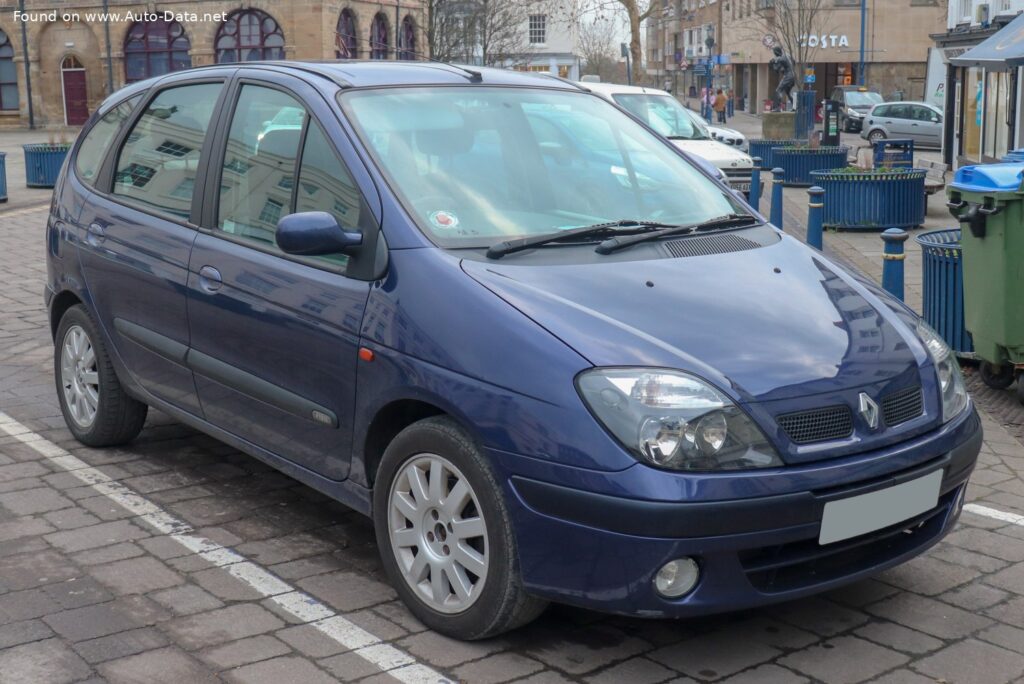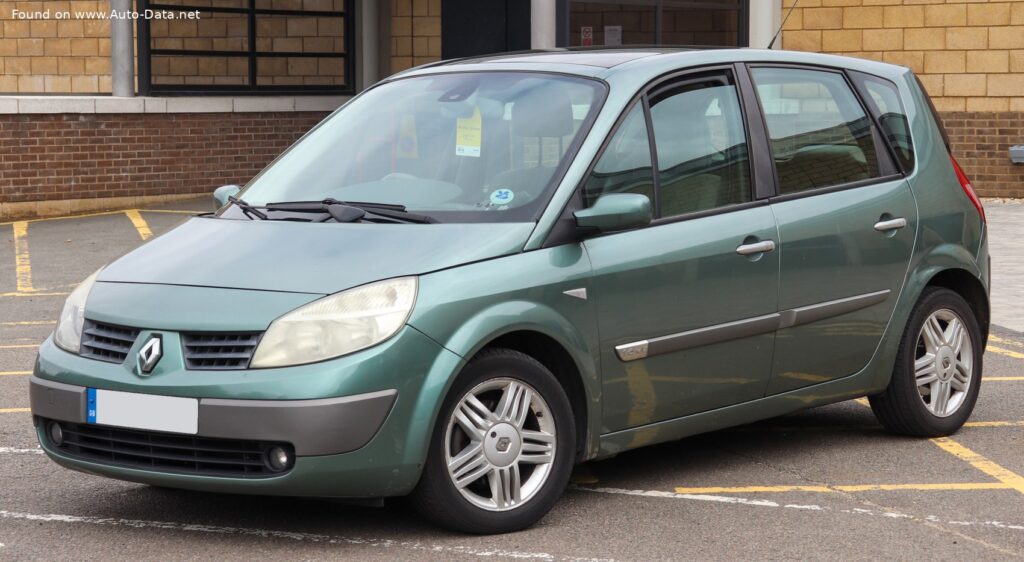
The Renault Scenic II (Phase I) 1.5 dCi, produced between 2003 and 2005, represents a significant evolution in the compact minivan segment. As a successor to the original Scenic, this generation aimed to refine the formula of spaciousness, practicality, and family-focused features. While not initially sold in the United States, the Scenic series has been a popular choice in Europe, known for its innovative design and versatility. The Phase I models, like the 1.5 dCi variant, established the Scenic II as a strong competitor against other European MPVs (Multi-Purpose Vehicles) such as the Citroën Picasso and Opel/Vauxhall Zafira.
Renault Scenic II (Phase I) 1.5 dCi: An Overview
The Scenic II Phase I was designed to appeal to families seeking a comfortable and functional vehicle for everyday use. It offered a five-seat configuration and a flexible interior layout, prioritizing passenger space and cargo capacity. The 1.5 dCi engine option, producing 101 horsepower, was a popular choice for its balance of fuel efficiency and adequate performance. This model was a key part of Renault’s strategy to dominate the European minivan market, offering a modern alternative to traditional station wagons and larger MPVs.
Engine & Performance
The heart of the Scenic II 1.5 dCi is a 1.5-liter inline four-cylinder diesel engine, designated K9K. This engine utilizes a turbocharger with an intercooler and a diesel commonrail fuel injection system to deliver a respectable 101 horsepower at 4000 rpm and 200 Nm (147.51 lb.-ft.) of torque at 1900 rpm. The engine’s power-to-liter ratio is 69.1 hp/l. While not a performance-oriented vehicle, the 1.5 dCi provides sufficient power for everyday driving and highway cruising. Acceleration from 0 to 100 km/h (0-62 mph) takes approximately 14.1 seconds, and 0 to 60 mph is achieved in around 13.4 seconds. The top speed is rated at 172 km/h (106.88 mph). A key selling point of this engine was its fuel economy, achieving approximately 5.1 liters per 100 kilometers (46.1 US mpg or 55.4 UK mpg) in combined driving conditions. CO2 emissions were rated at 135 g/km, meeting Euro 3 emission standards.
Design & Features
The Renault Scenic II Phase I features a distinctive minivan silhouette with a sloping roofline and a relatively short front overhang. The body style is a five-door configuration, providing easy access for passengers. The interior design prioritized practicality and user-friendliness. Key features included a modular seating system allowing for various configurations, ample storage compartments throughout the cabin, and a large trunk space ranging from 430 liters (15.19 cu. ft.) with the rear seats up to 1840 liters (64.98 cu. ft.) with the seats folded down. Safety features for the time included ABS (Anti-lock Braking System) as standard equipment. The vehicle’s dimensions are 4259 mm (167.68 in.) in length, 1810 mm (71.26 in.) in width, and 1620 mm (63.78 in.) in height. The wheelbase measures 2685 mm (105.71 in.). The kerb weight is 1340 kg (2954.19 lbs), with a maximum permissible weight of 1920 kg (4232.88 lbs).
Technical Specifications
| Brand | Renault |
| Model | Scenic |
| Generation | Scenic II (Phase I) |
| Type (Engine) | 1.5 dCi (101 Hp) |
| Start of production | 2003 |
| End of production | 2005 |
| Powertrain Architecture | Internal Combustion engine |
| Body type | Minivan |
| Seats | 5 |
| Doors | 5 |
| Fuel consumption (urban) | 6.3 l/100 km (37.3 US mpg, 44.8 UK mpg, 15.9 km/l) |
| Fuel consumption (extra urban) | 4.5 l/100 km (52.3 US mpg, 62.8 UK mpg, 22.2 km/l) |
| Fuel consumption (combined) | 5.1 l/100 km (46.1 US mpg, 55.4 UK mpg, 19.6 km/l) |
| CO2 emissions | 135 g/km |
| Fuel Type | Diesel |
| Acceleration 0 – 100 km/h | 14.1 sec |
| Acceleration 0 – 62 mph | 14.1 sec |
| Acceleration 0 – 60 mph | 13.4 sec |
| Maximum speed | 172 km/h (106.88 mph) |
| Emission standard | Euro 3 |
| Weight-to-power ratio | 13.3 kg/Hp, 75.4 Hp/tonne |
| Weight-to-torque ratio | 6.7 kg/Nm, 149.3 Nm/tonne |
| Power | 101 Hp @ 4000 rpm |
| Power per litre | 69.1 Hp/l |
| Torque | 200 Nm @ 1900 rpm (147.51 lb.-ft. @ 1900 rpm) |
| Engine layout | Front, Transverse |
| Engine Model/Code | K9K |
| Engine displacement | 1461 cm3 (89.16 cu. in.) |
| Number of cylinders | 4 |
| Engine configuration | Inline |
| Number of valves per cylinder | 2 |
| Fuel injection system | Diesel Commonrail |
| Engine aspiration | Turbocharger, Intercooler |
| Engine oil capacity | 4.5 l (4.76 US qt | 3.96 UK qt) |
| Coolant | 6.5 l (6.87 US qt | 5.72 UK qt) |
| Kerb Weight | 1340 kg (2954.19 lbs.) |
| Max. weight | 1920 kg (4232.88 lbs.) |
| Max load | 580 kg (1278.68 lbs.) |
| Trunk (boot) space – minimum | 430 l (15.19 cu. ft.) |
| Trunk (boot) space – maximum | 1840 l (64.98 cu. ft.) |
| Fuel tank capacity | 60 l (15.85 US gal | 13.2 UK gal) |
| Max. roof load | 80 kg (176.37 lbs.) |
| Permitted trailer load with brakes (12%) | 1300 kg (2866.01 lbs.) |
| Permitted trailer load without brakes | 650 kg (1433 lbs.) |
| Permitted towbar download | 75 kg (165.35 lbs.) |
| Length | 4259 mm (167.68 in.) |
| Width | 1810 mm (71.26 in.) |
| Width including mirrors | 2087 mm (82.17 in.) |
| Height | 1620 mm (63.78 in.) |
| Wheelbase | 2685 mm (105.71 in.) |
| Front track | 1514 mm (59.61 in.) |
| Rear (Back) track | 1514 mm (59.61 in.) |
| Front overhang | 851 mm (33.5 in.) |
| Rear overhang | 723 mm (28.46 in.) |
| Ride height (ground clearance) | 130 mm (5.12 in.) |
| Minimum turning circle (turning diameter) | 10.7 m (35.1 ft.) |
| Drivetrain Architecture | Front wheel drive |
| Number of gears and type of gearbox | 5 gears, manual transmission |
| Front suspension | Independent type McPherson |
| Rear suspension | Elastic beam |
| Front brakes | Ventilated discs, 280 mm |
| Rear brakes | Disc, 270 mm |
| Assisting systems | ABS (Anti-lock braking system) |
| Steering type | Steering rack and pinion |
| Tires size | 195/65 R15; 205/55 R16 |
| Wheel rims size | 15; 16 |
The Renault Scenic II Phase I 1.5 dCi remains a noteworthy vehicle in the history of European compact minivans. Its blend of practicality, fuel efficiency, and innovative features solidified its position as a popular choice for families, and its design influenced subsequent generations of the Scenic model.