The Renault Scenic IV, produced from 2016 to 2020, represents the fourth generation of Renault’s popular compact minivan. This generation marked a significant departure from its predecessors, adopting a more crossover-inspired design and focusing on interior space and technology. The Scenic IV was primarily marketed in Europe, where compact MPVs (Multi-Purpose Vehicles) held a substantial market share. The 1.5 Energy dCi (95 hp) variant, detailed here, was a key engine option, emphasizing fuel efficiency and practicality for everyday use. While not officially sold in the United States, understanding the Scenic IV provides insight into European automotive trends and Renault’s engineering capabilities.
Renault Scenic IV (Phase I) 1.5 Energy dCi (95 Hp)
The Scenic IV Phase I, specifically equipped with the 1.5 Energy dCi engine producing 95 horsepower, was a mainstay of the Renault lineup during its production run (2016-2018). This model aimed to provide a balance between affordability, fuel economy, and family-friendly practicality. It competed with vehicles like the Citroën C4 Picasso, Opel/Vauxhall Zafira, and Ford C-Max in the European market. The Phase I designation refers to the initial iteration of the fourth-generation Scenic, with subsequent updates (Phase II) introducing styling and technology revisions.
Engine & Performance
The heart of this Scenic variant is the 1.5-liter, four-cylinder diesel engine, designated K9K. This engine, a common choice in European Renault models, is a turbocharged common rail diesel, delivering 95 horsepower at 4000 rpm and 240 Nm (177 lb-ft) of torque at 1750 rpm. The turbocharger and intercooler work in tandem to enhance power output and efficiency. The engine’s relatively small displacement and turbocharging contribute to its impressive fuel economy figures. Combined fuel consumption is rated at 3.9 l/100 km (60.3 US mpg or 72.4 UK mpg), with CO2 emissions of 100 g/km, meeting Euro 6b emission standards. Performance is geared towards practicality rather than outright speed, with a 0-100 km/h (0-62 mph) acceleration time of 13.7 seconds and a maximum speed of 175 km/h (108.74 mph). The engine is transversely mounted at the front of the vehicle, driving the front wheels through a six-speed manual transmission.
Design & Features
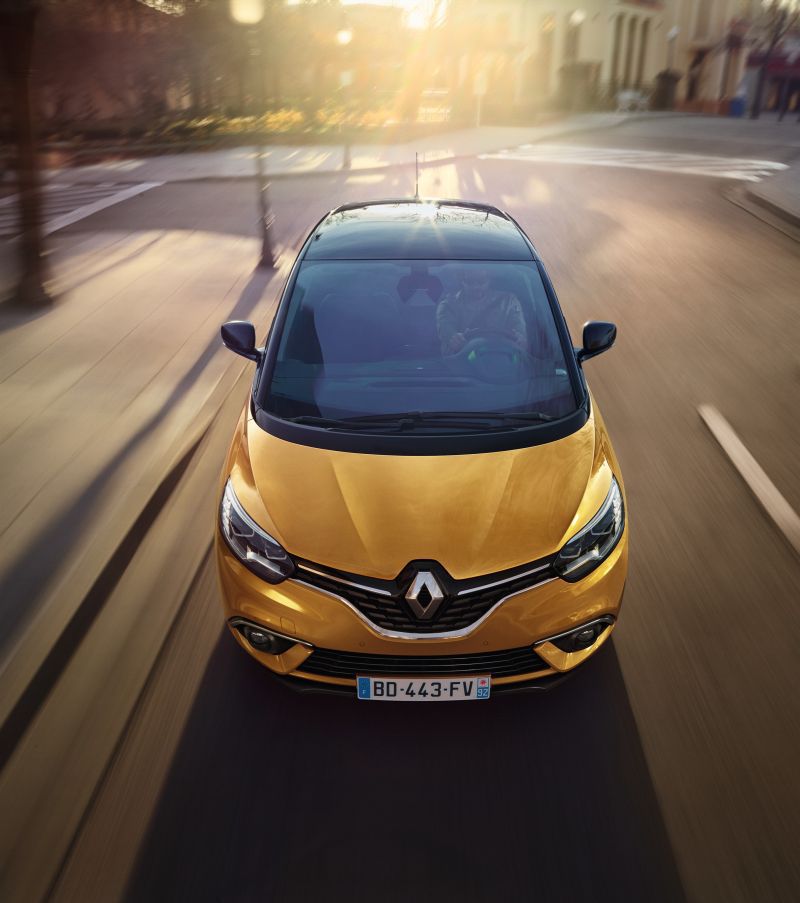
The Renault Scenic IV Phase I adopted a more dynamic and sculpted exterior design compared to previous generations. It features a sloping roofline, pronounced wheel arches, and a distinctive front end with Renault’s signature lighting signature. The body style is a five-door minivan, offering easy access for passengers and cargo. Inside, the Scenic IV prioritizes space and comfort. The rear seats can be folded down or removed entirely, providing a versatile cargo area. The minimum trunk space is 572 liters (20.2 cu ft), expanding significantly with the rear seats folded. Key features of this model include ABS (Anti-lock Braking System), electric power steering, and a comfortable ride thanks to its independent McPherson front suspension and semi-independent coil spring rear suspension. Safety features were a growing priority during this period, and the Scenic IV included multiple airbags and stability control systems. The interior design focused on a modern aesthetic with a central touchscreen infotainment system, though the specific features varied depending on trim level.
Technical Specifications
| Brand | Renault |
| Model | Scenic |
| Generation | Scenic IV (Phase I) |
| Type (Engine) | 1.5 Energy dCi (95 Hp) |
| Start of production | 2016 |
| End of production | September, 2018 |
| Powertrain Architecture | Internal Combustion engine |
| Body type | Minivan |
| Seats | 5 |
| Doors | 5 |
| Fuel consumption (urban) | 4.2 l/100 km (56 US mpg, 67.3 UK mpg, 23.8 km/l) |
| Fuel consumption (extra urban) | 3.7 l/100 km (63.6 US mpg, 76.3 UK mpg, 27 km/l) |
| Fuel consumption (combined) | 3.9 l/100 km (60.3 US mpg, 72.4 UK mpg, 25.6 km/l) |
| CO2 emissions | 100 g/km |
| Fuel Type | Diesel |
| Acceleration 0 – 100 km/h | 13.7 sec |
| Acceleration 0 – 62 mph | 13.7 sec |
| Acceleration 0 – 60 mph | 13 sec |
| Maximum speed | 175 km/h (108.74 mph) |
| Emission standard | Euro 6 b |
| Weight-to-power ratio | 15.1 kg/Hp, 66.4 Hp/tonne |
| Weight-to-torque ratio | 6 kg/Nm, 167.8 Nm/tonne |
| Power | 95 Hp @ 4000 rpm |
| Power per litre | 65 Hp/l |
| Torque | 240 Nm @ 1750 rpm (177.01 lb.-ft. @ 1750 rpm) |
| Engine layout | Front, Transverse |
| Engine Model/Code | K9K |
| Engine displacement | 1461 cm3 (89.16 cu. in.) |
| Number of cylinders | 4 |
| Engine configuration | Inline |
| Cylinder Bore | 76 mm (2.99 in.) |
| Piston Stroke | 80.5 mm (3.17 in.) |
| Number of valves per cylinder | 2 |
| Fuel injection system | Diesel Commonrail |
| Engine aspiration | Turbocharger, Intercooler |
| Engine oil capacity | 4.8 l (5.07 US qt | 4.22 UK qt) |
| Coolant | 6 l (6.34 US qt | 5.28 UK qt) |
| Kerb Weight | 1430 kg (3152.61 lbs.) |
| Max. weight | 1996 kg (4400.43 lbs.) |
| Max load | 566 kg (1247.82 lbs.) |
| Trunk (boot) space – minimum | 572 l (20.2 cu. ft.) |
| Fuel tank capacity | 52 l (13.74 US gal | 11.44 UK gal) |
| Permitted trailer load with brakes (12%) | 1850 kg (4078.55 lbs.) |
| Permitted trailer load without brakes | 750 kg (1653.47 lbs.) |
| Length | 4406 mm (173.46 in.) |
| Width | 1866 mm (73.46 in.) |
| Width including mirrors | 2128 mm (83.78 in.) |
| Height | 1653 mm (65.08 in.) |
| Wheelbase | 2734 mm (107.64 in.) |
| Front track | 1602 mm (63.07 in.) |
| Rear (Back) track | 1596 mm (62.83 in.) |
| Front overhang | 931 mm (36.65 in.) |
| Rear overhang | 741 mm (29.17 in.) |
| Ride height (ground clearance) | 170 mm (6.69 in.) |
| Minimum turning circle (turning diameter) | 11.18 m (36.68 ft.) |
| Drive wheel | Front wheel drive |
| Number of gears and type of gearbox | 6 gears, manual transmission |
| Front suspension | Independent type McPherson |
| Rear suspension | Semi-independent, coil spring |
| Front brakes | Ventilated discs |
| Rear brakes | Disc |
| Tires size | 195/55 R20 95H |
| Wheel rims size | 20 |