
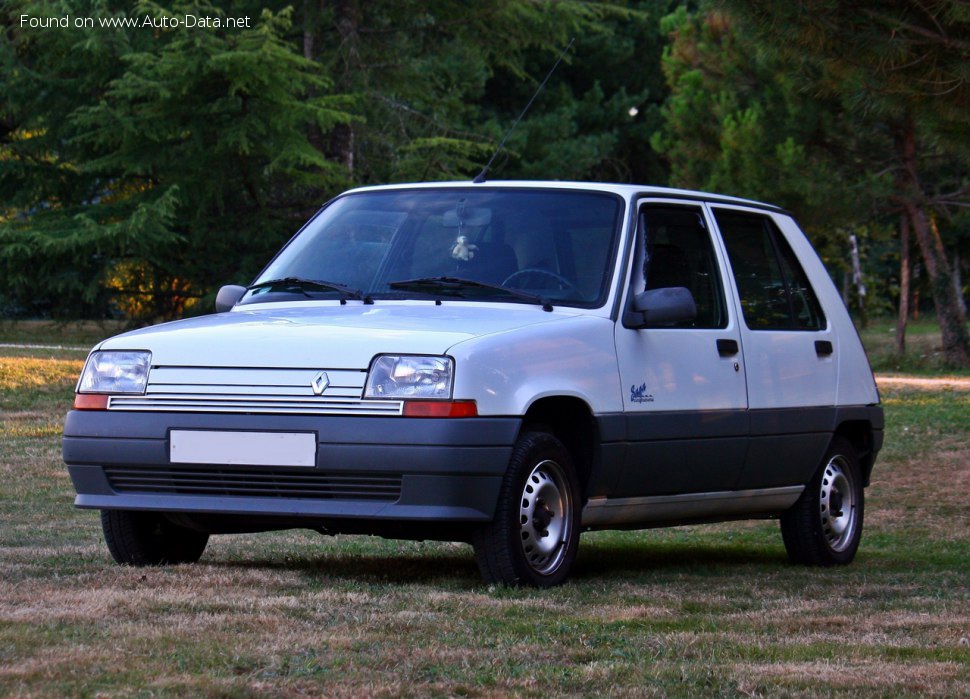
The Renault Super 5 (B/C40) represents a pivotal chapter in the history of European superminis, succeeding the immensely popular original Renault 5. Launched in 1984, this second-generation model, often affectionately known as the “Supercinq” in its native France, was designed to modernize the iconic formula of its predecessor while retaining its core strengths of compact dimensions, urban agility, and surprising interior spaciousness. The variant under scrutiny, the 1.0 (B/C/S400) with 41 horsepower, served as a foundational offering within the Super 5 lineup, catering to a broad segment of European drivers seeking economical and reliable personal transportation. Produced until 1988 in this specific configuration, the Super 5 (B/C40) quickly established itself as a ubiquitous sight on European roads, embodying the pragmatic and innovative spirit of Renault during the mid-to-late 1980s. Its powertrain architecture relied on a conventional internal combustion engine, reinforcing its accessibility and ease of maintenance.
Engine & Performance: The Renault Super 5 (B/C40)’s Enduring Heart
At the core of the Renault Super 5 (B/C40) 1.0 (B/C/S400) lies an engine known for its simplicity and robustness: the C1C, part of Renault’s venerable “Cléon-Fonte” family. This naturally aspirated, four-cylinder gasoline engine delivered a modest but effective 41 horsepower. While 41 Hp might seem humble by modern standards, it was perfectly adequate for the Super 5’s primary mission as an urban commuter and a versatile family car in 1980s Europe. The engine’s design prioritized reliability and fuel efficiency, characteristics highly valued by consumers during an era when fuel costs were a significant consideration. Its naturally aspirated nature meant a straightforward mechanical setup, contributing to lower manufacturing costs and easier maintenance for owners. The 1.0-liter displacement was a common choice for entry-level models across various European manufacturers, striking a balance between adequate power for city driving and minimal running expenses.
The performance profile of the 41 Hp Super 5 was defined by its accessible torque delivery and light curb weight, making it feel sprightly in congested city traffic. Acceleration was not blistering, but it was predictable and smooth, perfectly suited for navigating narrow streets and frequent stop-and-go conditions. On longer journeys, the engine provided sufficient power for cruising at typical European highway speeds, albeit without much in reserve for rapid overtaking maneuvers. The engine’s oil capacity of 3.5 liters (3.7 US quarts) and a coolant capacity of 5.5 liters (5.81 US quarts) were standard for its class, indicating a well-engineered thermal management system designed for durability under various operating conditions. The longevity and widespread availability of the Cléon-Fonte engine family meant that parts and expertise were readily available, further cementing the Super 5’s reputation as a dependable and economical choice for the everyday driver. This mechanical simplicity and resilience are key aspects of its heritage as a classic car, allowing many examples to still be maintained and enjoyed today.
Design & Features: The Practicality of the Renault Super 5 (B/C40)
The design of the Renault Super 5 (B/C40) marked a significant evolution from the original Renault 5, yet it retained its predecessor’s instantly recognizable silhouette. Penned under the direction of Marcello Gandini, the Super 5 adopted a more aerodynamic and contemporary aesthetic, characterized by smoother lines, flush glazing, and a more integrated bumper design. The hatchback body type, a defining feature of the Super 5, offered unparalleled practicality for its compact footprint. With 5 doors and seating for 5 occupants, it was designed to maximize interior space and versatility, a critical attribute for European families and individuals alike. The rear hatchback provided easy access to the cargo area, which could be expanded by folding down the rear seats, transforming the Super 5 into a surprisingly capable load-hauler for its size.
Inside, the Super 5 prioritized functionality and user-friendliness. While luxurious appointments were not the focus of the 1.0-liter entry model, the cabin was thoughtfully laid out with clear instrumentation and ergonomic controls. The emphasis was on durable materials and a design that could withstand the rigors of daily use. For its era, the Super 5 offered reasonable levels of comfort, with supportive seating and good all-around visibility, contributing to an easy and confidence-inspiring driving experience. Safety features, typical for a car of the mid-1980s, primarily focused on passive measures such as a robust body structure and seatbelts. The car’s compact dimensions and light weight also contributed to its agility and ease of parking in crowded urban environments, a crucial factor for its success in European cities. The fuel tank capacity of 43 liters (11.36 US gallons) provided a decent cruising range, further enhancing its practicality for both daily commutes and occasional longer trips, aligning perfectly with its role as a versatile and economical vehicle.
The Renault Super 5 (B/C40) Legacy: An Enduring European Icon
The Renault Super 5 (B/C40) holds a significant place in European automotive history, not just as a successor to a legend, but as a legend in its own right. Its production run from 1984 to 1988 for this specific 1.0-liter variant saw millions of units sold across the continent, solidifying its status as one of Europe’s most beloved and successful superminis. It embodied the French philosophy of creating practical, stylish, and economical cars that resonated deeply with the needs of the average consumer. The Super 5 was more than just transportation; it was a cultural phenomenon, a car that could be seen everywhere from bustling Parisian boulevards to quiet rural lanes, serving as a reliable companion for diverse lifestyles.
Its mechanical impact was substantial, further propagating the robust and easy-to-maintain Cléon-Fonte engine, which powered countless Renault models for decades. This legacy of simplicity and durability contributed significantly to its longevity on the road. The Super 5’s design, while evolutionary, set new standards for aerodynamics and packaging efficiency in its class, influencing subsequent generations of compact cars. It demonstrated that small cars didn’t have to be basic or uninspired; they could be charming, practical, and enjoyable to drive. The Super 5’s success laid the groundwork for future Renault superminis, most notably the Clio, which would eventually replace it and continue Renault’s dominance in the segment. Today, the Renault Super 5 (B/C40) is increasingly recognized as a classic, appreciated for its unpretentious charm, mechanical honesty, and its unmistakable role in shaping the automotive landscape of 1980s Europe. Collectors and enthusiasts seek out well-preserved examples, celebrating its heritage as a quintessential European compact car that perfectly balanced form, function, and affordability.
Technical Specifications: Renault Super 5 (B/C40) 1.0 (B/C/S400) (41 Hp)
| Brand | Renault |
| Model | Super 5 |
| Generation | Super 5 (B/C40) |
| Type (Engine) | 1.0 (B/C/S400) (41 Hp) |
| Start of production | 1984 year |
| End of production | 1988 year |
| Powertrain Architecture | Internal Combustion engine |
| Body type | Hatchback |
| Seats | 5 |
| Doors | 5 |
| Fuel Type | Petrol (Gasoline) |
| Power | 41 Hp |
| Engine Model/Code | C1C |
| Engine aspiration | Naturally aspirated engine |
| Engine oil capacity | 3.5 l (3.7 US qt | 3.08 UK qt) |
| Coolant | 5.5 l (5.81 US qt | 4.84 UK qt) |
| Fuel tank capacity | 43 l (11.36 US gal | 9.46 UK gal) |
