
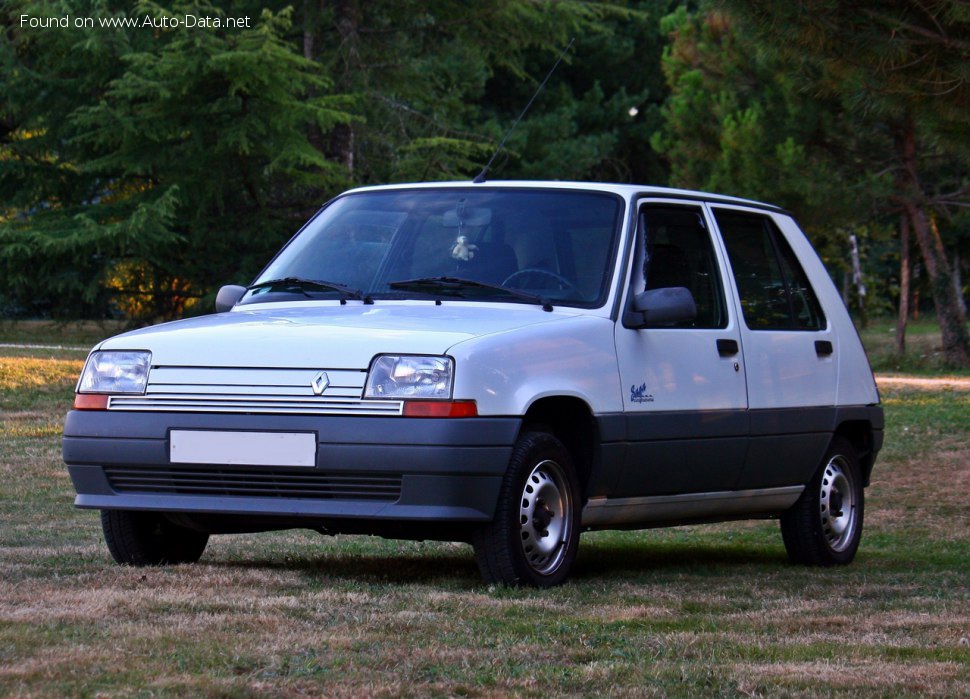
The Renault Super 5, officially designated the B/C40 generation, represents a significant chapter in the history of European automotive design and engineering, succeeding the highly successful original Renault 5. Launched in 1984, the Super 5 was engineered to build upon the legacy of its predecessor, which had become an icon of the supermini segment since its introduction in the early 1970s. This new generation, specifically the 1.4 (B/C402) variant with 59 horsepower, was pivotal in solidifying Renault’s position in the fiercely competitive compact car market across Europe. Produced until 1988, this particular iteration offered a blend of practicality, efficiency, and a distinctly modern aesthetic for its era, catering to a wide array of drivers seeking an economical yet versatile vehicle for urban and suburban environments.
The Evolution of the Renault Super 5: A European Icon
The Renault Super 5, known affectionately as the “Supercinq” in its home market, marked a substantial departure from the original Renault 5 while retaining its core philosophy of a compact, front-wheel-drive hatchback. While the original R5 was revolutionary for its time, the Super 5 aimed to modernize the concept with improved aerodynamics, enhanced interior space, and a more refined driving experience. This generation was designed by Marcello Gandini, renowned for his work with Lamborghini, lending the Super 5 a more contemporary and less quirky appearance than its predecessor. The B/C40 chassis designation signified a completely new platform, sharing few components with the original, emphasizing Renault’s commitment to innovation and progress.
The Super 5’s primary market was Europe, where it competed vigorously against other popular superminis such as the Peugeot 205, Fiat Uno, and Ford Fiesta. Its success was largely attributed to its clever packaging, which maximized interior room within a small footprint, and its reputation for reliability and low running costs. The 1.4 (B/C402) model, in particular, offered a compelling balance for consumers, providing adequate power for daily driving while maintaining excellent fuel economy, a crucial factor in European markets with higher fuel prices. Its role was to be the quintessential everyday car – a reliable commuter, a practical family vehicle for smaller households, and an accessible entry point into car ownership.
Engine and Performance: The 1.4-Liter Heart of the Renault Super 5
At the core of the Renault Super 5 (B/C40) 1.4 (B/C402) was its robust C1J engine, a 1.4-liter naturally aspirated gasoline (petrol) unit. This powertrain architecture, featuring an internal combustion engine, was a staple of compact cars during the 1980s, valued for its simplicity, ease of maintenance, and proven reliability. The engine produced a respectable 59 horsepower, a figure that might seem modest by today’s standards but was entirely competitive and suitable for a lightweight supermini of its time. This output provided sufficient acceleration for city traffic and comfortable cruising on secondary roads, embodying the pragmatic spirit of the Super 5.
The naturally aspirated design meant that the engine relied solely on atmospheric pressure to draw air into its cylinders, without the aid of turbochargers or superchargers. This design choice contributed to the engine’s straightforward nature and consistent power delivery, making it predictable and user-friendly. Fueling the vehicle was standard gasoline, aligning with the prevalent fuel types of the era. The engine’s modest power output also translated into commendable fuel efficiency, a key selling point for budget-conscious buyers. The engine oil capacity was 3.5 liters (3.7 US quarts), while the cooling system required 5.5 liters (5.81 US quarts) of coolant, indicating a well-engineered system designed for durability and consistent thermal management under various operating conditions. These specifications underscore the practical and economical design philosophy that underpinned the entire Renault Super 5 project, ensuring it remained an accessible and cost-effective option for a broad segment of the European populace.
Design and Features: Practicality Meets Mid-80s Style
The design of the Renault Super 5 (B/C40) was a significant step forward from its predecessor, embracing a more modern, angular, yet still friendly aesthetic. As a five-door hatchback, it epitomized practicality, offering easy access to both the front and rear seats, and a versatile cargo area. The five-seat configuration made it an ideal choice for small families or individuals who frequently carried passengers. The hatchback body type itself was a testament to its utilitarian design, allowing for a large opening at the rear for loading and unloading luggage or groceries, making it incredibly adaptable for everyday tasks.
Marcello Gandini’s influence was evident in the Super 5’s smoother lines, flush-fitting glass, and integrated plastic bumpers, which not only improved aerodynamics but also offered better resistance to minor impacts, a valuable feature for urban driving. The interior, while not luxurious, was thoughtfully designed with ergonomics in mind. Controls were intuitive and within easy reach, reflecting the era’s focus on functional simplicity. Features like a clear instrument cluster, manual windows, and a basic radio were standard for its class. Safety features, by 1980s standards, included three-point seatbelts for front occupants and basic crumple zones designed into the chassis to absorb impact energy. The overall design philosophy prioritized maximizing usable space and providing a comfortable, if not opulent, environment for its occupants. Its compact dimensions made it nimble and easy to park in congested European cities, while the relatively airy cabin and good outward visibility contributed to a pleasant driving experience. The Super 5 was a car built for purpose, excelling in its role as an efficient, practical, and dependable mode of transport for millions.
Technical Specifications: Renault Super 5 (B/C40) 1.4 (B/C402) (59 Hp)
| Brand | Renault |
| Model | Super 5 |
| Generation | Super 5 (B/C40) |
| Type (Engine) | 1.4 (B/C402) (59 Hp) |
| Start of production | 1984 year |
| End of production | 1988 year |
| Powertrain Architecture | Internal Combustion engine |
| Body type | Hatchback |
| Seats | 5 |
| Doors | 5 |
| Fuel Type | Petrol (Gasoline) |
| Power | 59 Hp |
| Engine Model/Code | C1J |
| Engine aspiration | Naturally aspirated engine |
| Engine oil capacity | 3.5 l (3.7 US qt | 3.08 UK qt) |
| Coolant | 5.5 l (5.81 US qt | 4.84 UK qt) |
| Fuel tank capacity | 43 l (11.36 US gal | 9.46 UK gal) |
