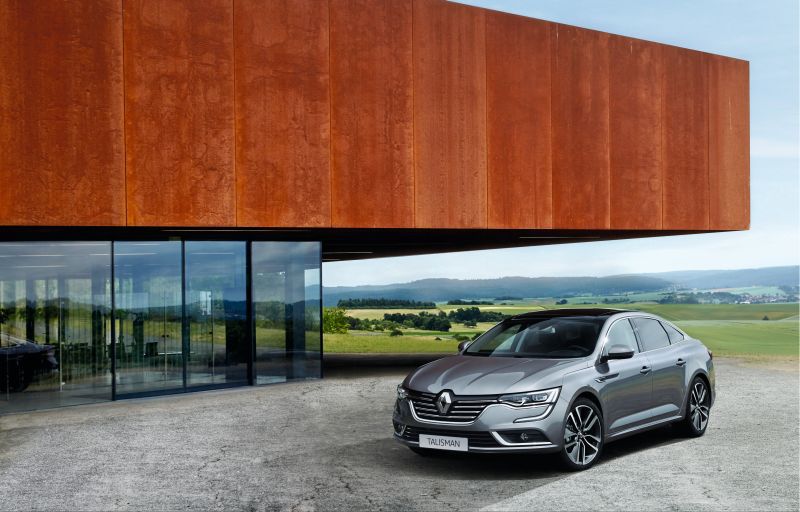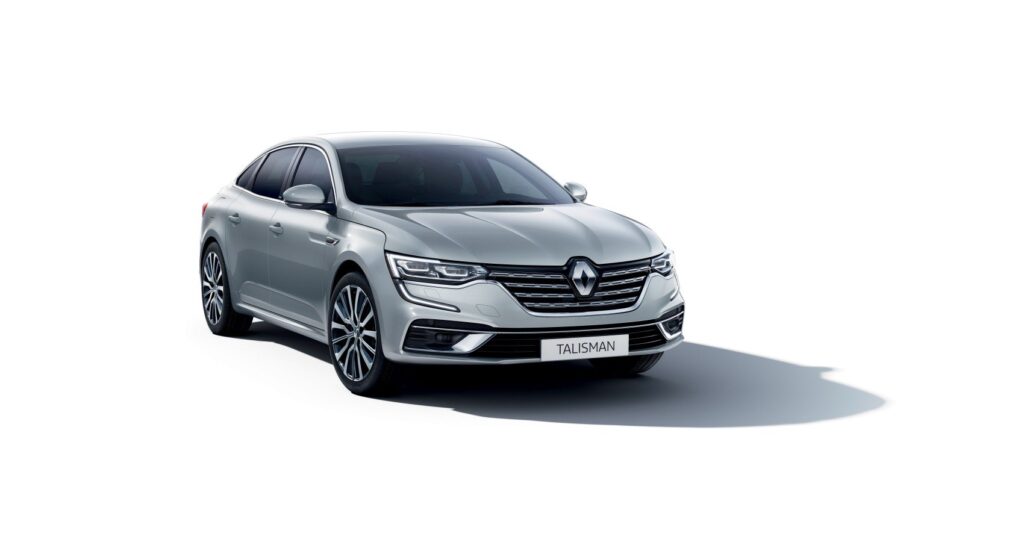
The Renault Talisman, particularly the facelifted 2020 model, represents Renault’s entry into the mid-size sedan segment, a class dominated by vehicles like the Ford Mondeo and Volkswagen Passat in Europe. While not officially sold in the United States, the Talisman was designed to compete with these established players, offering a blend of comfort, technology, and style. The 2020 facelift brought updated styling, enhanced technology, and refined engine options, including the 2.0 Blue dCi diesel engine producing 200 horsepower, paired with a dual-clutch transmission (EDC). This model aimed to provide a premium experience within the mainstream market.
Renault Talisman (Facelift 2020) 2.0 Blue dCi: An Overview
The Talisman was introduced in 2015 as a replacement for both the Renault Laguna and the Renault Latitude, consolidating Renault’s offerings in the D-segment. The 2020 facelift focused on modernizing the vehicle’s appearance and improving its technological features. The 2.0 Blue dCi variant, equipped with the EDC transmission, was positioned as a flagship engine choice, offering a balance of performance and fuel efficiency. The Talisman, throughout its production run, was primarily marketed in Europe, Russia, and select other international markets. It was never offered for sale in North America.
Engine & Performance
The heart of the 2020 Renault Talisman 2.0 Blue dCi is a 1.997-liter inline four-cylinder diesel engine. This engine utilizes a turbocharger and intercooler to generate 200 horsepower at 3500 rpm and 400 Nm (295.02 lb.-ft.) of torque at 1750 rpm. The power output translates to a respectable 0-100 km/h (0-62 mph) acceleration time of 8.8 seconds, and a calculated 0-60 mph time of 8.4 seconds. The engine is paired with a six-speed Efficient Dual Clutch (EDC) automatic transmission, providing smooth and quick gear changes. The Talisman’s diesel engine is designed for efficiency, achieving a combined fuel consumption of 5.6 l/100 km (42 US mpg, 50.4 UK mpg) and CO2 emissions of 146 g/km (WLTP). The engine also incorporates a Start & Stop system and a particulate filter to reduce emissions, meeting Euro 6D Temp standards.
Design & Features
The Renault Talisman (facelift 2020) is a four-door sedan with a sleek and modern design. The exterior features revised front and rear styling, including a larger Renault logo and updated LED lighting signatures. The interior is designed with a focus on comfort and technology, offering a spacious cabin for five passengers. Key features include a vertically oriented touchscreen infotainment system, digital instrument cluster, and a range of driver-assistance systems. Safety features are comprehensive, including ABS, electronic stability control, and multiple airbags. The Talisman boasts a trunk capacity of 608 liters (21.47 cu. ft.), providing ample space for luggage. The vehicle’s dimensions are 4848 mm (190.87 in.) in length, 1869 mm (73.58 in.) in width (including mirrors), and 1463 mm (57.6 in.) in height. The Talisman aimed to provide a more upscale experience than many of its competitors, with a focus on ride quality and interior refinement.
Technical Specifications
| Brand | Renault |
| Model | Talisman |
| Generation | Talisman (facelift 2020) |
| Type (Engine) | 2.0 Blue dCi (200 Hp) EDC |
| Start of production | June, 2020 |
| Powertrain Architecture | Internal Combustion engine |
| Body type | Sedan |
| Seats | 5 |
| Doors | 4 |
| Combined fuel consumption (WLTP) | 5.6 l/100 km |
| Fuel Economy (US mpg) | 42 |
| Fuel Economy (UK mpg) | 50.4 |
| CO2 emissions (WLTP) | 146 g/km |
| Fuel Type | Diesel |
| Acceleration 0 – 100 km/h | 8.8 sec |
| Acceleration 0 – 62 mph | 8.8 sec |
| Acceleration 0 – 60 mph | 8.4 sec |
| Maximum speed | 230 km/h (142.92 mph) |
| Emission standard | Euro 6D Temp |
| Weight-to-power ratio | 8 kg/Hp |
| Weight-to-torque ratio | 4 kg/Nm |
| Power | 200 Hp @ 3500 rpm |
| Power per litre | 100.2 Hp/l |
| Torque | 400 Nm @ 1750 rpm (295.02 lb.-ft. @ 1750 rpm) |
| Engine layout | Front, Transverse |
| Engine Model/Code | M9R |
| Engine displacement | 1997 cm3 (121.86 cu. in.) |
| Number of cylinders | 4 |
| Engine configuration | Inline |
| Number of valves per cylinder | 4 |
| Fuel injection system | Diesel Commonrail |
| Engine aspiration | Turbocharger, Intercooler |
| Engine oil capacity | 7.6 l (8.03 US qt | 6.69 UK qt) |
| Kerb Weight | 1595 kg (3516.37 lbs.) |
| Max. weight | 2197 kg (4843.56 lbs.) |
| Max load | 602 kg (1327.18 lbs.) |
| Trunk (boot) space – minimum | 608 l (21.47 cu. ft.) |
| Fuel tank capacity | 51 l (13.47 US gal | 11.22 UK gal) |
| AdBlue tank | 17 l (4.49 US gal | 3.74 UK gal) |
| Permitted trailer load with brakes (12%) | 1800 kg (3968.32 lbs.) |
| Permitted trailer load without brakes | 750 kg (1653.47 lbs.) |
| Length | 4848 mm (190.87 in.) |
| Width including mirrors | 1869 mm (73.58 in.) |
| Height | 1463 mm (57.6 in.) |
| Wheelbase | 2808 mm (110.55 in.) |
| Front track | 1614 mm (63.54 in.) |
| Rear (Back) track | 1609 mm (63.35 in.) |
| Minimum turning circle (turning diameter) | 11.6 m (38.06 ft.) |
| Drivetrain Architecture | Front wheel drive |
| Number of gears and type of gearbox | 6 gears, automatic transmission EDC |
| Front brakes | Ventilated discs, 320×28 mm |
| Rear brakes | Disc, 290×11 mm |
| Tires size | 225/55 R17 97W; 245/45 R18 100W; 245/40 R19 98Y |
| Wheel rims size | 17; 18; 19 |