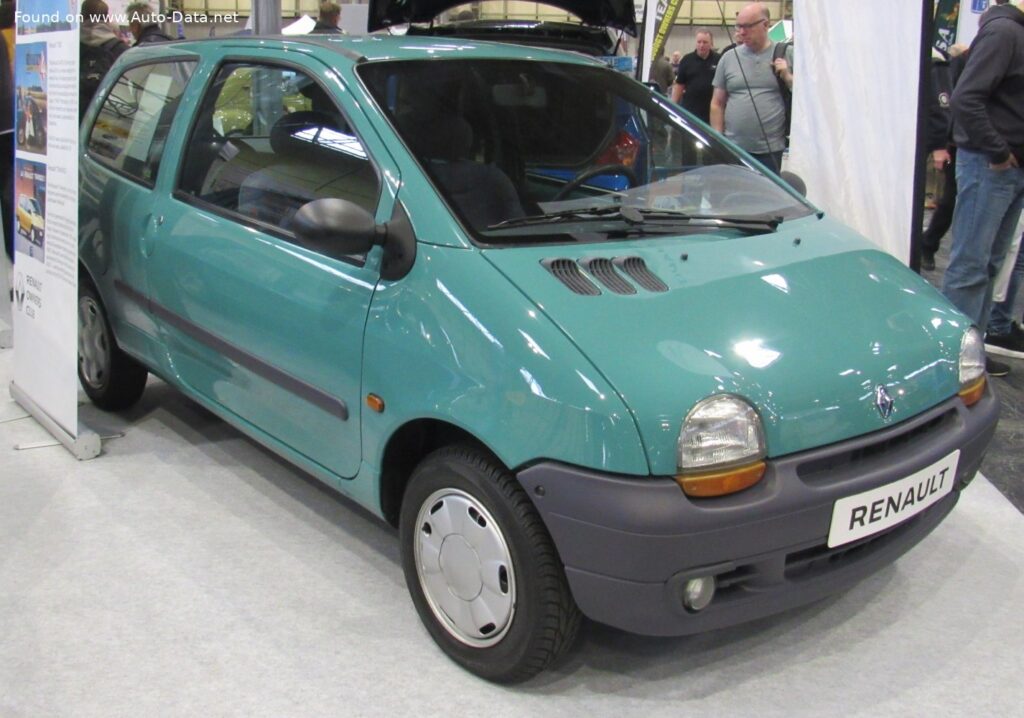
The Renault Twingo I 1.2, produced from 1993 to 1996, represents a significant entry in the European city car segment. Designed as a small, affordable, and practical hatchback, the Twingo aimed to provide a versatile solution for urban transportation. While never officially sold in the United States, the Twingo I was a popular choice in Europe, particularly in France, its home market, and quickly gained a reputation for its nimble handling and efficient engine. It distinguished itself with a distinctive, rounded design and a focus on maximizing interior space within a compact footprint.
Renault Twingo I: A City Car Pioneer
The Twingo I was part of Renault’s strategy to offer a range of vehicles catering to diverse needs. It filled a gap between the smaller Renault 5 and the larger Clio, offering a more modern and spacious alternative to the aging Renault 5. The Twingo’s design was a departure from the boxy shapes common in the early 1990s, embracing a more organic and rounded aesthetic. This approach, combined with its practical features, contributed to its success and established the Twingo as a recognizable and beloved vehicle in Europe.
Engine & Performance
The Renault Twingo I 1.2 is powered by a 1.2-liter inline four-cylinder gasoline engine, designated the C3G. This engine produces 55 horsepower at 5250 rpm and 93 Nm (68.59 lb.-ft.) of torque at 2500 rpm. While not a performance-oriented vehicle, the engine provides adequate power for city driving and short trips. The power-to-weight ratio of 16.2 kg/Hp allows for reasonable acceleration, with a 0-60 mph time of approximately 12.7 seconds and a 0-100 km/h time of 13.4 seconds. The Twingo I achieves a maximum speed of 148 km/h (91.96 mph). Fuel economy is a strong point, with a combined consumption of 6 liters per 100 kilometers (39.2 US mpg, 47.1 UK mpg, 16.7 km/l). The engine features a multi-port manifold fuel injection system and a naturally aspirated configuration, paired with a 5-speed manual transmission and front-wheel drive.
Design & Features
The Renault Twingo I is a three-door hatchback with seating for four passengers. Its compact dimensions – 3433 mm (135.16 in) in length, 1630 mm (64.17 in) in width, and 1423 mm (56.02 in) in height – make it easy to maneuver in congested urban environments. The interior is designed to maximize space, offering a surprisingly roomy cabin for its size. The rear seats can be folded down to increase cargo capacity from a minimum of 168 liters (5.93 cu. ft.) to a maximum of 1096 liters (38.7 cu. ft.). Safety features for the time included an Anti-lock Braking System (ABS), which was becoming increasingly common in European vehicles. The Twingo I features a steering rack and pinion system with hydraulic power steering for ease of handling. The suspension consists of a wishbone setup at the front and a coil spring arrangement at the rear. It rides on 13-inch wheels with 145/70 R13 tires.
Technical Specifications
| Brand | Renault |
| Model | Twingo |
| Generation | Twingo I |
| Type (Engine) | 1.2 (55 Hp) |
| Start of production | 1993 |
| End of production | 1996 |
| Powertrain Architecture | Internal Combustion engine |
| Body type | Hatchback |
| Seats | 4 |
| Doors | 3 |
| Fuel consumption (combined) | 6 l/100 km |
| Fuel consumption (US mpg) | 39.2 US mpg |
| Fuel consumption (UK mpg) | 47.1 UK mpg |
| Fuel consumption (km/l) | 16.7 km/l |
| Fuel Type | Petrol (Gasoline) |
| Acceleration 0 – 100 km/h | 13.4 sec |
| Acceleration 0 – 62 mph | 13.4 sec |
| Acceleration 0 – 60 mph | 12.7 sec |
| Maximum speed | 148 km/h |
| Maximum speed (mph) | 91.96 mph |
| Weight-to-power ratio | 16.2 kg/Hp |
| Weight-to-torque ratio | 9.6 kg/Nm |
| Power | 55 Hp @ 5250 rpm |
| Power per litre | 47.9 Hp/l |
| Torque | 93 Nm @ 2500 rpm |
| Torque (lb.-ft.) | 68.59 lb.-ft. @ 2500 rpm |
| Engine layout | Front, Transverse |
| Engine Model/Code | C3G |
| Engine displacement | 1149 cm3 |
| Engine displacement (cu. in.) | 70.12 cu. in. |
| Number of cylinders | 4 |
| Engine configuration | Inline |
| Cylinder Bore | 69 mm |
| Cylinder Bore (in.) | 2.72 in. |
| Piston Stroke | 76.8 mm |
| Piston Stroke (in.) | 3.02 in. |
| Compression ratio | 9.6:1 |
| Number of valves per cylinder | 2 |
| Fuel injection system | Multi-port manifold injection |
| Engine aspiration | Naturally aspirated engine |
| Valvetrain | OHC |
| Engine oil capacity | 3.5 l |
| Engine oil capacity (US qt) | 3.7 US qt |
| Engine oil capacity (UK qt) | 3.08 UK qt |
| Coolant | 5.5 l |
| Coolant (US qt) | 5.81 US qt |
| Coolant (UK qt) | 4.84 UK qt |
| Kerb Weight | 890 kg |
| Kerb Weight (lbs.) | 1962.11 lbs. |
| Max. weight | 1195 kg |
| Max. weight (lbs.) | 2634.52 lbs. |
| Max load | 305 kg |
| Max load (lbs.) | 672.41 lbs. |
| Trunk (boot) space – minimum | 168 l |
| Trunk (boot) space – minimum (cu. ft.) | 5.93 cu. ft. |
| Trunk (boot) space – maximum | 1096 l |
| Trunk (boot) space – maximum (cu. ft.) | 38.7 cu. ft. |
| Fuel tank capacity | 40 l |
| Fuel tank capacity (US gal) | 10.57 US gal |
| Fuel tank capacity (UK gal) | 8.8 UK gal |
| Length | 3433 mm |
| Length (in.) | 135.16 in. |
| Width | 1630 mm |
| Width (in.) | 64.17 in. |
| Height | 1423 mm |
| Height (in.) | 56.02 in. |
| Wheelbase | 2340 mm |
| Wheelbase (in.) | 92.13 in. |
| Front track | 1416 mm |
| Front track (in.) | 55.75 in. |
| Rear (Back) track | 1374 mm |
| Rear (Back) track (in.) | 54.09 in. |
| Drivetrain Architecture | The Internal combustion engine (ICE) drives the front wheels of the vehicle. |
| Drive wheel | Front wheel drive |
| Number of gears and type of gearbox | 5 gears, manual transmission |
| Front suspension | Wishbone |
| Rear suspension | Coil spring |
| Front brakes | Disc |
| Rear brakes | Drum |
| Assisting systems | ABS (Anti-lock braking system) |
| Steering type | Steering rack and pinion |
| Power steering | Hydraulic Steering |
| Tires size | 145/70 R13 |
| Wheel rims size | 13 |
The Renault Twingo I 1.2, while not a high-performance vehicle, offered a compelling package of affordability, practicality, and distinctive styling. Its success in Europe cemented its place as a significant player in the city car segment and paved the way for subsequent generations of the Twingo.