
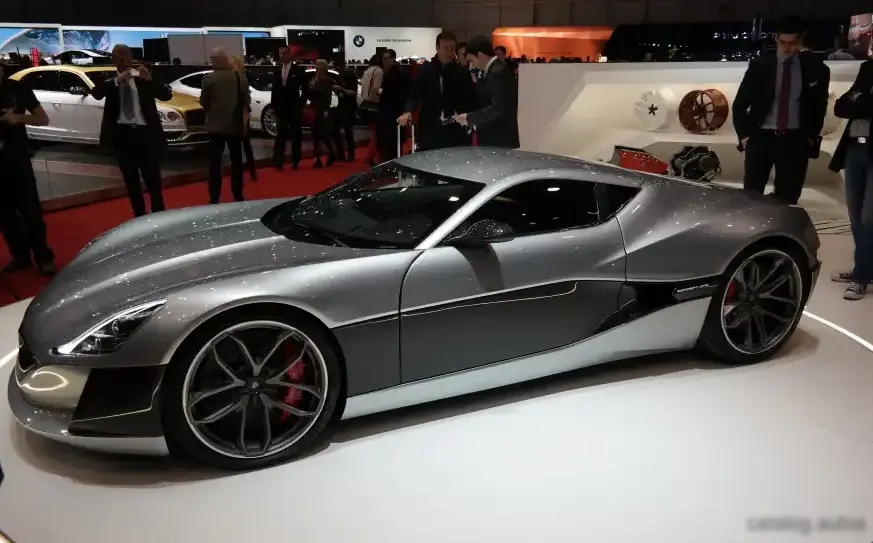
Technical Specifications
| Brand | Rimac |
| Model | One |
| Generation | Concept One |
| Type (Engine) | 90 kWh (1224 Hp) AWD CVT |
| Start of production | 2016 |
| Powertrain Architecture | BEV (Electric Vehicle) |
| Body type | Coupe |
| Seats | 2 |
| Doors | 2 |
| Fuel Type | Electricity |
| Acceleration 0 – 100 km/h | 2.5 sec |
| Acceleration 0 – 62 mph | 2.5 sec |
| Acceleration 0 – 60 mph | 2.4 sec |
| Maximum speed | 355 km/h (220.59 mph) |
| 100 km/h – 0 | 31.5 m |
| Weight-to-power ratio | 1.6 kg/Hp, 644.2 Hp/tonne |
| Gross battery capacity | 90 kWh |
| All-electric range | 350 km (217.48 mi) |
| Electric motor power | 1224 Hp |
| Electric motor Torque | 1600 Nm @ 6500 rpm (1180.1 lb.-ft. @ 6500 rpm) |
| System power | 1224 Hp |
| Kerb Weight | 1900 kg (4188.78 lbs) |
| Length | 4146 mm (163.23 in) |
| Width | 1854 mm (72.99 in) |
| Height | 1070 mm (42.13 in) |
| Wheelbase | 2563 mm (100.91 in) |
| Ride height (ground clearance) | 105-115 mm (4.13 – 4.53 in) |
| Drive wheel | All wheel drive (4×4) |
| Number of gears and type of gearbox | automatic transmission CVT |
| Front suspension | Double wishbone |
| Rear suspension | Double wishbone |
| Front brakes | Ventilated discs |
| Rear brakes | Ventilated discs |
| Assisting systems | ABS (Anti-lock braking system) |
| Steering type | Steering rack and pinion |
| Power steering | Electric Steering |
The Rimac Concept One, specifically the 90 kWh variant producing 1224 horsepower, represents a pivotal moment in the evolution of electric hypercars. Introduced in 2016, it wasn’t merely an attempt to replicate the performance of established gasoline-powered supercars, but to redefine it entirely. The Concept One served as Rimac Automobili’s initial production model, showcasing their in-house developed electric powertrain and advanced vehicle control systems. It established Rimac as a serious contender in the high-performance automotive world, paving the way for their subsequent models like the Nevera. The 90 kWh version was the primary configuration offered, demonstrating the company’s focus on maximizing energy density and performance from the outset.
Powertrain & Engine Architecture
The Rimac Concept One is built around a fully electric powertrain. The core of the system is a 90 kWh lithium-ion battery pack, strategically positioned within the vehicle’s floor to optimize weight distribution and lower the center of gravity. This battery pack powers four independent electric motors – one for each wheel. Each motor generates approximately 306 horsepower, combining for a total system output of 1224 horsepower and a staggering 1600 Nm (1180 lb-ft) of torque. The motors are liquid-cooled and utilize a sophisticated vectoring system, allowing for precise torque distribution to each wheel. This is crucial for maximizing traction and handling performance. The transmission is a single-speed CVT (Continuously Variable Transmission), optimized for the instant torque delivery of electric motors. Unlike traditional CVTs, Rimac’s system is designed to handle the immense power output and provide a responsive driving experience. The battery management system (BMS) is a critical component, constantly monitoring and controlling the battery’s temperature, voltage, and state of charge to ensure optimal performance and longevity.
Driving Characteristics
The driving experience in the Concept One is unlike anything offered by conventional hypercars. The instant torque delivery from the four electric motors results in breathtaking acceleration – 0 to 60 mph in a claimed 2.4 seconds. The all-wheel-drive system, coupled with the torque vectoring, provides exceptional grip and stability, even under hard acceleration. The CVT transmission, while unconventional for a hypercar, contributes to seamless acceleration without traditional gear changes. However, the lack of distinct gear shifts can feel somewhat detached to drivers accustomed to traditional transmissions. The car’s low center of gravity and sophisticated suspension contribute to remarkably flat cornering. Regenerative braking is a key feature, allowing the car to recapture energy during deceleration and extend its range. The level of regeneration can be adjusted, providing drivers with control over the braking feel. Compared to gasoline-powered rivals, the Concept One offers a quieter and more refined driving experience, with minimal engine noise or vibration.
Equipment & Trim Levels
Given the limited production run and bespoke nature of the Concept One, trim levels were not offered in the traditional sense. Each vehicle was largely customized to the buyer’s specifications. However, a standard level of luxury and technology was included. The interior featured premium leather upholstery, carbon fiber trim, and a minimalist dashboard design. A large touchscreen display served as the central control interface for the vehicle’s various systems, including navigation, climate control, and performance monitoring. Standard equipment included advanced driver-assistance systems (ADAS) such as adaptive cruise control and lane keeping assist. Optional extras included bespoke paint finishes, custom interior materials, and upgraded audio systems. The focus was on providing a luxurious and technologically advanced cabin that complemented the car’s extreme performance.
Chassis & Braking
The Concept One utilizes a lightweight carbon fiber monocoque chassis, providing exceptional rigidity and strength. The double-wishbone suspension system, with adjustable dampers, is designed to optimize handling and ride comfort. The car features ventilated disc brakes at all four corners, providing ample stopping power. The ABS (Anti-lock Braking System) is specifically tuned for the car’s weight and performance characteristics. The steering system is a rack and pinion setup with electric power assistance, offering precise and responsive steering feel. The low ride height and wide track contribute to the car’s stability and cornering ability. The weight distribution is carefully balanced, with the battery pack positioned low and centrally to minimize body roll.
Market Reception & Comparison
The Rimac Concept One was met with widespread acclaim from automotive journalists and enthusiasts. Critics praised its groundbreaking performance, advanced technology, and luxurious interior. The car’s ability to accelerate and handle on par with, or even surpass, established hypercars was particularly impressive. However, the high price tag (over $1 million) limited its appeal to a very select clientele. Compared to gasoline-powered rivals like the Bugatti Chiron or Ferrari LaFerrari, the Concept One offered a different driving experience – quieter, smoother, and more technologically advanced. Its all-electric powertrain also offered environmental benefits, although the range was relatively limited compared to modern EVs. Reliability was a concern for some early adopters, as with any new and complex technology, but Rimac addressed these issues through ongoing software updates and hardware improvements.
Legacy
The Rimac Concept One was a watershed moment for the electric vehicle industry. It demonstrated that electric cars could not only be environmentally friendly but also incredibly fast, luxurious, and technologically advanced. The car’s success paved the way for Rimac’s subsequent models, including the Nevera, which further pushed the boundaries of electric hypercar performance. On the used car market, Concept Ones are extremely rare and command high prices, reflecting their historical significance and limited production run. The powertrain, while complex, has proven to be relatively durable with proper maintenance. The Concept One remains a symbol of innovation and a testament to Rimac’s engineering prowess, solidifying its place in automotive history.
