
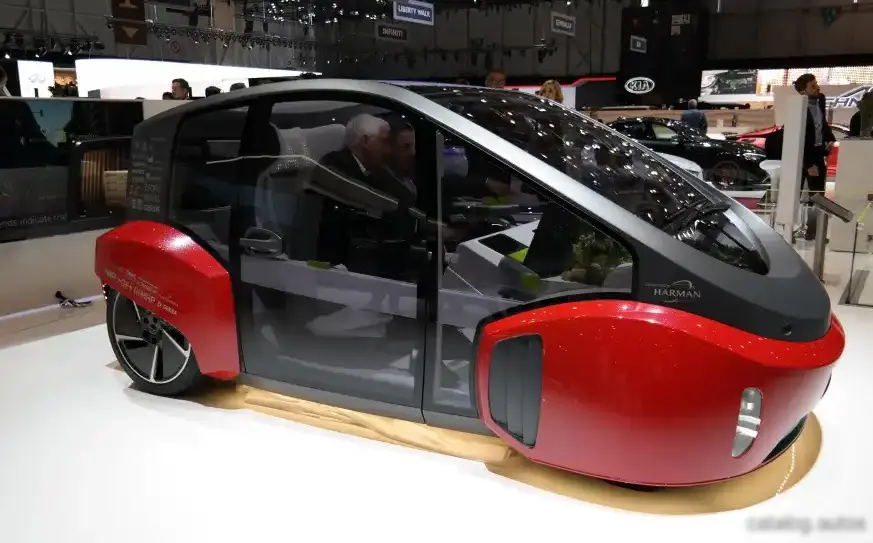
The Rinspeed Oasis Concept, unveiled in 2017, represents a unique vision of future urban mobility. This fully electric, two-seater concept car aimed to blend autonomous driving capabilities with a luxurious and connected experience. The Oasis wasn’t intended for mass production, but rather as a technology demonstrator showcasing Rinspeed’s innovative ideas. It’s built upon a custom chassis and features a distinctive design, most notably its partially open-air cockpit and integration of smart home technology. The 12 kWh (108 Hp) electric variant was the sole powertrain offered, positioning it as a forward-thinking exploration of personal transportation rather than a performance vehicle.
Technical Specifications
| Brand | Rinspeed |
| Model | Oasis |
| Generation | Oasis Concept |
| Type (Engine) | 12 kWh (108 Hp) Electric |
| Start of production | 2017 |
| Powertrain Architecture | BEV (Electric Vehicle) |
| Seats | 2 |
| Doors | 2 |
| Fuel Type | Electricity |
| Acceleration 0 – 100 km/h | 9.7 sec |
| Acceleration 0 – 62 mph | 9.7 sec |
| Acceleration 0 – 60 mph | 9.2 sec |
| Maximum speed | 130 km/h (80.78 mph) |
| Weight-to-power ratio | 10.2 kg/Hp, 98.2 Hp/tonne |
| Gross battery capacity | 12 kWh |
| All-electric range | 100 km (62.14 mi) |
| Electric motor | 1 |
| Electric motor power | 108 Hp |
| Electric motor Torque | 90 Nm (66.38 lb.-ft.) |
| System power | 108 Hp |
| Kerb Weight | 1100 kg (2425.08 lbs.) |
| Length | 3602 mm (141.81 in.) |
| Width | 1917 mm (75.47 in.) |
| Height | 1517 mm (59.72 in.) |
| Wheelbase | 2360 mm (92.91 in.) |
| Drive wheel | Rear wheel drive |
| Number of gears and type of gearbox | 1 gears, automatic transmission |
| Assisting systems | ABS (Anti-lock braking system) |
| Tires size | 155/55 R14; 215/45 R20 |
| Wheel rims size | 5J x 14; 7J x 20 |
Powertrain & Engine Architecture
The Rinspeed Oasis Concept is powered by a single electric motor producing 108 horsepower and 90 Nm (66.38 lb.-ft.) of torque. The vehicle utilizes a 12 kWh battery pack, providing an all-electric range of approximately 100 kilometers (62.14 miles). The powertrain is a fully electric, Battery Electric Vehicle (BEV) configuration, meaning it relies entirely on electricity for propulsion. Details regarding the specific battery chemistry are limited, but it’s likely a lithium-ion based system given the timeframe of the vehicle’s development. The single-speed automatic transmission is a direct-drive system common in electric vehicles, simplifying the drivetrain and maximizing efficiency. The motor is rear-mounted, contributing to a balanced weight distribution. The Oasis was not designed for high-performance acceleration; the focus was on smooth, quiet, and efficient urban transportation.
Driving Characteristics
With 108 horsepower and a relatively lightweight construction of 1100 kg (2425.08 lbs), the Oasis Concept achieves a 0-100 km/h (0-62 mph) time of 9.7 seconds. While not particularly quick, the instant torque delivery characteristic of electric motors provides adequate acceleration for city driving. The single-speed automatic transmission offers seamless power delivery, eliminating the need for gear changes. The rear-wheel-drive configuration contributes to a balanced feel, although the Oasis was primarily intended for autonomous operation. The limited range of 100 km (62.14 miles) suggests the vehicle was designed for short urban commutes rather than long-distance travel. The steering is likely power-assisted, providing ease of maneuverability in tight spaces.
Equipment & Trim Levels
As a concept car, the Rinspeed Oasis wasn’t offered with traditional trim levels. However, it was extensively equipped with advanced technology. The most striking feature is its partially open-air cockpit, achieved through a retractable roof and side windows. The interior is dominated by a large, curved display that serves as the instrument cluster and infotainment system. The Oasis incorporates smart home integration, allowing occupants to control various functions of their home from within the vehicle. Luxury materials, such as leather and wood trim, are used throughout the cabin. The steering wheel is a yoke-style design, further emphasizing the vehicle’s futuristic aesthetic. The seats are designed for comfort and support, and the interior layout prioritizes spaciousness despite the car’s compact dimensions.
Chassis & Braking
The Rinspeed Oasis Concept utilizes a custom-built chassis designed to accommodate the electric powertrain and advanced technology. Suspension details are limited, but it likely employs an independent suspension system to provide a comfortable ride. The braking system features ABS (Anti-lock Braking System) for enhanced safety. Given the vehicle’s weight and performance characteristics, the brakes are likely disc brakes on all four wheels, although this hasn’t been officially confirmed. The tires are a mixed size, with 155/55 R14 tires on the front and 215/45 R20 tires on the rear, suggesting a focus on both efficiency and aesthetics. The rear-wheel-drive layout necessitates a robust rear suspension setup to handle the driving forces.
Market Reception & Comparison
The Rinspeed Oasis Concept wasn’t subject to traditional market reception as it was never intended for production. However, it garnered significant attention at the 2017 Geneva Motor Show for its innovative design and technology. Critics praised its forward-thinking approach to urban mobility and its integration of smart home technology. Compared to other electric vehicles of the time, the Oasis stood out for its unique aesthetic and focus on autonomous driving. Its limited range and lack of practicality were acknowledged, but these were considered acceptable trade-offs for a concept car designed to explore future possibilities. The Oasis wasn’t directly comparable to mainstream electric vehicles like the Tesla Model S or Nissan Leaf, as it occupied a different niche as a technology demonstrator.
Legacy
The Rinspeed Oasis Concept serves as a testament to Rinspeed’s long-standing tradition of creating innovative and thought-provoking concept cars. While the Oasis itself didn’t reach production, many of the technologies it showcased, such as advanced driver-assistance systems and smart home integration, have since become commonplace in modern vehicles. The concept helped to push the boundaries of automotive design and technology, inspiring other manufacturers to explore new possibilities. The 12 kWh electric powertrain, while modest by today’s standards, demonstrated the potential of electric vehicles for urban transportation. The Oasis remains a significant example of early electric vehicle concept design, and its influence can be seen in the development of subsequent electric and autonomous vehicles.
