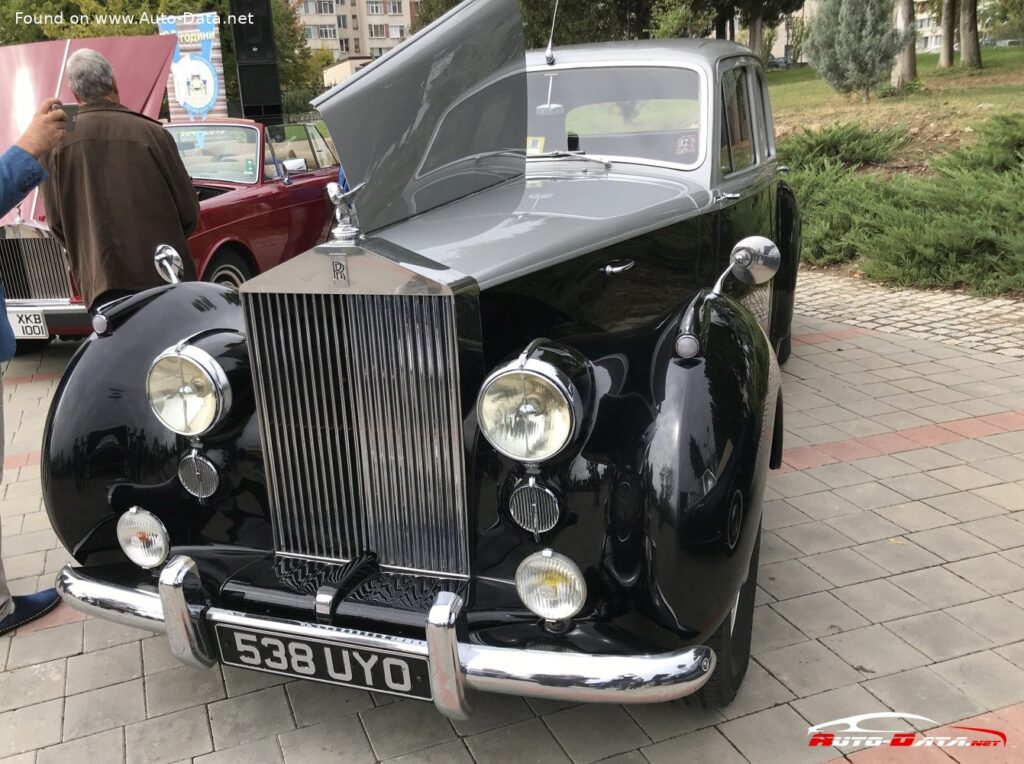
The Rolls-Royce Silver Dawn represents a pivotal moment in the storied history of the British marque. Produced between 1951 and 1955, it was the first post-war Rolls-Royce to be offered with factory-built bodywork, a significant departure from the pre-war tradition of chassis being sold to coachbuilders for bespoke designs. This shift reflected a changing market and a desire to streamline production. The Silver Dawn, positioned firmly in the luxury sedan segment, aimed to provide a refined and comfortable motoring experience for its discerning clientele. It served as a bridge between the pre-war aesthetic and the more modern designs that would characterize Rolls-Royce in the following decades.
Rolls-Royce Silver Dawn 4.6: A Post-War Icon
The Silver Dawn was conceived as a more accessible Rolls-Royce, though “accessible” is a relative term when discussing vehicles of this caliber. While still embodying the hallmarks of Rolls-Royce luxury – a smooth ride, quiet operation, and impeccable craftsmanship – the standardization of the bodywork allowed for increased production efficiency and a lower price point compared to its predecessors. The car was primarily marketed in the United Kingdom and Commonwealth countries, with a limited number exported to the United States. It represented a conscious effort by Rolls-Royce to re-establish itself in the post-war automotive landscape.
Engine & Performance
At the heart of the Silver Dawn lies a 4.6-liter (278.63 cubic inches) inline-six cylinder engine, producing 128 horsepower. While this output may seem modest by modern standards, it was more than adequate for the Silver Dawn’s intended purpose – effortless cruising. The engine, fed by a carburetor, features an overhead valve (OHV) valvetrain and a compression ratio of 6.75:1. Power is delivered to the rear wheels via a four-speed automatic transmission, a relatively advanced feature for the early 1950s. The Silver Dawn’s performance characteristics are geared towards refinement rather than outright speed. Acceleration from 0 to 60 mph takes a leisurely 16.2 seconds, and the car reaches a top speed of approximately 87 mph (140 km/h). Fuel economy is unsurprisingly poor, averaging around 11.6 US mpg (20.2 l/100km). The weight-to-power ratio of 15 kg/Hp reflects the car’s substantial weight and focus on a smooth, rather than rapid, driving experience.
Design & Features
The Silver Dawn’s bodywork, designed in-house by Rolls-Royce, is a classic example of post-war British styling. The sedan body style, accommodating five passengers across two rows of seating, is characterized by graceful lines, a prominent grille, and generous use of chrome trim. The car’s dimensions – a length of 203.46 inches (5168 mm), a width of 70 inches (1778 mm), and a height of 65.75 inches (1670 mm) – reflect its substantial size and presence. Inside, the Silver Dawn offers a luxurious and comfortable cabin, trimmed with high-quality materials such as leather and wood veneer. While lacking the advanced safety features of modern vehicles, the Silver Dawn prioritized passenger comfort and a serene driving experience. Features such as independent coil spring front suspension and leaf spring rear suspension contribute to the car’s renowned ride quality. Drum brakes are employed on all four wheels, providing adequate stopping power for the vehicle’s weight and performance.
Heritage and Mechanical Impact
The Silver Dawn’s significance extends beyond its luxurious appointments. It marked a turning point in Rolls-Royce’s manufacturing process, paving the way for the standardization of bodywork and increased production efficiency. This approach allowed Rolls-Royce to reach a wider audience while maintaining its reputation for quality and exclusivity. The car’s inline-six engine, while not particularly powerful, was known for its reliability and smooth operation. The adoption of an automatic transmission was also a notable advancement, enhancing the Silver Dawn’s ease of driving. The Silver Dawn’s design influenced subsequent Rolls-Royce models, establishing a visual language that would endure for decades. It remains a highly sought-after classic car, prized by collectors for its elegance, craftsmanship, and historical significance.
Technical Specifications
| Brand | Rolls-Royce |
| Model | Silver Dawn |
| Generation | Silver Dawn |
| Type (Engine) | 4.6 (128 Hp) Automatic |
| Start of production | 1951 |
| End of production | 1955 |
| Powertrain Architecture | Internal Combustion engine |
| Body type | Sedan |
| Seats | 5 |
| Doors | 4 |
| Fuel consumption (combined) | 20.2 l/100 km |
| Fuel consumption (US mpg) | 11.6 US mpg |
| Fuel consumption (UK mpg) | 14 UK mpg |
| Fuel consumption (km/l) | 5 km/l |
| Fuel Type | Petrol (Gasoline) |
| Acceleration 0 – 60 mph | 16.2 sec |
| Maximum speed | 140 km/h (86.99 mph) |
| Weight-to-power ratio | 15 kg/Hp |
| Power | 128 Hp |
| Power per litre | 28 Hp/l |
| Engine displacement | 4566 cm3 (278.63 cu. in.) |
| Number of cylinders | 6 |
| Engine configuration | Inline |
| Cylinder Bore | 91.95 mm (3.62 in.) |
| Piston Stroke | 114.3 mm (4.5 in.) |
| Compression ratio | 6.75:1 |
| Number of valves per cylinder | 2 |
| Fuel injection system | Carburettor |
| Engine aspiration | Naturally aspirated engine |
| Valvetrain | OHV |
| Engine oil capacity | 9 l (9.51 US qt | 7.92 UK qt) |
| Coolant | 18 l (19.02 US qt | 15.84 UK qt) |
| Kerb Weight | 1914 kg (4219.65 lbs.) |
| Fuel tank capacity | 82 l (21.66 US gal | 18.04 UK gal) |
| Length | 5168 mm (203.46 in.) |
| Width | 1778 mm (70 in.) |
| Height | 1670 mm (65.75 in.) |
| Wheelbase | 3048 mm (120 in.) |
| Front track | 1435 mm (56.5 in.) |
| Rear track | 1485 mm (58.46 in.) |
| Ride height (ground clearance) | 191 mm (7.52 in.) |
| Minimum turning circle | 12.5 m (41.01 ft.) |
| Drivetrain Architecture | Rear wheel drive |
| Drive wheel | Rear wheel drive |
| Number of gears and type of gearbox | 4 gears, automatic transmission |
| Front suspension | Independent coil spring |
| Rear suspension | Leaf spring |
| Front brakes | Drum |
| Rear brakes | Drum |
| Steering type | Cone worm with recirculation balls |
| Tires size | Front wheel tires: 215/75 R16 Rear wheel tires: 215/75 R16 |
| Wheel rims size | 6.5J x 16 |