
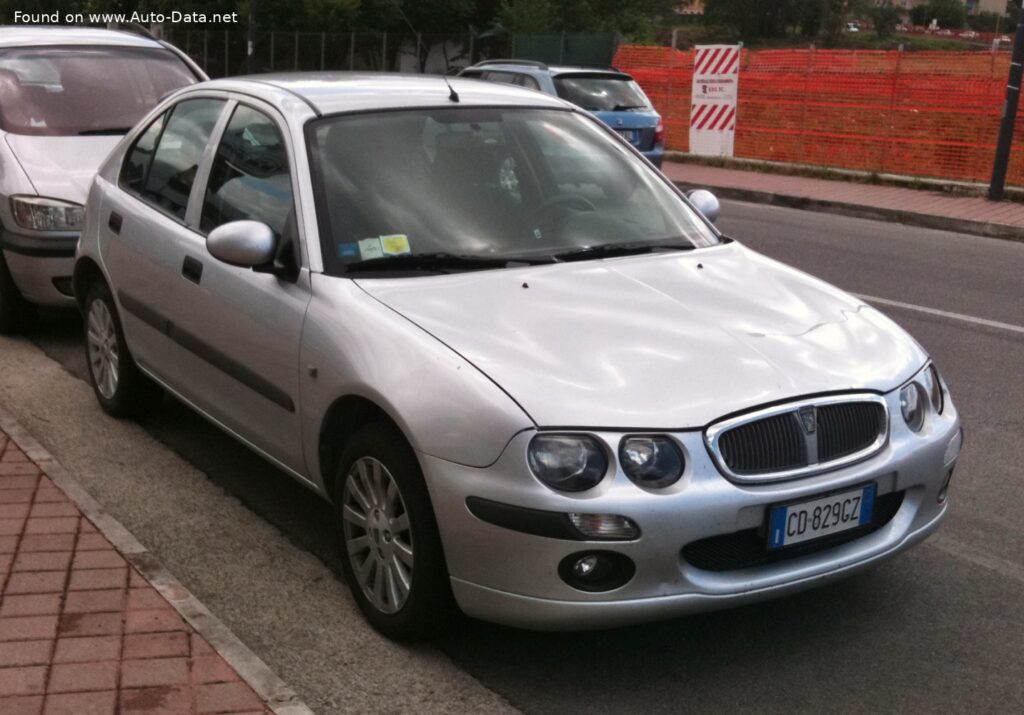
The Rover 25, internally designated RF, represents a significant chapter in the history of the British automotive manufacturer, Rover Group. Introduced in 1999, it served as a heavily revised and rebadged version of the popular Rover 200 (R3) series, aiming to refresh the brand’s presence in the highly competitive European compact car segment. Positioned as a practical and affordable hatchback, the Rover 25 sought to combine traditional British styling cues with modern driving dynamics. Its production spanned from 1999 until the unfortunate demise of the MG Rover Group in 2005. The specific variant under review, the Rover 25 (RF) 1.4 i 16V (84 Hp), was a core offering, providing a balance of economy and adequate performance for its target market, primarily in the United Kingdom and continental Europe. While never officially sold in the United States, the Rover 25 played a crucial role in maintaining Rover’s market share in its home territories during a challenging period for the company.
Powertrain & Engine Architecture
At the heart of the Rover 25 (RF) 1.4 i 16V (84 Hp) lies Rover’s venerable K-Series engine, a 1.4-liter (1396 cm³ or 85.19 cu. in.) naturally aspirated inline-four unit. This engine, known for its compact design and lively character, featured a Double Overhead Camshaft (DOHC) valvetrain with four valves per cylinder, totaling 16 valves. It employed a multi-port manifold fuel injection system and a compression ratio of 10:1, contributing to its efficiency and responsiveness. The K-Series engine, in its various iterations, was a mainstay of Rover’s lineup for many years, prized for its relatively lightweight construction and potential for performance upgrades.
The 1.4-liter variant utilized a Bosch Motronic engine control unit (ECU) to manage fuel delivery and ignition timing. The fuel injection system was a sequential multi-point injection, ensuring precise fuel metering for optimal combustion. The valvetrain employed hydraulic lifters, reducing the need for frequent valve adjustments. The engine’s block was constructed from cast iron, providing durability, while the cylinder head was made from aluminum alloy, contributing to weight savings. This specific engine was paired with a Jatco automatic transmission, a 4-speed unit known for its smooth operation and reliability. This transmission was a common choice for Rover during this period, offering a comfortable driving experience, particularly in urban environments.
Driving Characteristics
The Rover 25 (RF) 1.4 i 16V (84 Hp) with the automatic transmission offered a comfortable, if not particularly exhilarating, driving experience. The 84 horsepower output, while adequate for everyday driving, meant that acceleration was modest. The 0 to 60 mph sprint took approximately 11.2 seconds, and the car had a top speed of around 108.74 mph. Compared to the 1.8-liter versions, the 1.4-liter felt noticeably less powerful, especially when fully loaded or tackling steep inclines. The automatic transmission, while smooth, contributed to this feeling, as it lacked the direct engagement and responsiveness of a manual gearbox.
The gear ratios of the Jatco 4-speed automatic were optimized for fuel efficiency and comfortable cruising rather than outright performance. First gear provided adequate launch power, but subsequent gears were spaced to prioritize economy. The transmission featured a conventional torque converter, which provided smooth take-offs but also introduced some energy loss. The overall driving experience was best suited for urban commuting and relaxed highway driving. The car’s relatively light weight (2392.02 lbs) helped to mitigate the lack of power, making it feel reasonably nimble in city traffic.
Equipment & Trim Levels
The Rover 25 (RF) 1.4 i 16V (84 Hp) typically came equipped as standard with features considered essential for its target market. These included power steering, central locking, electric front windows, and an adjustable steering column. Interior upholstery was typically cloth, with a range of colors available. The dashboard featured a simple, functional design with easy-to-read gauges. Optional extras included air conditioning, alloy wheels, a CD player, and upgraded interior trim. Higher trim levels, such as the ‘Style’ or ‘Impress’ variants, added features like body-colored bumpers, upgraded seat fabrics, and additional convenience items.
The Rover 25 offered a reasonable level of practicality for a compact hatchback. The rear seats could be folded down to increase cargo space, and there were numerous storage compartments throughout the cabin. Safety features included a driver’s airbag and Anti-lock Braking System (ABS) as standard equipment. The car’s interior was designed to be comfortable and user-friendly, with a focus on providing a pleasant driving environment.
Chassis & Braking
The Rover 25 (RF) utilized a MacPherson strut front suspension with an anti-roll bar, providing a comfortable ride and predictable handling. The rear suspension employed a trailing arm setup, which was relatively simple but effective. The suspension was tuned to prioritize ride comfort over sporty handling, making it well-suited for everyday driving. The car’s steering was hydraulic power-assisted, providing a light and responsive feel. Braking was handled by ventilated discs at the front and drum brakes at the rear. The ABS system helped to prevent wheel lock-up during emergency braking, enhancing safety.
The chassis was relatively lightweight, contributing to the car’s agility. The front and rear tracks were 57.99 inches and 57.72 inches respectively, providing a stable platform. The car rode on 175/65 R14 T tires, which offered a good balance of grip and ride comfort. The braking system was adequate for the car’s weight and performance, but it lacked the stopping power of more modern braking systems.
Market Reception & Comparison
Critics generally viewed the Rover 25 (RF) 1.4 i 16V (84 Hp) as a competent, if unremarkable, compact hatchback. It was praised for its comfortable ride, user-friendly interior, and competitive price. However, it was also criticized for its lack of performance, dated design, and the potential reliability issues associated with the K-Series engine. Compared to the 1.8-liter versions, the 1.4-liter offered better fuel economy but significantly less power. The 1.8-liter was considered a more engaging and versatile option, but it came at a higher price.
Fuel economy was a strong point for the 1.4-liter variant, with a combined fuel consumption of 36.8 US mpg. This made it an attractive option for budget-conscious buyers. However, the 1.4-liter’s reliability was a concern, as the K-Series engine was prone to head gasket failure, particularly if not properly maintained. Despite these issues, the Rover 25 remained a popular choice in the UK and Europe, offering a blend of affordability, practicality, and British charm.
Technical Specifications
| General Information | |
| Brand | Rover |
| Model | 25 |
| Generation | 25 (RF) |
| Type (Engine) | 1.4 i 16V (84 Hp) |
| Start of Production | 1999 year |
| End of Production | 2005 year |
| Powertrain Architecture | Internal Combustion engine |
| Body type | Hatchback |
| Seats | 5 |
| Doors | 3-5 |
| Performance Specs | |
| Fuel Consumption (Economy) – Urban | 8.8 l/100 km (26.7 US mpg) |
| Fuel Consumption (Economy) – Extra Urban | 5.3 l/100 km (44.4 US mpg) |
| Fuel Consumption (Economy) – Combined | 6.4 l/100 km (36.8 US mpg) |
| Fuel Type | Petrol (Gasoline) |
| Acceleration 0 – 60 mph | 11.2 sec |
| Acceleration 0 – 100 km/h | 11.8 sec |
| Maximum Speed | 175 km/h (108.74 mph) |
| Weight-to-Power Ratio | 12.9 kg/Hp (77.4 Hp/tonne) |
| Weight-to-Torque Ratio | 9.9 kg/Nm (101.4 Nm/tonne) |
| Engine Specs | |
| Power | 84 Hp @ 6000 rpm |
| Power per Liter | 60.2 Hp/l |
| Torque | 110 Nm (81.13 lb-ft) @ 4500 rpm |
| Engine Layout | Front, Transverse |
| Engine Model/Code | K |
| Engine Displacement | 1396 cm³ (85.19 cu. in.) |
| Number of Cylinders | 4 |
| Engine Configuration | Inline |
| Cylinder Bore | 75 mm (2.95 in.) |
| Piston Stroke | 79 mm (3.11 in.) |
| Compression Ratio | 10:1 |
| Number of Valves per Cylinder | 4 |
| Fuel Injection System | Multi-port manifold injection |
| Engine Aspiration | Naturally aspirated engine |
| Valvetrain | DOHC |
| Engine Oil Capacity | 5 l (5.28 US qt) |
| Coolant Capacity | 5.3 l (5.6 US qt) |
| Space, Volume and Weights | |
| Kerb Weight | 1085 kg (2392.02 lbs) |
| Max. Weight | 1500 kg (3306.93 lbs) |
| Max Load | 415 kg (914.92 lbs) |
| Trunk (Boot) Space – Minimum | 304 l (10.74 cu. ft.) |
| Trunk (Boot) Space – Maximum | 1086 l (38.35 cu. ft.) |
| Fuel Tank Capacity | 50 l (13.21 US gal) |
| Dimensions | |
| Length | 3990 mm (157.09 in.) |
| Width | 1688 mm (66.46 in.) |
| Height | 1417 mm (55.79 in.) |
| Wheelbase | 2500 mm (98.43 in.) |
| Front Track | 1473 mm (57.99 in.) |
| Rear Track | 1466 mm (57.72 in.) |
| Drivetrain, Brakes and Suspension Specs | |
| Drivetrain Architecture | The Internal combustion engine (ICE) drives the front wheels of the vehicle. |
| Drive Wheel | Front wheel drive |
| Number of Gears and Type of Gearbox | 5 gears, manual transmission |
| Front Suspension | Wishbone |
| Rear Suspension | Spring Strut |
| Front Brakes | Ventilated discs |
| Rear Brakes | Drum |
| Assisting Systems | ABS (Anti-lock braking system) |
| Steering Type | Steering rack and pinion |
| Power Steering | Hydraulic Steering |
| Tires Size | 175/65 R14 T |
Legacy
The Rover 25, particularly the Rover 25 (RF) 1.4 i 16V (84 Hp) variant, holds a unique place in automotive history as one of the final models produced under the original Rover Group before its collapse. It represented a valiant effort to keep the brand competitive in the compact segment, leveraging an existing, proven platform (the Rover 200) with updated styling and features. Despite its facelift, the underlying architecture dated back to the mid-1990s, which meant it faced stiff competition from newer, more technologically advanced rivals.
Today, the Rover 25 is largely a budget-friendly used car in the UK and parts of Europe, appreciated by enthusiasts for its classic British design cues and comfortable driving experience, particularly when well-maintained. The 1.4-liter automatic variant, while not the most powerful, offers a particularly smooth and relaxed driving experience. However, potential buyers should be aware of the K-Series engine’s susceptibility to head gasket failure and ensure that the car has been properly maintained. It stands as a testament to Rover’s resilience and design capabilities, even as the company navigated increasingly turbulent waters in its final years. While not a global powerhouse, the Rover 25 (RF) 1.4 i 16V (84 Hp) remains a recognizable and fondly remembered vehicle in the annals of British automotive production.
