
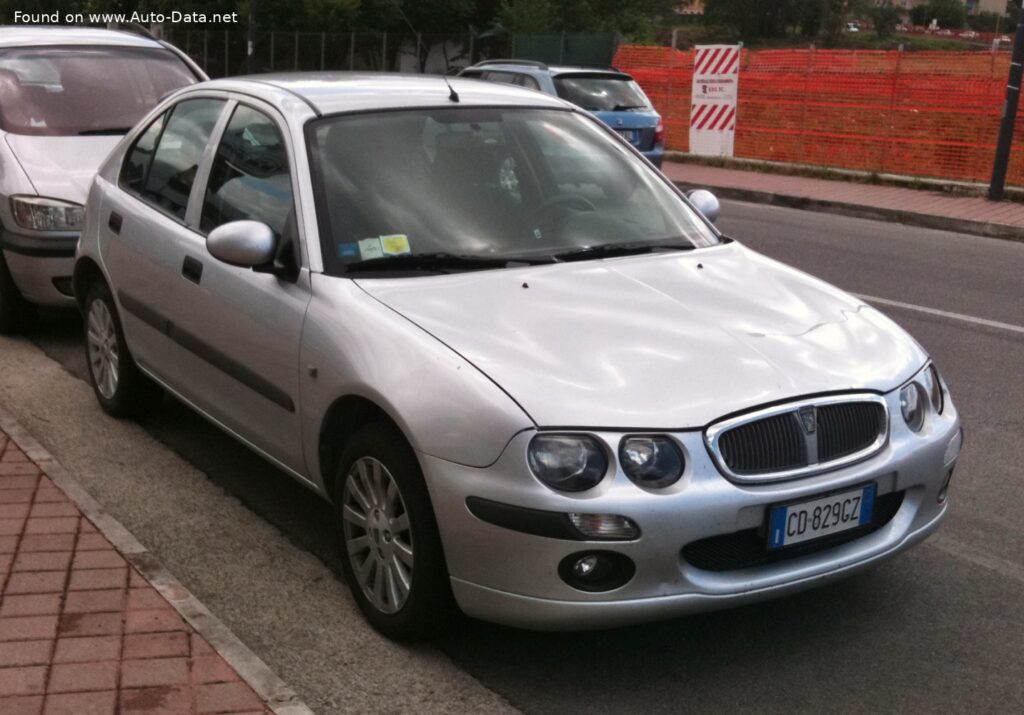
The Rover 25, designated internally as the RF generation, emerged in 1999 as a significant evolution of the popular Rover 200 (R3) model. Positioned firmly within Europe’s highly competitive supermini and compact car segments, the 25 aimed to blend traditional British motoring charm with contemporary performance and practicality. While never officially sold in the United States, the Rover 25 played a crucial role in the European market, particularly in its home country, the United Kingdom, where it was a familiar sight on roads for over half a decade. This particular variant, the Rover 25 (RF) 1.8 i 16V (145 Hp), represented a step up from the base models, offering a compelling blend of lively performance and everyday usability, while remaining distinct from the more extreme performance of the MG ZR hot hatch derivative. Its introduction marked Rover’s concerted effort to appeal to a younger, more dynamic audience while retaining its established customer base.
Rover 25 (RF) 1.8 i 16V (145 Hp): Overview and Positioning
Produced from 1999 until Rover’s cessation of operations in 2005, the 25 series was a front-wheel-drive, internal combustion engine vehicle available in both three-door and five-door hatchback configurations. The 1.8 i 16V (145 Hp) model occupied a mid-range position within the Rover 25 lineup. Below it were the 1.4-liter variants, geared towards economy and affordability. Above it were the higher-specification trims and the performance-focused MG ZR models. The 1.8 i 16V aimed to strike a balance between cost, performance, and equipment, making it a popular choice for drivers seeking a more engaging driving experience without the higher price tag of the MG ZR. It was designed to appeal to those who wanted a sporty feel but still prioritized practicality and comfort.
Powertrain & Engine Architecture
At the core of the Rover 25 (RF) 1.8 i 16V (145 Hp) was Rover’s renowned K18 VVC engine. This naturally aspirated, 1.8-liter (1795 cm³ or 109.54 cu. in.) inline four-cylinder engine was a marvel of its time, especially for a compact car. Utilizing a DOHC (Dual Overhead Camshaft) valvetrain with four valves per cylinder, the engine’s standout feature was its Variable Valve Control (VVC) system. This innovative technology, developed by Rover, allowed for continuous adjustment of valve timing, optimizing both power output and fuel efficiency across the rev range. The VVC system operated by altering the camshaft profile based on engine speed and load, effectively providing a variable valve lift and duration. This resulted in improved low-end torque and high-end power.
The engine employed multi-port fuel injection, delivering fuel directly into the intake ports. The K18 VVC produced an impressive 145 horsepower at a high 6750 rpm, translating to a specific output of 80.8 horsepower per liter – a commendable figure for a non-turbocharged engine. Torque delivery was equally respectable, peaking at 128.34 lb.-ft. (174 Nm) at 4000 rpm, ensuring a broad powerband suitable for both enthusiastic driving and daily commuting. Power was channeled to the front wheels via a five-speed manual transmission, which was the most common configuration for this variant. A Jatco-sourced four-speed automatic transmission was also available, though it was less popular due to its impact on performance and fuel economy.
Driving Characteristics
The Rover 25 (RF) 1.8 i 16V (145 Hp) offered a surprisingly engaging driving experience. The K18 VVC engine was eager to rev, and the VVC system provided a noticeable boost in power at higher engine speeds. The five-speed manual transmission was slick-shifting and well-matched to the engine’s powerband. The car felt nimble and responsive, thanks to its relatively light weight and well-tuned suspension. Compared to the lower-powered 1.4-liter models, the 1.8 i 16V offered significantly more punch, making overtaking and merging onto highways much easier. However, it didn’t possess the outright performance of the MG ZR, which featured a more heavily tuned engine and sportier suspension. The automatic transmission, while offering convenience, noticeably dulled the driving experience, resulting in slower acceleration and reduced fuel economy. Gear ratios were optimized for a balance of acceleration and cruising efficiency.
Equipment & Trim Levels
The Rover 25 (RF) 1.8 i 16V (145 Hp) typically came equipped with a reasonable level of standard features. These included power steering, power windows, central locking, and an RDS stereo system. Interior upholstery was typically cloth, with options for upgraded materials and colors. Higher trim levels offered features such as alloy wheels, air conditioning, electric sunroof, and upgraded audio systems. The dashboard layout was functional and straightforward, with a clear instrument cluster and easy-to-use controls. Optional extras included leather upholstery, heated front seats, and a trip computer. The 1.8 i 16V often served as a base for adding these optional extras, allowing buyers to customize their vehicle to their preferences.
Chassis & Braking
The Rover 25 (RF) utilized a front-wheel-drive chassis with independent suspension at the front (MacPherson strut) and a torsion beam rear suspension. This setup provided a good balance of ride comfort and handling. The car rode on 205/45 R16 tires, providing adequate grip for most driving conditions. Braking was handled by ventilated discs at the front and drum brakes at the rear. While the front discs provided good stopping power, the rear drums were a cost-saving measure that limited overall braking performance. Anti-lock Braking System (ABS) was standard on the 1.8 i 16V, enhancing driver control during emergency braking. The steering was hydraulic power-assisted, offering precise and communicative feedback.
Market Reception & Comparison
Critics generally viewed the Rover 25 (RF) 1.8 i 16V (145 Hp) favorably, praising its lively engine, comfortable ride, and relatively upmarket interior. It was often seen as a more refined and characterful alternative to its mainstream competitors. Fuel economy was considered reasonable for its class, with combined figures around 31.4 US mpg (7.5 l/100 km). However, some critics noted the car’s somewhat dated design and the potential for reliability issues with the K-Series engine, particularly regarding head gasket failure. Compared to the 1.4-liter models, the 1.8 i 16V offered a significant performance upgrade, but at a higher price point. Compared to the MG ZR, it lacked the same level of sporting prowess but offered a more comfortable and practical driving experience. The automatic transmission version suffered from lower fuel economy and reduced performance compared to the manual.
Technical Specifications: Rover 25 (RF) 1.8 i 16V (145 Hp)
| General Information | |
| Brand | Rover |
| Model | 25 |
| Generation | 25 (RF) |
| Type (Engine) | 1.8 i 16V (145 Hp) |
| Start of Production | 1999 year |
| End of Production | 2005 year |
| Powertrain Architecture | Internal Combustion engine |
| Body type | Hatchback |
| Seats | 5 |
| Doors | 3-5 |
| Performance Specifications | |
| Fuel Consumption (Economy) – Urban | 10.4 l/100 km (22.6 US mpg) |
| Fuel Consumption (Economy) – Extra Urban | 5.8 l/100 km (40.6 US mpg) |
| Fuel Consumption (Economy) – Combined | 7.5 l/100 km (31.4 US mpg) |
| Fuel Type | Petrol (Gasoline) |
| Acceleration 0 – 60 mph | 7.4 sec |
| Acceleration 0 – 62 mph (0 – 100 km/h) | 7.8 sec |
| Maximum Speed | 124.27 mph (200 km/h) |
| Weight-to-Power Ratio | 7.5 kg/Hp (133 Hp/tonne) |
| Weight-to-Torque Ratio | 6.3 kg/Nm (159.6 Nm/tonne) |
| Engine Specifications | |
| Power | 145 Hp @ 6750 rpm |
| Power per Litre | 80.8 Hp/l |
| Torque | 174 Nm @ 4000 rpm (128.34 lb.-ft. @ 4000 rpm) |
| Engine Layout | Front, Transverse |
| Engine Model/Code | K18 VVC |
| Engine Displacement | 1795 cm³ (109.54 cu. in.) |
| Number of Cylinders | 4 |
| Engine Configuration | Inline |
| Cylinder Bore | 80 mm (3.15 in.) |
| Piston Stroke | 89.3 mm (3.52 in.) |
| Compression Ratio | 10.5:1 |
| Number of Valves per Cylinder | 4 |
| Fuel Injection System | Multi-port manifold injection |
| Engine Aspiration | Naturally Aspirated |
| Valvetrain | DOHC |
| Engine Oil Capacity | 5 l (5.28 US qt) |
| Coolant Capacity | 4.8 l (5.07 US qt) |
| Space, Volume and Weights | |
| Kerb Weight | 1090 kg (2403.04 lbs.) |
| Max. Weight | 1520 kg (3351.03 lbs.) |
| Max Load | 430 kg (947.99 lbs.) |
| Trunk (Boot) Space – Minimum | 304 l (10.74 cu. ft.) |
| Trunk (Boot) Space – Maximum | 1086 l (38.35 cu. ft.) |
| Fuel Tank Capacity | 50 l (13.21 US gal) |
| Dimensions | |
| Length | 3990 mm (157.09 in.) |
| Width | 1688 mm (66.46 in.) |
| Height | 1417 mm (55.79 in.) |
| Wheelbase | 2500 mm (98.43 in.) |
| Front Track | 1473 mm (57.99 in.) |
| Rear (Back) Track | 1466 mm (57.72 in.) |
| Drivetrain, Brakes and Suspension | |
| Drivetrain Architecture | Front-wheel drive, Internal Combustion engine |
| Drive Wheel | Front-wheel drive |
| Number of Gears and Type of Gearbox | 5 gears, manual transmission |
| Front Suspension | Wishbone |
| Rear Suspension | Spring Strut |
| Front Brakes | Ventilated discs |
| Rear Brakes | Drum |
| Assisting Systems | ABS (Anti-lock braking system) |
| Steering Type | Steering rack and pinion |
| Power Steering | Hydraulic Steering |
| Tires Size | 205/45 R16 |
Legacy
The Rover 25 (RF) 1.8 i 16V (145 Hp) has become a sought-after model among Rover enthusiasts. While the K-Series engine is known for potential head gasket issues if not properly maintained, many examples remain on the road today, testament to their inherent durability. The car’s relatively low purchase price on the used market makes it an affordable entry point into classic British motoring. It is often appreciated for its unique character, comfortable ride, and surprisingly capable engine. The 1.8 i 16V variant, in particular, is valued for its balance of performance and practicality, making it a versatile and enjoyable classic car for those willing to embrace its quirks.
