
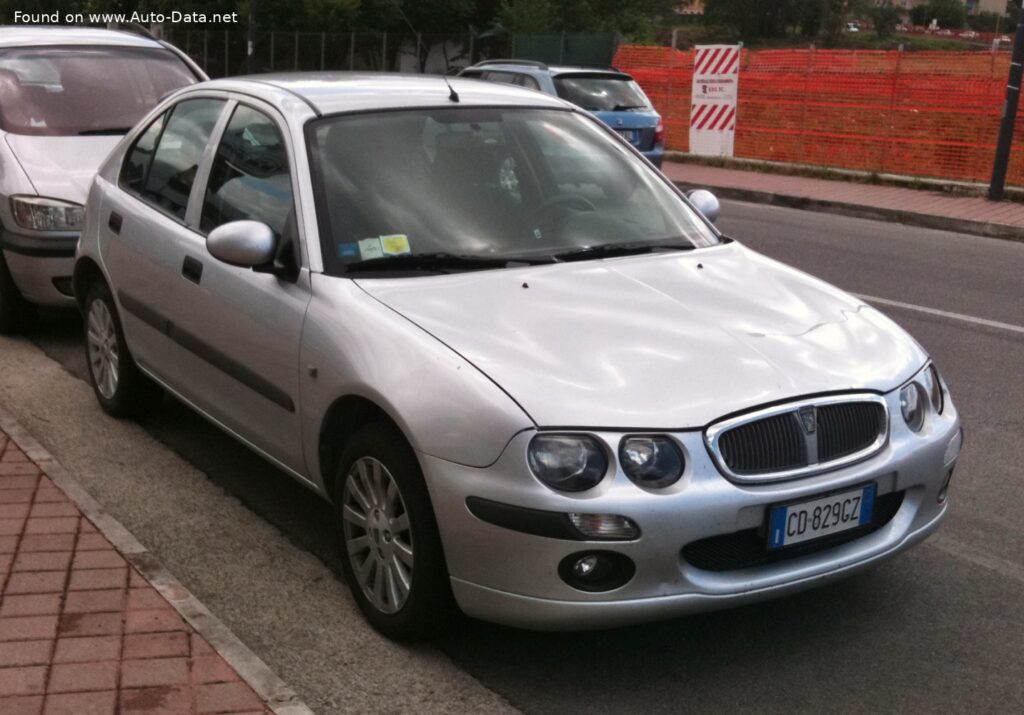
The Rover 25 (RF) 2.0 TD (101 Hp) represents a significant, though ultimately poignant, chapter in the history of the British automotive manufacturer, Rover. Launched in 1999, the Rover 25 was essentially a heavily revised and rebadged version of the Rover 200 (R3) series, aiming to modernize its appeal in the highly competitive European compact car segment. Positioned as a practical and affordable hatchback, it sought to blend traditional British styling cues with contemporary engineering for its era. The specific variant under review, the Rover 25 (RF) 2.0 TD (101 Hp), was particularly notable for its robust and efficient turbodiesel powertrain, a popular choice in European markets where diesel engines were favored for their fuel economy and torque characteristics. Produced from 1999 until 2005, the Rover 25 played a crucial role in Rover’s lineup during its final years, offering a compelling package for buyers seeking a compact, front-wheel-drive vehicle with a blend of comfort and cost-effectiveness. It occupied a mid-range position within the Rover 25 lineup, offering a step up in performance and refinement compared to the base 1.4L petrol models, but remaining more accessible than the higher-specification trims.
Powertrain & Engine Architecture: The Rover L-Series Diesel
At the heart of the Rover 25 (RF) 2.0 TD (101 Hp) was Rover’s well-regarded L-Series turbodiesel engine. This 2.0-liter (1994 cm3 or 121.68 cu. in.) inline four-cylinder unit was engineered for durability and efficiency, a hallmark of diesel technology popular in Europe. The engine, codenamed L / 20T2N, featured an overhead camshaft (OHC) valvetrain with two valves per cylinder and utilized a precombustion chamber injection system, characteristic of diesel engines of the late 1990s. This system, while less sophisticated than direct injection, proved reliable and contributed to the engine’s longevity. Bolstered by a Garrett turbocharger, it delivered a respectable 101 horsepower at 4200 rpm. More significantly, it produced a substantial 177.01 lb.-ft. (240 Nm) of torque at a low 2000 rpm, providing excellent pulling power and making it well-suited for both city driving and highway cruising.
The engine was typically paired with a 5-speed manual transmission, although an automatic transmission was also available. The automatic, a Jatco unit, was a four-speed design. While offering convenience, the automatic transmission slightly diminished the car’s acceleration and fuel economy compared to the manual version. The engine management system was a Bosch EDC (Electronic Diesel Control) unit, responsible for controlling fuel injection timing and turbocharger boost pressure.
Driving Characteristics: A Balance of Economy and Usability
The Rover 25 (RF) 2.0 TD (101 Hp) offered a distinctly different driving experience compared to its petrol-powered siblings. The high torque output of the diesel engine meant that strong acceleration was available from low engine speeds, making it particularly adept at navigating urban environments and overtaking on country roads. While not a particularly fast car – 0 to 60 mph took around 9.4 seconds – it felt more responsive than the lower-powered 1.4L and 1.6L petrol versions. The automatic transmission, while smooth, did result in some power loss and a less engaging driving experience. Gear ratios were optimized for fuel efficiency, with a relatively tall final drive. Compared to the higher-output 2.0L petrol versions, the diesel offered significantly better fuel economy but lacked the same level of outright performance. The manual transmission version provided a more direct connection to the engine and allowed for greater control, appealing to drivers who prioritized engagement.
Equipment & Trim Levels: Practical Comfort
The Rover 25 2.0 TD (101 Hp) was typically offered in several trim levels, including the base model and the more well-equipped ‘S’ and ‘SE’ variants. Standard equipment on the base model generally included central locking, power steering, and an adjustable steering column. The ‘S’ trim added features such as alloy wheels, electric front windows, and a radio/cassette player. The ‘SE’ trim, the highest specification, included features like air conditioning, leather upholstery (optional), and upgraded interior trim. Interior upholstery was typically cloth, although leather was available as an option on higher trims. The dashboard layout was functional and straightforward, with clearly labeled controls. Optional extras included a sunroof, upgraded sound system, and metallic paint finishes.
Chassis & Braking: A Conventional Setup
The Rover 25 (RF) utilized a conventional front-wheel-drive chassis layout. The front suspension consisted of MacPherson struts with a stabilizer bar, while the rear suspension employed a torsion beam setup. This configuration provided a comfortable ride quality, although it wasn’t particularly sporty. Braking was handled by ventilated disc brakes at the front and drum brakes at the rear, a common setup for cars in this class at the time. Anti-lock Braking System (ABS) was available as an option, and became increasingly common on higher trim levels. Steering was rack and pinion, providing reasonably precise control. The suspension was tuned for comfort rather than outright handling performance, prioritizing a smooth ride over sharp cornering.
Market Reception & Comparison: A Practical Choice
The Rover 25 2.0 TD (101 Hp) was generally well-received by critics for its fuel efficiency, strong torque, and comfortable ride. It was seen as a practical and affordable option for buyers seeking a compact diesel hatchback. However, it was often criticized for its somewhat dated interior and lack of cutting-edge technology compared to some of its rivals. Compared to the petrol-powered Rover 25 models, the 2.0 TD offered significantly better fuel economy – around 46.1 US mpg combined – but at the cost of some performance. Against competitors like the Ford Focus and Vauxhall/Opel Astra, the Rover 25 offered a more traditional British driving experience, but lacked the same level of refinement and brand prestige. Reliability was generally good, particularly with the diesel engine, although the Rover 25 suffered from the broader reputation for build quality issues that plagued the Rover Group.
Technical Specifications: Rover 25 (RF) 2.0 TD (101 Hp)
| Category | Specification |
| General Information | |
| Brand | Rover |
| Model | 25 |
| Generation | 25 (RF) |
| Type (Engine) | 2.0 TD (101 Hp) |
| Start of Production | 1999 year |
| End of Production | 2005 year |
| Powertrain Architecture | Internal Combustion engine |
| Body type | Hatchback |
| Seats | 5 |
| Doors | 3-5 |
| Performance Specs | |
| Fuel consumption (economy) – urban | 6.9 l/100 km (34.1 US mpg) |
| Fuel consumption (economy) – extra urban | 4.1 l/100 km (57.4 US mpg) |
| Fuel consumption (economy) – combined | 5.1 l/100 km (46.1 US mpg) |
| Fuel Type | Diesel |
| Acceleration 0 – 60 mph | 9.4 sec |
| Acceleration 0 – 100 km/h | 9.9 sec |
| Maximum speed | 185 km/h (114.95 mph) |
| Engine Specs | |
| Power | 101 Hp @ 4200 rpm. |
| Torque | 240 Nm @ 2000 rpm. (177.01 lb.-ft. @ 2000 rpm.) |
| Engine layout | Front, Transverse |
| Engine Model/Code | L / 20T2N |
| Engine displacement | 1994 cm3 (121.68 cu. in.) |
| Number of cylinders | 4 |
| Engine configuration | Inline |
| Fuel injection system | Precombustion chamber injection |
| Engine aspiration | Turbocharger |
Legacy: A Final Rover with Enduring Appeal
The Rover 25 2.0 TD (101 Hp), despite being a product of a financially troubled company, remains a fondly remembered car among enthusiasts. The L-Series diesel engine is particularly well-regarded for its durability and reliability. Today, surviving examples are relatively rare, but those that remain are often well-maintained by dedicated owners. The car’s affordability and practicality make it an attractive option in the used car market, particularly for those seeking a classic British hatchback with good fuel economy. While it may not offer the same level of refinement or technology as more modern vehicles, the Rover 25 2.0 TD (101 Hp) represents a unique and charming piece of British automotive history, and a testament to the enduring appeal of the Rover brand.
