
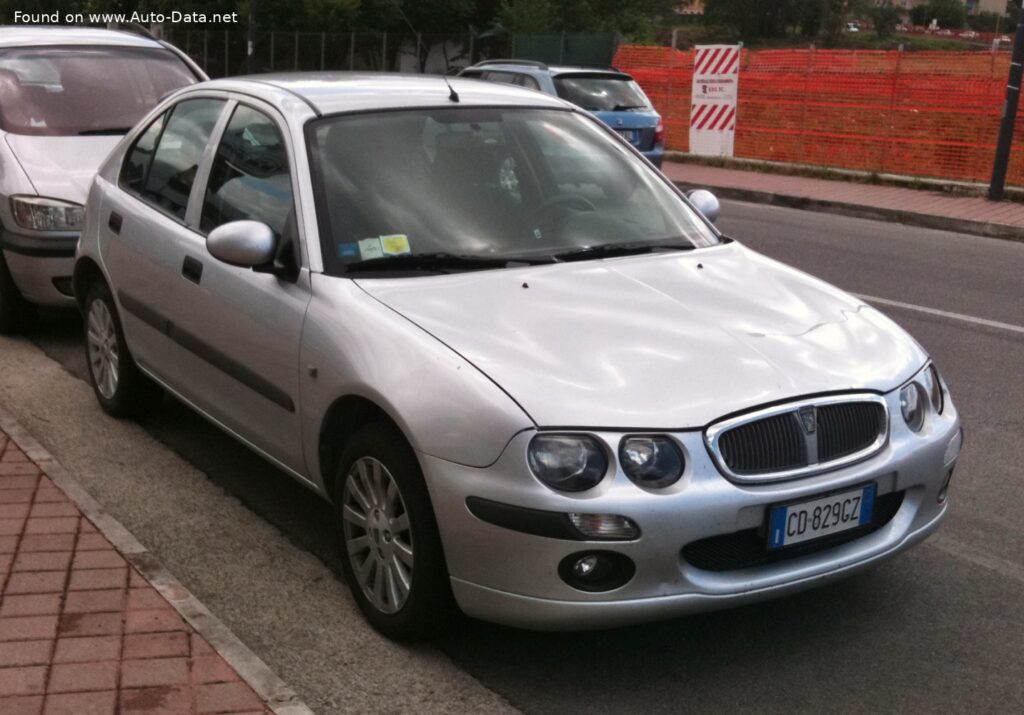
The Rover 25 (RF) 2.0 TD (113 Hp) represents a significant chapter in the history of the British automotive manufacturer Rover, particularly within the European compact car segment. Produced from 2002 to 2005, this generation of the Rover 25 was an updated and rebadged version of the earlier Rover 200 (R3) series, aiming to maintain Rover’s competitiveness in a fiercely contested market. While never officially sold in the United States, the Rover 25 was a common sight on European roads, appreciated for its compact dimensions, relatively refined ride, and, in the case of the 2.0 TD variant, its robust diesel powertrain. This particular model, with its 113 horsepower turbo-diesel engine, offered a compelling blend of performance and fuel efficiency, catering to a market increasingly focused on economical and capable daily drivers.
Rover 25 (RF) 2.0 TD: Positioning and Overview
The Rover 25 occupied the supermini or subcompact segment, a popular category across Europe known for its practicality, maneuverability in urban environments, and lower running costs. Available in both three-door and five-door hatchback configurations, it provided versatility for diverse buyer needs. The ‘RF’ designation signifies its platform lineage, tracing back to the Honda Concerto-derived architecture that underpinned its predecessors. Despite its age by the early 2000s, the Rover 25 remained a cornerstone of Rover’s product lineup during the company’s challenging final years, offering a distinctly British approach to the compact car formula. The 2.0 TD variant was positioned as a mid-range offering, bridging the gap between the base petrol models and any potential higher-performance trims that were never fully realized due to Rover’s financial constraints.
Powertrain & Engine Architecture
At the heart of the Rover 25 (RF) 2.0 TD (113 Hp) lay Rover’s acclaimed L-series turbo-diesel engine, a unit renowned for its durability and strong torque delivery. This specific iteration, designated L / 20T2N, featured a 1,994 cubic centimeter (approximately 2.0-liter) inline four-cylinder configuration. The engine employed an Overhead Camshaft (OHC) valvetrain with two valves per cylinder and a modern Commonrail fuel injection system, crucial for optimizing fuel atomization and combustion efficiency. The addition of a turbocharger and intercooler significantly boosted power output and responsiveness across the rev range. The Commonrail system, a significant upgrade over earlier diesel injection technologies, allowed for more precise fuel delivery and reduced engine noise.
The engine produced 113 horsepower at 4200 revolutions per minute (rpm), making it one of the more powerful diesel options in its class. More importantly for everyday driving, it delivered a substantial 191.77 lb-ft of torque at a low 2000 rpm. This ample low-end torque made the Rover 25 2.0 TD feel eager and capable, particularly in urban driving and during overtaking maneuvers. Power was transmitted to the front wheels via a smooth-shifting 5-speed manual transmission, a common and reliable setup for compact cars of that era. While an automatic transmission was offered on some Rover 25 models, it was not typically paired with the 2.0 TD engine due to torque limitations of the available automatic gearbox.
Driving Characteristics
The Rover 25 2.0 TD offered a distinctly different driving experience compared to the lower-powered petrol versions or the hypothetical higher-performance trims. The abundant low-end torque meant that the car felt responsive even at lower speeds, requiring less frequent gear changes in typical urban driving. While not a sports car, the 2.0 TD provided ample power for highway cruising and overtaking. The 5-speed manual transmission was well-matched to the engine’s characteristics, with gear ratios designed to maximize fuel efficiency and provide adequate acceleration. Compared to a manual transmission version of the same engine, the difference in performance was minimal, with the manual offering slightly quicker acceleration due to reduced drivetrain losses. However, the 2.0 TD’s torque output masked any significant performance disadvantage compared to the higher-revving petrol engines.
Equipment & Trim Levels
The Rover 25 2.0 TD was typically offered in mid-range trim levels, often denoted as ‘S’ or ‘SE’. Standard features included central locking, power steering, electric front windows, and an RDS radio. Interior upholstery was typically cloth, with options for upgraded materials and trim finishes. Air conditioning was a popular optional extra, as were alloy wheels and a sunroof. The dashboard configuration was relatively simple and functional, with clearly labeled controls and a straightforward instrument cluster. Higher-spec models might include features such as a trip computer, upgraded sound system, and leather-wrapped steering wheel. Safety features included a driver’s airbag and Anti-lock Braking System (ABS) as standard equipment.
Chassis & Braking
The Rover 25 (RF) featured a conventional chassis setup for its time. The front suspension employed a MacPherson strut design, known for its ability to provide a good balance between ride comfort and handling precision. The rear suspension utilized a torsion beam arrangement, a cost-effective solution that offered adequate ride quality for everyday driving. Braking was handled by ventilated discs at the front, providing effective stopping power, complemented by drum brakes at the rear. The use of drum brakes on the rear was a cost-saving measure common in this segment. Steering was managed by a hydraulic rack and pinion system, providing direct feedback to the driver. Stabilizer bars were fitted to both the front and rear axles to reduce body roll during cornering.
Market Reception & Comparison
Critics generally viewed the Rover 25 2.0 TD favorably, praising its fuel efficiency, strong torque delivery, and comfortable ride. It was considered a practical and economical choice for drivers seeking a compact car with diesel power. Compared to its rivals, such as the Ford Fiesta TDCi and Vauxhall Corsa CDTi, the Rover 25 2.0 TD offered a similar level of performance and economy, but often at a slightly lower price point. However, it lagged behind some competitors in terms of interior refinement and technological features. Reliability was generally good, although the L-series diesel engine was known to be sensitive to oil quality and maintenance. Fuel economy was a significant selling point, with the 2.0 TD achieving around 36.2 US mpg on the combined cycle, bettering many of its petrol-powered counterparts.
Technical Specifications
| Category | Specification |
| Brand | Rover |
| Model | 25 |
| Generation | 25 (RF) |
| Type (Engine) | 2.0 TD (113 Hp) |
| Start of Production | 2002 |
| End of Production | 2005 |
| Powertrain Architecture | Internal Combustion engine |
| Body type | Hatchback |
| Seats | 5 |
| Doors | 3-5 |
| Fuel consumption (economy) – urban | 30.5 US mpg (7.7 l/100 km) |
| Fuel consumption (economy) – extra urban | 56 US mpg (4.2 l/100 km) |
| Fuel consumption (economy) – combined | 36.2 US mpg (6.5 l/100 km) |
| Fuel Type | Diesel |
| Acceleration 0 – 60 mph | 8.6 sec |
| Maximum speed | 114.95 mph (185 km/h) |
| Power | 113 Hp @ 4200 rpm |
| Torque | 191.77 lb.-ft. @ 2000 rpm (260 Nm @ 2000 rpm) |
| Engine displacement | 121.68 cu. in. (1994 cm3) |
| Number of cylinders | 4 |
| Engine configuration | Inline |
| Fuel injection system | Diesel Commonrail |
| Number of gears and type of gearbox | 5 gears, manual transmission |
| Front brakes | Ventilated discs |
| Rear brakes | Drum |
Legacy
The Rover 25, and particularly the 2.0 TD (113 Hp) variant, holds a bittersweet legacy. It represented a final attempt by Rover to compete in the European compact car market, showcasing the company’s engineering prowess, especially in diesel engine development. While the car itself was well-regarded for its practicality and economy, it was ultimately overshadowed by Rover’s financial difficulties and eventual demise. Today, the Rover 25 2.0 TD is a relatively rare sight on the roads, but it remains a popular choice among enthusiasts and collectors who appreciate its unique character and British heritage. The L-series diesel engine, despite its age, is known for its durability and can provide reliable service with proper maintenance. In the used car market, well-maintained examples of the 2.0 TD command a modest premium due to their fuel efficiency and relatively strong performance.
