
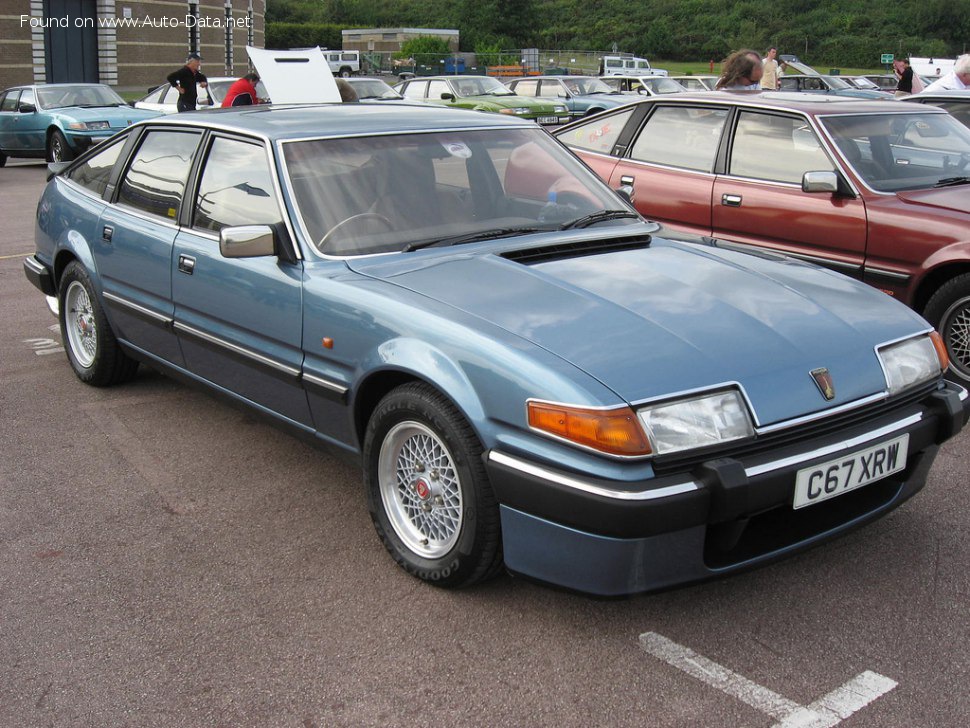
The Rover 2000-3500 Hatchback (SD1), officially known as the Rover 2000-3500 Hatchback, represents a significant chapter in British automotive history. Launched in 1976, the SD1 was a bold and ambitious executive car designed to compete with established European rivals. Its striking fastback silhouette, often mistaken for a sedan, was a radical departure from traditional British luxury car design, drawing inspiration from contemporary Italian supercars like the Ferrari Daytona and Lancia Gamma. The SD1 nomenclature stood for “Special Division 1,” indicating its status as the first car developed by the newly formed Rover-Triumph division of British Leyland.
The Rover 2000-3500 Hatchback (SD1) 2400 TD (91 Hp) Variant
The specific variant under examination, the Rover 2000-3500 Hatchback (SD1) 2400 TD (91 Hp), was introduced in 1982 and remained in production until 1986. This model marked Rover’s foray into the executive diesel market, a growing segment in Europe driven by increasing fuel costs and a demand for greater efficiency. While the SD1 was never officially sold in the United States, it played a crucial role in the European and UK markets, serving as a flagship for the Rover brand and embodying both the aspirations and challenges of the British automotive industry during the early 1980s. This trim level occupied a mid-range position within the SD1 lineup, offering a more economical alternative to the fuel-hungry V8 models, but still providing the prestige and comfort expected of an executive car.
Powertrain & Engine Architecture
At the heart of the Rover 2000-3500 Hatchback (SD1) 2400 TD (91 Hp) was its 2.4-liter (approximately 2393cc) turbocharged diesel engine. This unit, internally designated as the 200TDi, produced a modest but respectable 91 horsepower (Hp). The inclusion of a Garrett turbocharger was a significant feature, enabling the engine to deliver more power and, crucially, greater torque across a wider rev range than a naturally aspirated diesel of similar displacement. This characteristic was vital for providing adequate acceleration and cruising ability in a car of the SD1’s size and weight. The engine utilized indirect injection, a common technology for diesel engines of the era, and a Bosch fuel injection pump. The valvetrain consisted of a single overhead camshaft operating two valves per cylinder.
The powertrain architecture was a conventional internal combustion engine, positioned longitudinally, driving the rear wheels. This rear-wheel-drive (RWD) layout was typical for executive cars of the period, contributing to balanced handling dynamics and a classic driving feel. The transmission options included a five-speed manual gearbox, offering driver engagement and efficiency, or an optional three-speed automatic transmission (Chrysler Torqueflite) for a more relaxed driving experience. The automatic transmission was particularly popular with fleet buyers and those prioritizing comfort. While specific torque figures for this exact variant are not readily available, a turbocharged diesel of this size in the early 1980s would typically produce around 130-150 lb-ft of torque, providing ample pulling power for everyday driving and comfortable highway cruising.
Driving Characteristics
The 2400 TD was not designed for blistering acceleration. Its 0-60 mph sprint would likely have been in the 14-16 second range, with a top speed approaching 100 mph. Compared to the V8-powered SD1s, the diesel variant felt significantly slower, particularly in terms of responsiveness. However, its strength lay in its fuel economy and durability. The turbocharger mitigated some of the inherent sluggishness of diesel engines, providing a more responsive and less strained driving experience. The five-speed manual transmission allowed drivers to maximize fuel efficiency and maintain control, while the automatic transmission offered a smoother, more effortless driving experience, albeit at the expense of some performance. The gear ratios in the automatic were optimized for cruising, prioritizing fuel economy over rapid acceleration. The rear-wheel-drive layout provided a balanced feel, although the added weight of the diesel engine and turbocharger compared to the gasoline models could be felt in cornering.
Equipment & Trim Levels
The 2400 TD variant of the SD1 typically came equipped with a respectable level of standard features for an executive car of the early 1980s. Standard interior upholstery was typically cloth, although optional velour or leather upholstery was available. The dashboard configuration was similar across the SD1 range, featuring a wood veneer trim and clear instrumentation. Standard equipment included power-assisted steering, central locking, and electric windows. Air conditioning was a popular optional extra, as were a sunroof and a premium audio system. The trim levels varied slightly depending on the market, but generally included a base model and a more luxurious “Vitesse” trim, which added features such as upgraded upholstery, alloy wheels, and additional chrome trim. The 2400 TD was often favored by fleet buyers, so many examples were equipped with practical options such as a trip computer and a more durable interior trim.
Chassis & Braking
The SD1 utilized a robust chassis and suspension system designed to provide a comfortable ride and stable handling. The front suspension consisted of independent double wishbones with coil springs and anti-roll bar, while the rear suspension featured a live axle with trailing arms, coil springs, and a Panhard rod. The 2400 TD, being a heavier variant due to the diesel engine, often featured a slightly stiffer suspension setup to compensate for the added weight. Braking systems varied depending on the year and market. Early models typically featured disc brakes on the front wheels and drum brakes on the rear wheels. Later models often received disc brakes on all four wheels, providing improved stopping power. The brake system was typically hydraulically assisted, and anti-lock braking (ABS) was not available on the 2400 TD variant.
Market Reception & Comparison
Critics generally viewed the Rover SD1 2400 TD as a sensible and practical choice for those prioritizing fuel economy and durability. While it lacked the performance of the V8 models, it offered a comfortable ride, a spacious interior, and a distinctive design. Fuel economy was a significant advantage, with the diesel variant achieving around 30-35 mpg in real-world driving, compared to the 18-22 mpg of the V8 models. However, the 2400 TD was often criticized for its relatively slow acceleration and the inherent noise and vibration associated with diesel engines. Compared to its rivals, such as the BMW 524d and the Mercedes-Benz 230D, the SD1 2400 TD offered a more stylish and distinctive design, but often lagged behind in terms of refinement and build quality. Reliability was also a concern, as the SD1 was known for its susceptibility to rust and electrical problems.
Technical Specifications
| Brand | Rover |
| Model | 2000-3500 Hatchback (SD1) |
| Generation | SD1 |
| Engine Type | 2400 TD (Turbo Diesel) |
| Production Start | 1982 year |
| Production End | 1986 year |
| Powertrain Architecture | Internal Combustion Engine |
| Body Type | Hatchback |
| Doors | 5 |
| Seats | 5 |
| Fuel Type | Diesel |
| Power Output | 91 Hp |
| Engine Aspiration | Turbocharger |
| Engine Displacement | Approx. 2.4 Liters (2393 cc) |
| Drive Type | Rear-Wheel Drive (RWD) |
| Transmission (Typical) | 5-speed Manual (Optional Automatic) |
Legacy
The Rover SD1 2400 TD, while not the most celebrated variant of the SD1 range, represents an important chapter in Rover’s history. The diesel engine proved to be relatively durable, and many examples remain on the road today. However, like all SD1s, they are prone to rust and require regular maintenance. In the used car market, the 2400 TD is often more affordable than the V8 models, making it an attractive option for enthusiasts looking for a classic British executive car. The engine’s longevity and relatively simple mechanical design make it easier to maintain and repair than the more complex V8 engines. Despite its shortcomings in terms of performance and refinement, the SD1 2400 TD remains a distinctive and characterful car, embodying the ambition and challenges of the British automotive industry during the early 1980s.
