
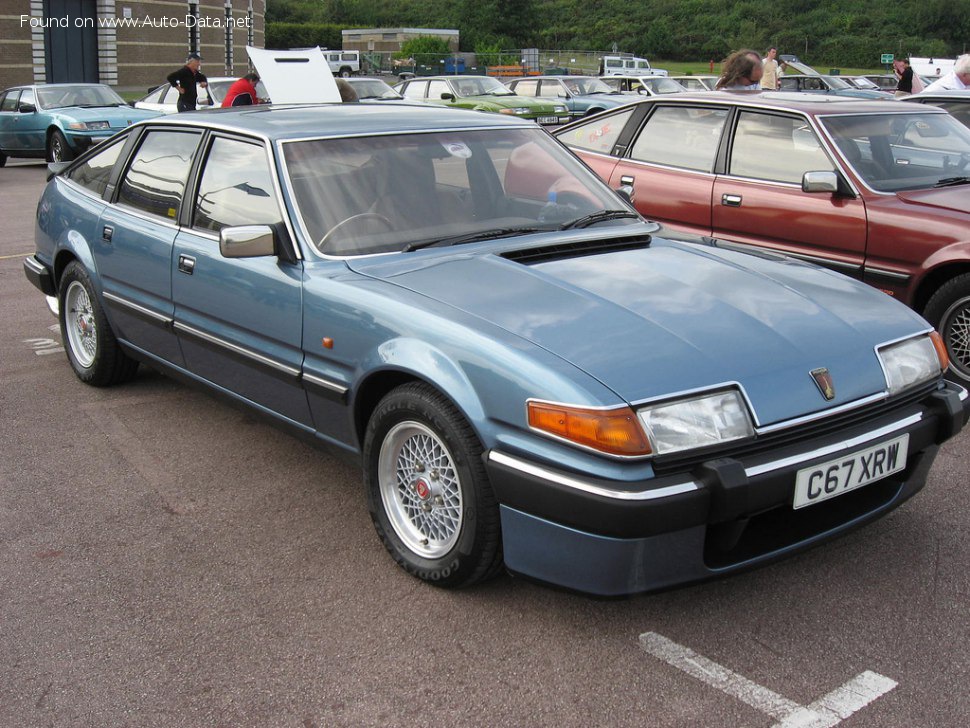
The Rover 2000-3500 Hatchback (SD1), officially designated as the Rover 2000-3500 Hatchback (SD1), represents a pivotal and often debated period in British automotive history. Launched in 1976, the SD1 (Specialist Division 1) was an executive car produced by British Leyland, intended to replace both the traditional Rover P6 and the more conventional Triumph 2000/2500 models. This article specifically focuses on the entry-level Rover 2000-3500 Hatchback (SD1) 2000 (97 Hp) variant, produced from 1982 to 1986. While never officially sold in the United States, the SD1 garnered acclaim in European markets for its groundbreaking design, combining the practicality of a five-door hatchback with the prestige and comfort expected of an executive car.
Rover SD1 2000 (97 Hp): Positioning and Overview
The SD1 2000, with its 97 horsepower engine, occupied the entry-level position within the SD1 range. It was designed to appeal to buyers who desired the car’s distinctive styling and spaciousness but were more conscious of fuel costs and purchase price. It sat below the 2300, 2600, and the flagship V8-powered 3500 models. This variant aimed to broaden the SD1’s market reach, attracting a wider customer base than the more expensive and performance-oriented trims. It was a deliberate attempt by British Leyland to offer a more accessible executive car, capitalizing on the SD1’s modern design and spacious interior.
Powertrain & Engine Architecture
The Rover 2000-3500 Hatchback (SD1) 2000 (97 Hp) was powered by a naturally aspirated, 2.0-liter (1998cc) inline-four cylinder gasoline engine. This engine, typically identified by engine codes such as the O-Series, was known for its relatively simple design and focus on reliability. It featured a single overhead camshaft (SOHC) valvetrain and utilized a Bosch K-Jetronic fuel injection system, a sophisticated system for the time, designed to improve fuel efficiency and reduce emissions. The engine produced 97 horsepower (Hp) at 5200 rpm and approximately 125 lb-ft of torque at 3000 rpm.
The engine was typically paired with a five-speed manual transmission, providing drivers with good control over the vehicle’s performance. A three-speed automatic transmission, the Borg Warner DG, was also available as an option, catering to those who preferred a more relaxed driving experience. The automatic transmission, while offering convenience, did impact acceleration and fuel economy compared to the manual version. The rear-wheel-drive layout was standard across the SD1 range, providing a traditional driving experience favored by many executive car buyers.
Driving Characteristics
The SD1 2000, with its 97 hp engine and automatic transmission, offered a comfortable but not particularly sporty driving experience. Acceleration was adequate for everyday driving, with a 0-60 mph time of around 11-12 seconds. The automatic transmission featured relatively widely spaced gear ratios, prioritizing fuel economy and smooth cruising over rapid acceleration. Compared to the manual transmission version, the automatic resulted in a noticeable decrease in responsiveness.
Compared to the higher-output SD1 variants, such as the 2600 and 3500, the 2000 felt noticeably less powerful. The V8-powered models offered significantly more torque and acceleration, making them more suitable for drivers who prioritized performance. However, the 2000’s lighter weight and more modest power output resulted in better fuel economy and lower running costs. The rear-wheel-drive configuration provided balanced handling, but the SD1’s relatively soft suspension setup prioritized ride comfort over sharp cornering. Overall, the driving experience was geared towards relaxed cruising and everyday usability.
Equipment & Trim Levels
The Rover SD1 2000 typically came equipped with a reasonable level of standard features for an executive car of the early 1980s. Standard equipment generally included cloth upholstery, central locking, a basic stereo system, and power-assisted steering. Interior trim was generally functional and well-laid-out, though materials were not as luxurious as those found in the higher-spec models. The dashboard featured a distinctive pod-like instrument binnacle, housing the speedometer, tachometer, fuel gauge, and other essential instruments.
Optional extras available for the SD1 2000 included power windows, a sunroof, upgraded stereo systems, and leather upholstery. Air conditioning was also available as an option, though it was not standard equipment. Trim levels varied slightly depending on the market, but generally, the SD1 2000 offered a good balance of comfort and practicality without the added expense of the more luxurious features found in the higher-spec models.
Chassis & Braking
The Rover SD1 utilized a traditional body-on-frame construction, which contributed to its robust feel but also added weight. The suspension system consisted of independent front suspension with coil springs and a live axle rear suspension with trailing arms and coil springs. The 2000 variant typically featured a smaller diameter stabilizer bar compared to the higher-spec models, resulting in slightly more body roll during cornering.
Braking was initially provided by disc brakes on the front wheels and drum brakes on the rear wheels. Later models often featured disc brakes all around, offering improved stopping performance. Power assistance was standard, providing drivers with a comfortable and confident braking experience. The steering system was a recirculating ball system, offering a relatively heavy but precise steering feel.
Market Reception & Comparison
The Rover SD1 2000 received mixed reviews from automotive critics. While its styling and spaciousness were widely praised, concerns were often raised about its build quality and reliability. The 97 hp engine was considered adequate for everyday driving, but some critics felt it was underpowered for a car of its size and weight. Fuel economy was generally considered to be reasonable for the time, but not exceptional.
Compared to its rivals, such as the Ford Granada and Opel Senator, the SD1 2000 offered a more distinctive and modern design. However, it often lagged behind in terms of reliability and build quality. The BMW 5 Series and Mercedes-Benz W123 offered superior build quality and performance, but at a higher price point. The SD1 2000’s main advantage was its unique combination of style, spaciousness, and affordability.
Technical Specifications
| Brand | Rover |
| Model | 2000-3500 Hatchback |
| Generation | SD1 |
| Engine Type | 2.0L Inline-Four |
| Start of Production | 1982 |
| End of Production | 1986 |
| Horsepower | 97 hp @ 5200 rpm |
| Torque | 125 lb-ft @ 3000 rpm |
| Fuel Type | Gasoline |
| Transmission | 5-speed Manual or 3-speed Automatic |
| Drivetrain | Rear-Wheel Drive |
| Body Type | 5-door Hatchback |
| Seating Capacity | 5 |
| Brakes (Front) | Disc |
| Brakes (Rear) | Drum (early models), Disc (later models) |
Legacy
The Rover SD1 2000, despite its production issues, has gained a cult following among classic car enthusiasts. Its distinctive design and spacious interior continue to appeal to those seeking a stylish and practical classic car. While the build quality issues can present challenges for owners, the engine is generally considered to be reliable and relatively easy to maintain.
In the used car market today, the SD1 2000 is relatively affordable, making it an accessible entry point into classic car ownership. However, finding a well-maintained example can be challenging. The 2000 variant is often seen as a more practical and affordable alternative to the V8-powered models, appealing to those who prioritize usability over performance. The SD1 2000 remains a significant reminder of a bold and ambitious period in British automotive history, embodying both the triumphs and tribulations of British Leyland.
