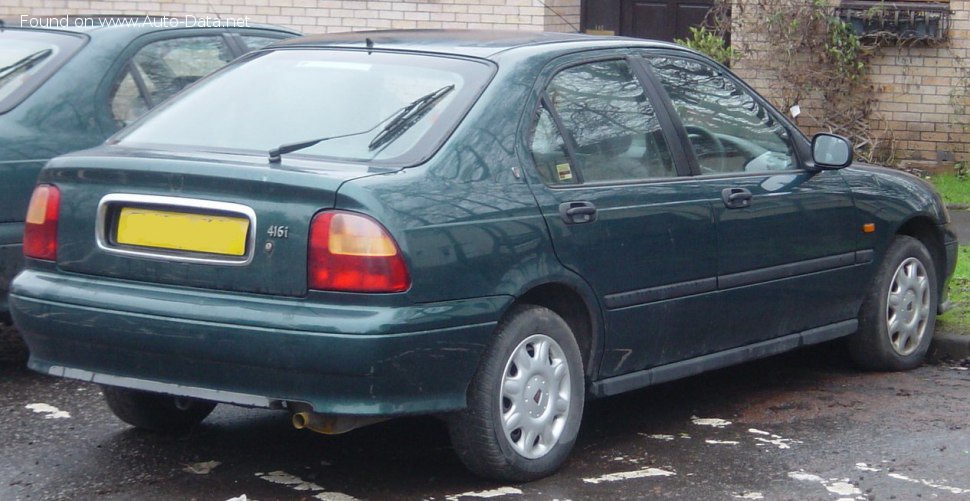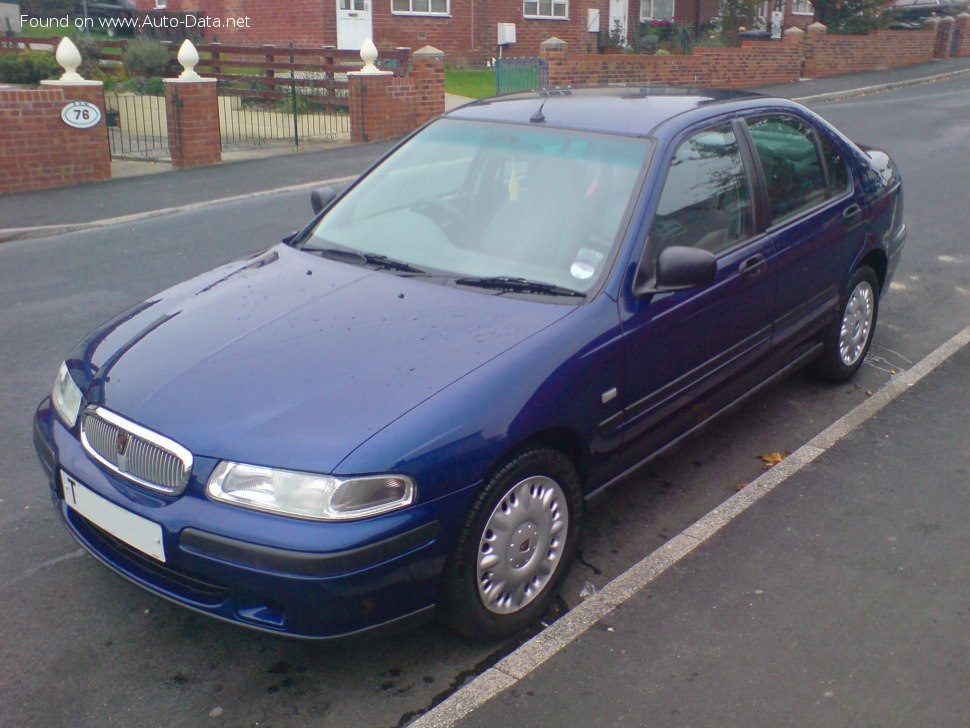
The Rover 400 (RT) 416 Si Automatic represents a significant chapter in the history of the British automotive manufacturer, Rover. Launched in 1995, the second-generation Rover 400, internally codenamed “RT,” was a compact family car designed to compete in the highly competitive European C-segment. While never officially sold in the United States, the Rover 400 (RT) played a crucial role in its primary markets, particularly the United Kingdom and continental Europe, as a mainstream offering aiming to blend traditional British styling cues with reliable, modern engineering. This particular variant, the 416 Si, featured a capable 1.6-liter engine paired with a four-speed automatic transmission, positioning it as a comfortable and practical choice for families seeking a touch of perceived refinement without an exorbitant price tag. Its production run spanned from 1995 to 2000, during a period of considerable change and challenge for the Rover Group.
Engineering and Performance: The Rover 400 (RT) 416 Si Powertrain
At the heart of the Rover 400 (RT) 416 Si Automatic was Rover’s own K16 engine, a 1.6-liter (1589 cm3 or 96.97 cubic inches) naturally aspirated inline-four unit. This engine was a testament to Rover’s engineering capabilities, featuring a Double Overhead Camshaft (DOHC) valvetrain with four valves per cylinder, a configuration that was becoming standard for efficient power delivery in the mid-1990s. Fuel was supplied via a multi-port manifold injection system, ensuring precise fuel delivery and combustion.
The K16 engine in the 416 Si delivered a respectable 111 horsepower at 6000 rpm, translating to a power-per-liter figure of 69.9 HP/l. Torque output stood at 145 Newton-meters (106.95 lb.-ft.) at a relatively low 3000 rpm, providing decent low-end responsiveness for everyday driving. This powertrain was mounted transversely at the front, driving the front wheels, a standard layout for compact sedans of the era, optimizing interior space and manufacturing cost.
Paired with a 4-speed automatic transmission, the 416 Si variant prioritized smooth, effortless driving over outright performance. Despite the automatic gearbox, the car still managed a 0 to 60 mph acceleration time of 10.3 seconds, with a top speed of 118 mph (190 km/h). These figures placed it competitively within its segment, offering sufficient performance for highway cruising and urban commuting. The car’s weight-to-power ratio was 10.6 kg/Hp (94.5 Hp/tonne), and its weight-to-torque ratio was 8.1 kg/Nm (123.4 Nm/tonne), indicating a balanced approach to performance and efficiency for a family sedan.
Fuel economy for the Rover 400 (RT) 416 Si Automatic was rated at a combined 8.1 liters per 100 kilometers, which translates to approximately 29 US miles per gallon. Urban consumption was higher at 10.1 l/100 km (23.3 US mpg), while extra-urban driving yielded a more efficient 6.5 l/100 km (36.2 US mpg). These figures were competitive for a 1.6-liter automatic sedan of the mid-1990s, offering a reasonable balance of performance and running costs for European drivers.
Driving Characteristics of the 1.6L Automatic
The Rover 400 (RT) 416 Si Automatic offered a distinctly different driving experience compared to its manual transmission counterparts or higher-output siblings like the 420 Si. The four-speed automatic transmission, while providing convenience, inherently resulted in some power loss compared to a five-speed manual. Gear ratios were optimized for smooth cruising and acceptable acceleration, but lacked the responsiveness favored by drivers seeking a more engaging experience. The automatic transmission’s shift points were programmed for economy and comfort, meaning it wouldn’t hold gears as long as a manual transmission would when accelerating, resulting in a slightly less urgent feel.
Compared to the 414 Si (with its smaller 1.4-liter engine), the 416 Si Automatic offered noticeably more power and torque, making it more comfortable for highway driving and overtaking maneuvers. However, it didn’t possess the sharper handling or quicker acceleration of the 420 Si, which featured a larger 2.0-liter engine. The 416 Si Automatic was positioned as a middle ground – a practical and comfortable option for drivers who didn’t prioritize outright performance but still wanted a reasonably capable family car. The automatic transmission smoothed out the engine’s power delivery, making it a more forgiving car to drive in stop-and-go traffic.
Equipment & Trim Levels
The Rover 400 (RT) 416 Si Automatic typically came equipped with a reasonable level of standard features for its price point. These included central locking, power windows, power steering, an adjustable steering column, and a basic stereo system. Interior upholstery was generally cloth, with options for upgraded materials and colors. The dashboard layout was functional and straightforward, with clearly labeled controls.
Optional extras available for the 416 Si Automatic included air conditioning, alloy wheels, a sunroof, and upgraded audio systems. Higher trim levels, such as the “SLI,” offered additional features like leather upholstery, wood trim, and more sophisticated audio equipment. The 416 Si Automatic was often seen as a good value proposition, offering a comfortable and well-equipped car without the expense of the top-of-the-line models.
Chassis & Braking
The Rover 400 (RT) utilized a robust chassis derived from a collaboration with Honda, specifically sharing its platform with the Honda Domani and the sixth-generation Civic. This provided a solid foundation, contributing to its reputation for reliability and competent handling. The suspension system featured spring struts at both the front and rear, a common and effective setup for balancing ride comfort and handling dynamics. The suspension was tuned for comfort, providing a relatively smooth ride over uneven surfaces.
Braking was handled by disc brakes on all four wheels, complemented by an Anti-lock Braking System (ABS), which was an important safety advancement in the mid-1990s. Steering was handled by a hydraulic rack and pinion system, providing direct and communicative feedback to the driver. The car rode on 185/60 R14 H tires mounted on 14-inch wheel rims, offering a good balance of grip and ride comfort. Rear brakes were typically solid discs, reflecting the car’s weight and intended use as a family sedan.
Market Reception & Comparison
Critics generally viewed the Rover 400 (RT) 416 Si Automatic as a competent and comfortable family car, but often noted its somewhat conservative styling and lack of a truly sporty driving experience. It was praised for its smooth ride, spacious interior, and reliable powertrain. However, it was often overshadowed by rivals like the Ford Mondeo and Vauxhall Vectra, which offered more dynamic handling or more distinctive designs.
In terms of fuel economy, the 416 Si Automatic performed competitively with other 1.6-liter automatic sedans of the era. Its reliability was generally considered good, benefiting from the Honda-derived platform and the robust K16 engine. However, some critics pointed to potential issues with electrical components, a common concern with British cars of the period. The 416 Si Automatic offered a good balance of value, comfort, and reliability, making it a popular choice for families and commuters.
Technical Specifications: Rover 400 (RT) 416 Si (111 Hp) Automatic (1995-2000)
| Category | Specification |
| General Information | |
| Brand | Rover |
| Model | 400 |
| Generation | 400 (RT) |
| Type (Engine) | 416 Si (111 Hp) Automatic |
| Production Start | 1995 |
| Production End | 2000 |
| Powertrain Architecture | Internal Combustion Engine, Front-Wheel Drive |
| Body Type | Sedan |
| Seats | 5 |
| Doors | 4 |
| Performance Specifications | |
| Fuel Consumption (City) | 10.1 l/100 km (23.3 US mpg) |
| Fuel Consumption (Highway) | 6.5 l/100 km (36.2 US mpg) |
| Fuel Consumption (Combined) | 8.1 l/100 km (29 US mpg) |
| Fuel Type | Petrol (Gasoline) |
| Acceleration 0-60 mph | 10.3 seconds |
| Maximum Speed | 118.06 mph (190 km/h) |
| Weight-to-Power Ratio | 10.6 kg/Hp (94.5 Hp/tonne) |
| Weight-to-Torque Ratio | 8.1 kg/Nm (123.4 Nm/tonne) |
| Engine Specifications | |
| Power | 111 Hp @ 6000 rpm |
| Power per Liter | 69.9 Hp/l |
| Torque | 145 Nm (106.95 lb.-ft.) @ 3000 rpm |
| Engine Layout | Front, Transverse |
| Engine Model/Code | K16 |
| Engine Displacement | 1589 cm3 (96.97 cu. in.) |
| Number of Cylinders | 4 |
| Engine Configuration | Inline |
| Cylinder Bore | 80 mm (3.15 in.) |
| Piston Stroke | 79 mm (3.11 in.) |
| Compression Ratio | 10.5:1 |
| Valves per Cylinder | 4 |
| Fuel Injection System | Multi-port manifold injection |
| Engine Aspiration | Naturally aspirated |
| Valvetrain | DOHC |
| Engine Oil Capacity | 3.5 l (3.7 US qt) |
| Coolant Capacity | 5.5 l (5.81 US qt) |
| Dimensions, Volume & Weights | |
| Kerb Weight | 1175 kg (2590.43 lbs) |
| Max. Weight (GVWR) | 1640 kg (3615.58 lbs) |
| Max Load | 465 kg (1025.15 lbs) |
| Trunk Space (Minimum) | 470 l (16.6 cu. ft.) |
| Trunk Space (Maximum) | 810 l (28.6 cu. ft.) |
| Fuel Tank Capacity | 55 l (14.53 US gal) |
| Length | 4490 mm (176.77 in.) |
| Width | 1695 mm (66.73 in.) |
| Height | 1390 mm (54.72 in.) |
| Wheelbase | 2622 mm (103.23 in.) |
| Front Track | 1477 mm (58.15 in.) |
| Rear Track | 1465 mm (57.68 in.) |
| Drivetrain, Brakes & Suspension | |
| Drivetrain Architecture | Internal combustion engine drives the front wheels. |
| Drive Wheel | Front-wheel drive |
| Number of Gears | 4 gears, automatic transmission |
| Front Suspension | Spring Strut |
| Rear Suspension | Spring Strut |
| Front Brakes | Disc |
| Rear Brakes | Disc |
| Assisting Systems | ABS (Anti-lock braking system) |
| Steering Type | Steering rack and pinion |
| Power Steering | Hydraulic Steering |
| Tires Size | 185/60 R14 H |
| Wheel Rims Size | 14 inches |
Legacy
The Rover 400 (RT) 416 Si Automatic, while not a groundbreaking vehicle, holds a significant place in automotive history as a representative of British engineering during a period of transition. The K16 engine, while not without its quirks, proved to be a relatively durable and reliable unit, and examples continue to be found on the road today. The Honda-derived platform contributed to the car’s overall dependability.
In the used car market, the 416 Si Automatic is often sought after by enthusiasts and collectors looking for a classic British car. Prices vary depending on condition, mileage, and originality, but well-maintained examples can command a reasonable premium. Common issues to look for include electrical problems, rust (particularly in areas prone to corrosion), and wear and tear on suspension components. Despite its age, the Rover 400 (RT) 416 Si Automatic remains a charming and practical classic, offering a glimpse into a bygone era of British automotive design and engineering.