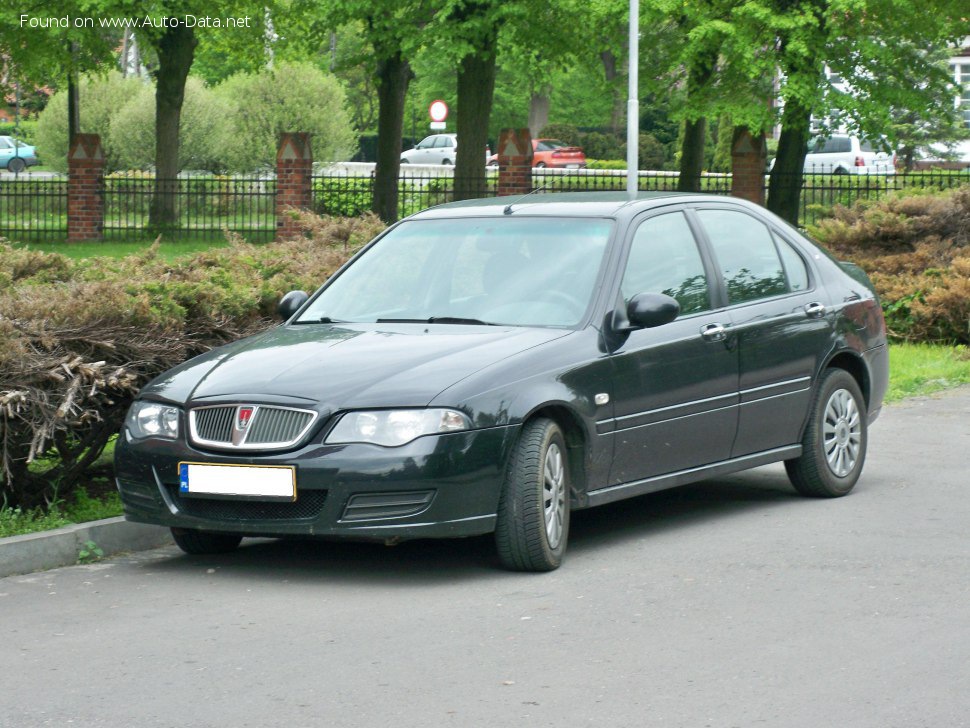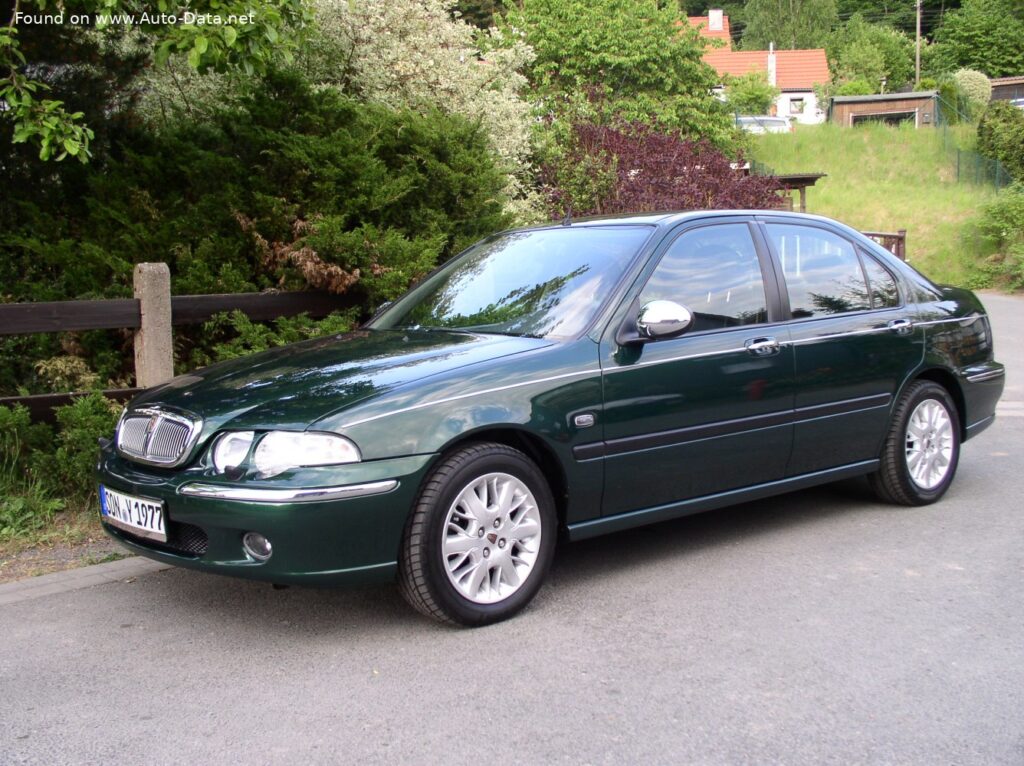
The Rover 45 (RT), produced by the British automaker Rover Group (and later MG Rover Group) from 1999 to 2005, represented a key offering in the highly competitive European compact executive segment. Positioned as a slightly more upscale alternative to mainstream compact cars, the Rover 45 was a facelifted and re-engineered version of the outgoing Rover 400 (HH-R) series. While the Rover brand had a limited presence in North America in earlier decades, the Rover 45 was never officially sold in the United States, primarily targeting the United Kingdom and other European markets. It aimed to blend traditional British styling cues and a comfortable ride with practical dimensions, evolving from a platform shared with Honda models.
Rover 45 (RT): Overview and Market Positioning
The Rover 45 series was available in both sedan and five-door hatchback configurations, with the sedan being the focus of this specification. It sought to appeal to buyers looking for a vehicle that offered a touch more refinement and a classic aesthetic than its direct rivals, often at a competitive price point. The 1.6 i 16V variant, with its 109 horsepower engine, was a popular choice, providing a balance of performance and fuel efficiency suitable for everyday driving. The Rover 45 occupied a niche between mainstream compacts and more premium offerings, attempting to deliver British character without a corresponding premium price tag.
Engine & Performance
At the heart of the Rover 45 (RT) 1.6 i 16V model lies Rover’s K-Series engine, a 1.6-liter (1588 cm3 or 96.91 cubic inches) naturally aspirated inline-four gasoline unit. This engine was well-regarded for its lightweight design and efficient packaging. It featured a Double Overhead Camshaft (DOHC) valvetrain with four valves per cylinder, ensuring effective breathing and a relatively broad power band for its displacement. A compression ratio of 10.5:1 and a multi-port fuel injection system contributed to smooth operation and responsive power delivery.
The K16 engine variant produced 109 horsepower (HP) at 6000 revolutions per minute (rpm), resulting in a power-per-liter output of 68.6 HP/liter. Torque figures stood at 138 Newton-meters (Nm), or 101.78 pound-feet (lb.-ft.), available at 4500 rpm. Combined with the vehicle’s kerb weight of 2601.45 pounds (1180 kg), this yielded a weight-to-power ratio of 10.8 kg/Hp. Performance figures included an estimated 0 to 60 miles per hour (mph) acceleration time of 9.8 seconds (0-100 km/h in 10.3 seconds), and a maximum speed of 118.06 mph (190 km/h). Power was delivered to the front wheels via a five-speed manual transmission.
Fuel economy was competitive for its time. The urban cycle consumption was approximately 9.2 liters per 100 kilometers (25.6 US mpg), while the extra-urban cycle saw a significant improvement to 5.6 liters per 100 kilometers (42 US mpg). The combined fuel economy figure was 6.9 liters per 100 kilometers, or 34.1 US mpg. A 14.53 US gallon (55 liter) fuel tank provided a reasonable cruising range.
Design & Features
The Rover 45 (RT) adopted a classic four-door sedan body style, distinctively Rover in its aesthetics despite sharing underpinnings with Honda. The design featured a traditional grille and headlamp treatment, aiming for a mature and understated look. Its dimensions – 177.83 inches (4517 mm) in length, 66.77 inches (1696 mm) in width, and 54.88 inches (1394 mm) in height – were well-suited for both city driving and highway cruising. The 103.15-inch (2620 mm) wheelbase contributed to a stable ride and adequate interior space.
Inside, the Rover 45 aimed for a comfortable and refined cabin experience. While not overtly luxurious, the interior materials and layout were generally considered pleasant for its segment. The emphasis was on practicality and ease of use, with a straightforward dashboard design. Luggage capacity was a strong point, offering a minimum trunk space of 16.6 cubic feet (470 liters), expandable to 28.6 cubic feet (810 liters) with the rear seats folded.
The chassis featured an independent front suspension with wishbones and a rear suspension utilizing spring struts, designed for a comfortable ride and decent handling. Braking was handled by ventilated discs at the front and solid discs at the rear, often augmented by an Anti-lock Braking System (ABS). The steering system was a hydraulic rack and pinion setup, providing tactile feedback. The vehicle rode on 175/70 R14 H tires, balancing grip and ride comfort.
Technical Specifications
| Category | Specification |
| General Information | |
| Brand | Rover |
| Model | 45 |
| Generation | 45 (RT) |
| Type (Engine) | 1.6 i 16V (109 Hp) |
| Start of production | 1999 year |
| End of production | 2005 year |
| Powertrain Architecture | Internal Combustion engine |
| Body type | Sedan |
| Seats | 5 |
| Doors | 4 |
| Performance Specifications | |
| Fuel consumption (economy) – urban | 9.2 l/100 km (25.6 US mpg) |
| Fuel consumption (economy) – extra urban | 5.6 l/100 km (42 US mpg) |
| Fuel consumption (economy) – combined | 6.9 l/100 km (34.1 US mpg) |
| Fuel Type | Petrol (Gasoline) |
| Acceleration 0 – 60 mph | 9.8 sec |
| Acceleration 0 – 100 km/h | 10.3 sec |
| Maximum speed | 190 km/h (118.06 mph) |
| Weight-to-power ratio | 10.8 kg/Hp (92.4 Hp/tonne) |
| Weight-to-torque ratio | 8.6 kg/Nm (116.9 Nm/tonne) |
| Engine Specifications | |
| Power | 109 Hp @ 6000 rpm |
| Power per liter | 68.6 Hp/l |
| Torque | 138 Nm @ 4500 rpm (101.78 lb.-ft. @ 4500 rpm) |
| Engine layout | Front, Transverse |
| Engine Model/Code | K16 |
| Engine displacement | 1588 cm3 (96.91 cu. in.) |
| Number of cylinders | 4 |
| Engine configuration | Inline |
| Cylinder Bore | 80 mm (3.15 in.) |
| Piston Stroke | 79 mm (3.11 in.) |
| Compression ratio | 10.5:1 |
| Number of valves per cylinder | 4 |
| Fuel injection system | Multi-port manifold injection |
| Engine aspiration | Naturally aspirated engine |
| Valvetrain | DOHC |
| Engine oil capacity | 5 l (5.28 US qt) |
| Coolant | 4.6 l (4.86 US qt) |
| Space, Volume and Weights | |
| Kerb Weight | 1180 kg (2601.45 lbs.) |
| Max. weight | 1640 kg (3615.58 lbs.) |
| Max load | 460 kg (1014.13 lbs.) |
| Trunk (boot) space – minimum | 470 l (16.6 cu. ft.) |
| Trunk (boot) space – maximum | 810 l (28.6 cu. ft.) |
| Fuel tank capacity | 55 l (14.53 US gal) |
| Dimensions | |
| Length | 4517 mm (177.83 in.) |
| Width | 1696 mm (66.77 in.) |
| Height | 1394 mm (54.88 in.) |
| Wheelbase | 2620 mm (103.15 in.) |
| Front track | 1475 mm (58.07 in.) |
| Rear (Back) track | 1465 mm (57.68 in.) |
| Drivetrain, Brakes and Suspension Specifications | |
| Drivetrain Architecture | The Internal combustion engine (ICE) drives the front wheels of the vehicle. |
| Drive wheel | Front wheel drive |
| Number of gears and type of gearbox | 5 gears, manual transmission |
| Front suspension | Wishbone |
| Rear suspension | Spring Strut |
| Front brakes | Ventilated discs |
| Rear brakes | Disc |
| Assisting systems | ABS (Anti-lock braking system) |
| Steering type | Steering rack and pinion |
| Power steering | Hydraulic Steering |
| Tires size | 175/70 R14 H |
Legacy and Market Impact
The Rover 45 (RT) entered the European market during a challenging period for the Rover brand. Launched in 1999, it was a successor to the Rover 400, based on the Honda Civic/Domani platform. While the 45 received a facelift and interior upgrades, its underlying platform was aging compared to newer rivals. This meant it offered a comfortable ride and traditional styling, but often lagged in dynamic handling, refinement, and technology.
In its primary markets, particularly the United Kingdom, the Rover 45 competed against vehicles like the Ford Focus, Vauxhall Astra (Opel Astra), Volkswagen Bora (Jetta), and Peugeot 307. The Rover 45 carved out a niche by appealing to buyers who appreciated its traditional design, softer ride, and perceived British heritage. It was often favored by a slightly older or more conservative demographic.
Despite its qualities, the Rover 45 struggled to gain significant market share. The production period coincided with the financial difficulties of the MG Rover Group, and limited resources meant the 45 didn’t receive the updates needed to remain competitive. This lack of investment ultimately contributed to the brand’s decline.
The Rover 45’s legacy is intertwined with the broader story of the Rover brand. It represents a final attempt by a British-owned volume car manufacturer to compete in a crucial segment. While not groundbreaking, it offered a distinctive alternative with its blend of classic styling, comfort, and practicality. Today, it’s remembered as a testament to Rover’s design philosophy and its struggle to adapt to a changing automotive landscape, before the collapse of MG Rover Group in 2005. For enthusiasts, it remains a piece of late 20th and early 21st-century British automotive history.