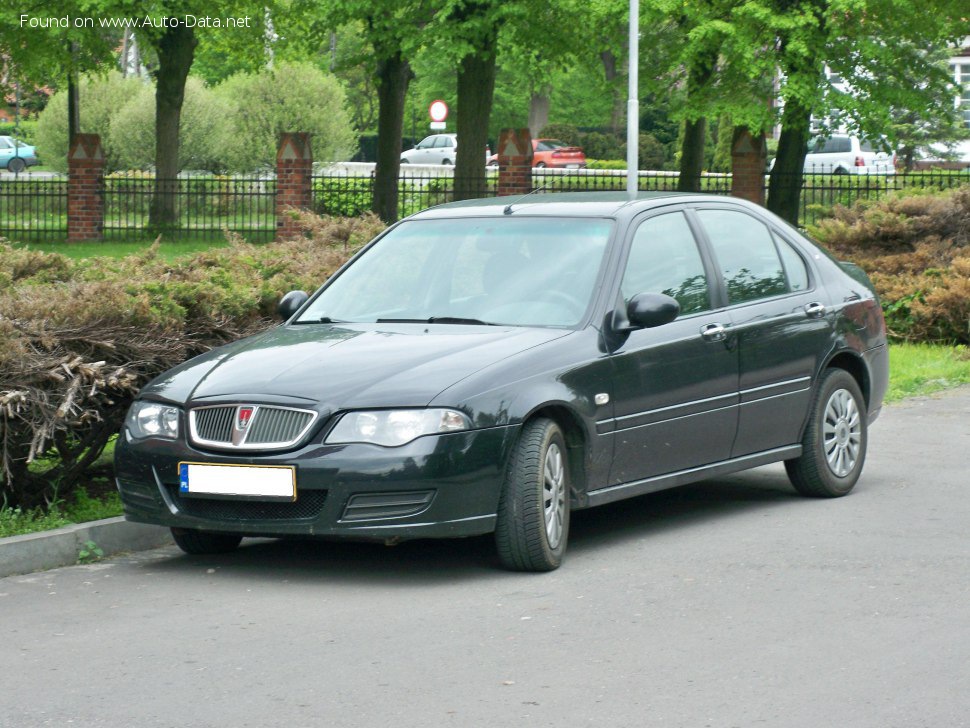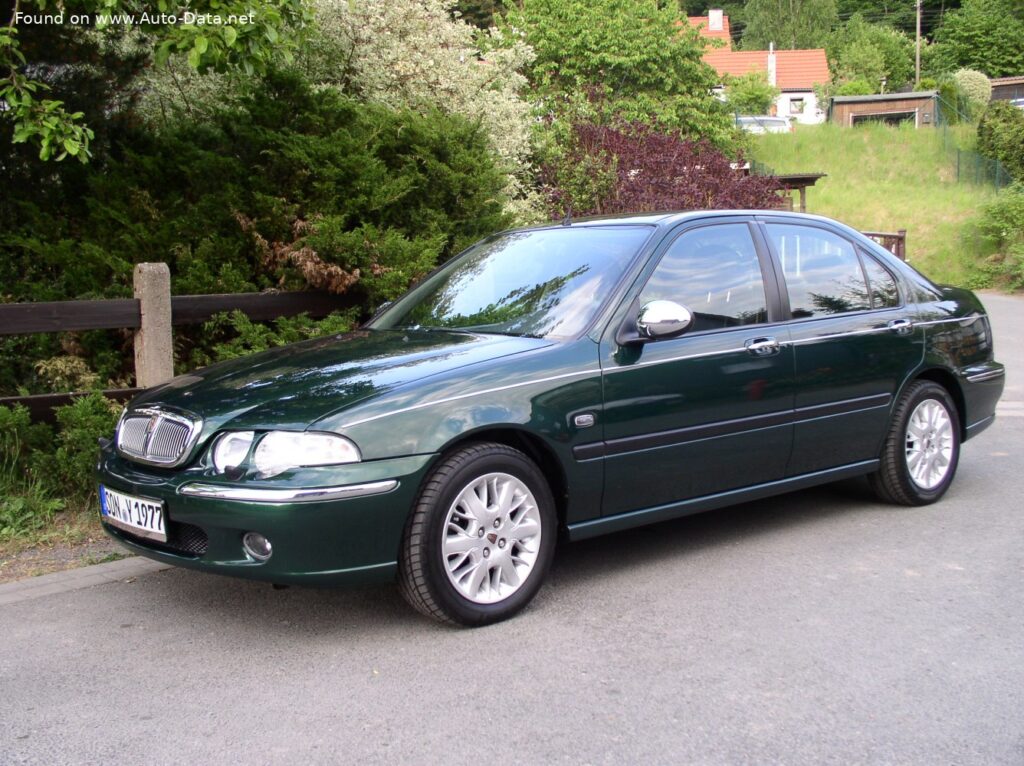
The Rover 45 (RT) 2.0 TD (101 Hp) represents a significant chapter in the history of the British automotive manufacturer Rover. Introduced in 1999 as a facelifted and rebadged version of the Rover 400 (HH-R) series, the 45 aimed to refresh Rover’s offering in the highly competitive European compact family car segment. Produced until 2005, the Rover 45 was a four-door sedan (also available as a five-door hatchback) that sought to blend traditional British comfort and styling with practical, efficient powertrains, particularly its robust 2.0-liter turbo-diesel engine. While never officially sold in the United States, the Rover 45 played a crucial role in its primary markets, offering a distinct alternative to its German, French, and Japanese rivals.
Evolution and Market Positioning of the Rover 45 (RT)
The Rover 45 was born from the collaboration between Rover and Honda, sharing its platform with the Honda Civic and Concerto. By the time the 45 debuted, Rover had been acquired by BMW, leading to some internal refinements and a refreshed design intended to give the car a more upmarket feel. The “RT” designation refers to this particular generation, which was a direct evolution from the previous 400 series. In its European context, the Rover 45 competed against popular models such as the Ford Focus, Volkswagen Jetta (known as Bora in some markets), Opel Astra (Vauxhall Astra in the UK), and Peugeot 306/407. Its target audience was families and individuals seeking a comfortable, well-appointed vehicle with a touch of traditional British character, often valuing ride comfort over outright sportiness.
Engine & Performance: The Rover 45 (RT) 2.0 TD (101 Hp) Powertrain
At the heart of this particular variant of the Rover 45 (RT) was a dependable 2.0-liter (1994 cm3 or 121.68 cubic inches) inline four-cylinder turbo-diesel engine, internally designated as the “L-series.” This powertrain was a cornerstone of Rover’s diesel offerings, known for its strong low-end torque and impressive fuel economy. It produced 101 horsepower at 4200 rpm, which for its time and segment, provided a respectable balance of power and efficiency. More notably, the engine generated 240 Nm (approximately 177.01 lb-ft) of torque at a low 2000 rpm. This characteristic made the Rover 45 (RT) 2.0 TD (101 Hp) particularly well-suited for relaxed cruising and effortless overtaking on European motorways, as well as providing ample grunt for city driving.
Power was delivered to the front wheels via a 5-speed manual transmission, a common and reliable setup for cars in this class. The performance figures were solid for a diesel sedan of its era: acceleration from 0 to 60 mph was achieved in a calculated 10.1 seconds, with 0 to 100 km/h taking 10.6 seconds. The top speed reached 185 km/h (approximately 114.95 mph). Fuel efficiency was a strong selling point for the diesel variant, with a combined consumption rating of 5.4 liters per 100 kilometers, translating to an excellent 43.6 US miles per gallon. Urban driving yielded 33.1 US mpg, while extra-urban (highway) driving could see figures as high as 54.7 US mpg, making it an economical choice for long-distance commuters.
The engine featured a direct injection fuel system and a turbocharger, enhancing both power delivery and fuel efficiency. With a compression ratio of 19.5:1 and an OHC (Overhead Camshaft) valvetrain with two valves per cylinder, it was a robust and proven design. The engine’s layout was front, transverse, contributing to the car’s front-wheel-drive architecture and optimizing cabin space.
Design & Features: Practicality Meets British Styling
The Rover 45 (RT) was offered as a four-door sedan, a body style that remained popular in many European markets for its traditional appeal and secure trunk space. Its design, while a facelift of the earlier 400, incorporated styling cues that aligned it more closely with the larger Rover 75, aiming for a more premium and sophisticated appearance. The car measured 177.83 inches in length, 66.77 inches in width, and 54.88 inches in height, with a wheelbase of 103.15 inches. These dimensions placed it firmly in the compact executive or large family car segment in Europe.
Inside, the Rover 45 provided seating for five occupants. The interior was often praised for its comfortable seats and a more traditional, wood-trimmed or chrome-accented dashboard layout, which distinguished it from the more minimalist designs of some competitors. Trunk space was generous for the class, offering a minimum of 16.6 cubic feet (470 liters), expandable to 28.6 cubic feet (810 liters) with the rear seats folded, providing ample capacity for luggage or groceries.
In terms of driver aids and safety, the Rover 45 (RT) 2.0 TD (101 Hp) came equipped with Anti-lock Braking System (ABS), a crucial safety feature for its time. Braking was handled by ventilated discs at the front and solid discs at the rear. The steering system utilized a rack and pinion setup with hydraulic power steering, providing a direct and communicative feel to the driver. The suspension system featured wishbones at the front and spring struts at the rear, aiming for a compliant ride characteristic of Rover vehicles, prioritizing comfort over aggressive handling dynamics.
Technical Specifications: Rover 45 (RT) 2.0 TD (101 Hp)
| Category | Specification |
| General Information | |
| Brand | Rover |
| Model | 45 |
| Generation | 45 (RT) |
| Type (Engine) | 2.0 TD (101 Hp) |
| Start of Production | 1999 year |
| End of Production | 2005 year |
| Powertrain Architecture | Internal Combustion engine, Front Wheel Drive |
| Body Type | Sedan |
| Seats | 5 |
| Doors | 4 |
| Performance Specs | |
| Fuel Consumption (Urban) | 7.1 l/100 km |
| Fuel Consumption (Extra Urban) | 4.3 l/100 km |
| Fuel Consumption (Combined) | 5.4 l/100 km |
| Fuel Type | Diesel |
| Acceleration 0 – 60 mph | 10.1 sec |
| Acceleration 0 – 100 km/h | 10.6 sec |
| Maximum Speed | 185 km/h |
| Engine Specs | |
| Power | 101 Hp @ 4200 rpm |
| Torque | 240 Nm @ 2000 rpm |
| Engine Layout | Front, Transverse |
| Engine Displacement | 1994 cm3 |
| Number of Cylinders | 4 |
| Compression Ratio | 19.5:1 |
| Space, Volume and Weights | |
| Kerb Weight | 1305 kg |
| Trunk (Boot) Space – Minimum | 470 l |
| Trunk (Boot) Space – Maximum | 810 l |
| Dimensions | |
| Length | 4517 mm |
| Width | 1696 mm |
| Height | 1394 mm |
| Wheelbase | 2620 mm |
Legacy and Market Impact
The Rover 45 (RT), particularly in its 2.0 TD (101 Hp) guise, was a significant offering for Rover in its home market of the United Kingdom and across Europe. It represented Rover’s attempt to maintain a foothold in a fiercely competitive segment, leveraging its reputation for comfort and traditional British craftsmanship. However, its market impact was somewhat hampered by its origins as a rebadged and facelifted model, which meant it was based on an aging platform that struggled to keep pace with newer, more technologically advanced rivals like the first-generation Ford Focus or the Volkswagen Golf IV/Jetta. These competitors often offered more dynamic handling, more modern interiors, and a broader range of engines.
Despite these challenges, the Rover 45 carved out a niche for itself. Owners often appreciated its comfortable ride, relatively quiet cabin, and the robust nature of the L-series diesel engine, which was known for its longevity and fuel efficiency. The car’s classic British styling, distinct from the more aerodynamic or angular designs emerging from other manufacturers, appealed to a certain demographic looking for a less utilitarian aesthetic. Its competitors included a wide array of vehicles, from the aforementioned European stalwarts to Japanese entries like the Toyota Corolla and Nissan Primera, all vying for the same family and fleet sales.
The Rover 45 (RT) 2.0 TD (101 Hp) also symbolizes a critical period in Rover’s history. Produced during BMW’s ownership and subsequently under the MG Rover Group, it was one of the last models developed before the company’s eventual collapse in 2005. Its production run concluded with the demise of MG Rover, making it a poignant reminder of a once-proud British marque. Today, the Rover 45 is remembered as a practical, comfortable, and economical family sedan that, despite its underlying older architecture, offered a distinctive character and a strong diesel powertrain to European consumers. Its legacy is intertwined with the broader narrative of the British automotive industry in the late 20th and early 21st centuries, representing both the enduring appeal of Rover’s brand and the difficulties it faced in adapting to a rapidly changing global market.