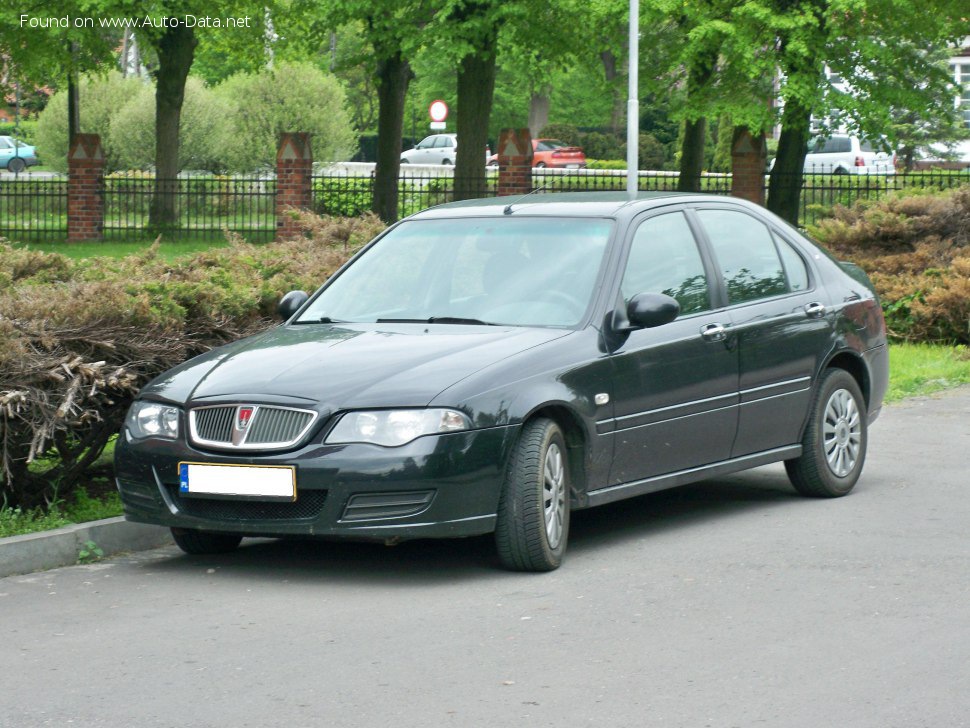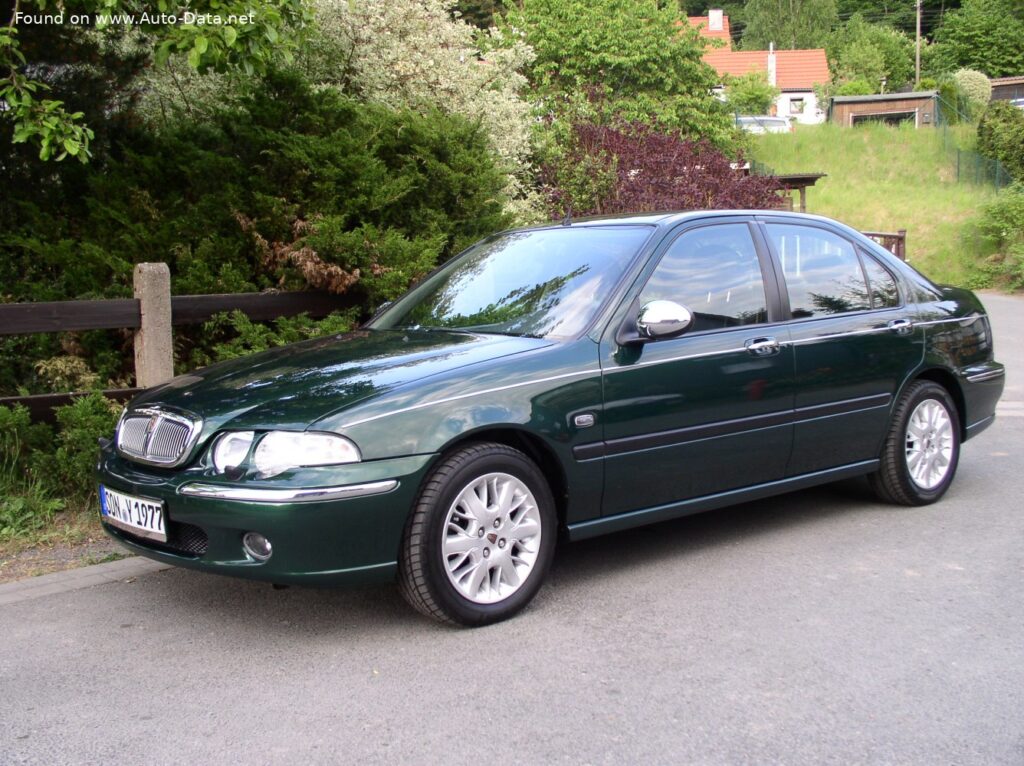
The Rover 45 (RT) represents a significant, albeit challenging, chapter in the history of the British automotive manufacturer, Rover Group. Launched in 1999 as a facelifted and rebadged version of the Rover 400 Series (which itself was based on the Honda Domani/Civic platform), the Rover 45 (RT) aimed to compete in the highly competitive European compact family car segment. The particular variant under scrutiny, the 2.0 TD with 113 horsepower, produced between 2002 and 2005, was a diesel-powered sedan designed to offer a blend of fuel efficiency and adequate performance for the discerning European buyer. While Rover vehicles were never officially sold in the United States, understanding models like the 45 provides valuable insight into the brand’s engineering philosophy and market positioning in its primary European and Asian markets during the early 2000s, a period marked by intense competition and evolving consumer demands. The 45 (RT) was a four-door sedan, offering five seats and a practical interior, striving to uphold Rover’s traditional values of comfort and a slightly more upscale feel compared to its direct rivals.
Rover 45 (RT) 2.0 TD (113 Hp): A Detailed Overview
The Rover 45 (RT) 2.0 TD (113 Hp) occupied a crucial position within Rover’s lineup as a diesel-powered offering in the compact sedan segment. It was designed to appeal to European consumers prioritizing fuel economy and practicality. The “RT” designation signified a specific trim level, often including enhanced features and refinements compared to base models. The vehicle’s origins lie in a collaborative effort with Honda, leveraging the platform of the Honda Domani and Civic, but Rover significantly reworked the design and interior to align with its brand identity and customer expectations.
Engine & Performance
The heart of the Rover 45 (RT) 2.0 TD was a 2.0-liter (1994 cc or 121.68 cubic inches) inline four-cylinder turbodiesel engine, designated with the engine code L / 20T2N. This engine was a key component in Rover’s strategy to capture a growing share of the diesel market, where fuel efficiency and torque were becoming increasingly important to buyers. The engine was mounted transversely at the front of the vehicle, driving the front wheels – a common configuration for cars in this class, maximizing interior space and simplifying manufacturing.
The 2.0 TD engine produced 113 horsepower at 4200 rpm, resulting in a power-to-liter ratio of 56.7 hp per liter. However, its defining characteristic was its substantial torque output of 260 Newton-meters (191.77 lb.-ft.) at a low 2000 rpm. This ample low-end torque provided strong acceleration and effortless cruising, particularly beneficial in urban driving and when the vehicle was fully loaded. Performance figures were competitive for the segment; the 45 2.0 TD could accelerate from 0 to 60 mph in approximately 9.3 seconds, and 0 to 62 mph (100 km/h) in 9.8 seconds, reaching a top speed of 118.06 mph (190 km/h).
Fuel economy was a major selling point. The Rover 45 2.0 TD achieved 30.2 US mpg (7.8 l/100 km) in urban conditions and an impressive 54.7 US mpg (4.3 l/100 km) on the highway. This efficiency was achieved through a common rail direct injection system, a turbocharger, and an intercooler – advanced technologies for the era. The engine featured a high compression ratio of 19.5:1, typical for diesel engines, and utilized an Overhead Camshaft (OHC) valvetrain with two valves per cylinder. Power was transmitted to the front wheels via a smooth-shifting 5-speed manual transmission.
Design & Features
The Rover 45 (RT) maintained the traditional four-door sedan body style, appealing to families and business users. Its design was an evolution of the earlier 400 Series, retaining a distinctive British elegance, though it was beginning to appear dated compared to more contemporary designs from competitors like Volkswagen, Ford, and Vauxhall. The vehicle measured 177.83 inches (4517 mm) in length, 66.77 inches (1696 mm) in width, and 54.88 inches (1394 mm) in height, offering a compact footprint with adequate interior space. A wheelbase of 103.15 inches (2620 mm) contributed to a comfortable ride and stable handling.
The interior of the Rover 45 offered seating for five passengers. Rover prioritized comfort and materials, often incorporating wood trim and quality fabrics or leather options to create a more premium ambiance than many rivals. Practicality was also emphasized, with a trunk (boot) capacity of 16.6 cubic feet (470 liters), expandable to 28.6 cubic feet (810 liters) with the rear seats folded. The chassis featured a front wishbone suspension and a rear spring strut setup, providing a balanced ride and handling. Braking was handled by ventilated discs at the front and solid discs at the rear, equipped with an Anti-lock Braking System (ABS) for enhanced safety. The steering system was a hydraulic power-assisted rack and pinion, offering responsive feedback. The vehicle rode on 195/55 R15 tires, balancing grip and ride comfort. The kerb weight of the 2.0 TD model was 2700.66 lbs. (1225 kg), with a maximum permissible weight of 3902.18 lbs. (1770 kg).
Technical Specifications: Rover 45 (RT) 2.0 TD (113 Hp)
| Category | Specification |
| General Information | |
| Brand | Rover |
| Model | 45 |
| Generation | 45 (RT) |
| Type (Engine) | 2.0 TD (113 Hp) |
| Start of Production | 2002 |
| End of Production | 2005 |
| Powertrain Architecture | Internal Combustion Engine |
| Body Type | Sedan |
| Seats | 5 |
| Doors | 4 |
| Performance Specs | |
| Fuel Consumption (Urban) | 30.2 US mpg (7.8 l/100 km) |
| Fuel Consumption (Extra Urban) | 54.7 US mpg (4.3 l/100 km) |
| Fuel Type | Diesel |
| Acceleration 0 – 60 mph | 9.3 sec |
| Acceleration 0 – 62 mph (0 – 100 km/h) | 9.8 sec |
| Maximum Speed | 118.06 mph (190 km/h) |
| Weight-to-Power Ratio | 10.8 kg/Hp, 92.2 Hp/tonne |
| Weight-to-Torque Ratio | 4.7 kg/Nm, 212.2 Nm/tonne |
| Engine Specs | |
| Power | 113 Hp @ 4200 rpm |
| Power per Liter | 56.7 Hp/l |
| Torque | 191.77 lb.-ft. @ 2000 rpm (260 Nm) |
| Engine Layout | Front, Transverse |
| Engine Model/Code | L / 20T2N |
| Engine Displacement | 2.0 liters (1994 cm3, 121.68 cu. in.) |
| Number of Cylinders | 4 |
| Engine Configuration | Inline |
| Cylinder Bore | 3.33 in. (84.5 mm) |
| Piston Stroke | 3.5 in. (88.9 mm) |
| Compression Ratio | 19.5:1 |
| Number of Valves per Cylinder | 2 |
| Fuel Injection System | Diesel Commonrail |
| Engine Aspiration | Turbocharger, Intercooler |
| Valvetrain | OHC |
| Engine Oil Capacity | 5.28 US qt (5 l) |
| Coolant Capacity | 7.4 US qt (7 l) |
| Space, Volume, and Weights | |
| Kerb Weight | 2700.66 lbs. (1225 kg) |
| Max. Weight | 3902.18 lbs. (1770 kg) |
| Max Load | 1201.52 lbs. (545 kg) |
| Trunk (Boot) Space – Minimum | 16.6 cu. ft. (470 l) |
| Trunk (Boot) Space – Maximum | 28.6 cu. ft. (810 l) |
| Fuel Tank Capacity | 14.53 US gal (55 l) |
| Dimensions | |
| Length | 177.83 in. (4517 mm) |
| Width | 66.77 in. (1696 mm) |
| Height | 54.88 in. (1394 mm) |
| Wheelbase | 103.15 in. (2620 mm) |
| Front Track | 58.07 in. (1475 mm) |
| Rear (Back) Track | 57.68 in. (1465 mm) |
| Drivetrain, Brakes, and Suspension Specs | |
| Drivetrain Architecture | Front-wheel drive (ICE drives front wheels) |
| Drive Wheel | Front Wheel Drive |
| Number of Gears and Type of Gearbox | 5 gears, Manual Transmission |
| Front Suspension | Wishbone |
| Rear Suspension | Spring Strut |
| Front Brakes | Ventilated Discs |
| Rear Brakes | Disc |
| Assisting Systems | ABS (Anti-lock Braking System) |
| Steering Type | Steering rack and pinion |
| Power Steering | Hydraulic Steering |
| Tires Size | 195/55 R15 |
Legacy and Market Impact
The Rover 45 (RT) 2.0 TD (113 Hp), along with its petrol counterparts, played a crucial role in Rover’s strategy to maintain its presence in the competitive European C-segment. In its primary markets, particularly the UK and parts of continental Europe, the 45 competed against established players such as the Ford Focus, Vauxhall Astra (Opel Astra), Volkswagen Golf/Bora (Jetta in the US), Peugeot 307, and Renault Mégane. While the 45 offered a distinctive British charm, a comfortable ride, and a more traditional interior ambiance, its underpinnings, derived from a 1990s Honda design, meant it often lagged behind newer rivals in terms of dynamic prowess and cutting-edge technology.
The diesel variant, especially the 113 horsepower 2.0 TD, was particularly important for fleet sales and for buyers seeking lower running costs. Its strong torque and excellent fuel economy made it an attractive proposition in an era where diesel engines were increasingly favored for their efficiency over long distances. However, despite these strengths, the Rover 45 (RT) faced an uphill battle. Rover Group was undergoing significant financial difficulties and ownership changes throughout the 45’s production run, which impacted development budgets and public perception. The brand struggled to shed its somewhat conservative image and appeal to younger buyers who were drawn to the sportier and more modern designs of its competitors.
The legacy of the Rover 45 is inextricably linked to the eventual demise of the Rover brand itself. Production ceased in 2005 with the collapse of MG Rover Group, marking the end of a long and storied British automotive manufacturer. The 45, therefore, stands as one of the last mainstream Rover models produced, a testament to the brand’s efforts to survive in a rapidly evolving global automotive landscape. While it may not have achieved the widespread success or iconic status of some of its predecessors, the Rover 45 (RT) 2.0 TD served its purpose, offering a practical, comfortable, and efficient option for European consumers who valued a touch of traditional British motoring. Its robust diesel engine and solid, if dated, engineering provided reliable transportation for many, even as the company that built it faced insurmountable challenges. For enthusiasts and historians, the 45 remains a poignant reminder of a unique marque’s final chapter.