
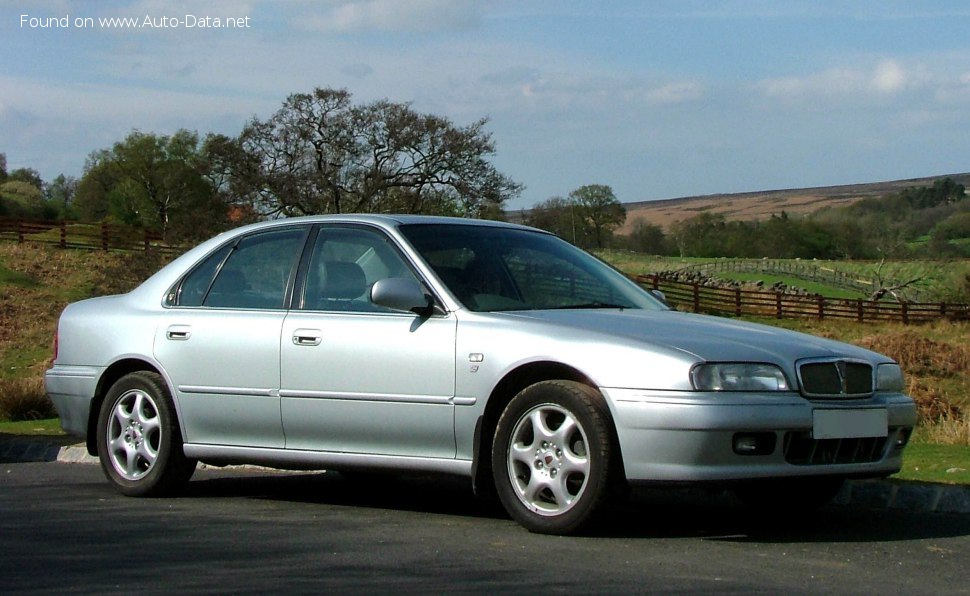
The Rover 600 (RH) 620 i (115 Hp) represents a pivotal moment in the history of the British automotive manufacturer, Rover Group. Launched in 1993, the 600 series was a premium mid-size sedan designed to compete in the highly competitive European D-segment. This generation, internally designated ‘RH’, was a crucial model for Rover, embodying a strategic partnership with Honda that aimed to modernize the brand’s engineering and reliability while preserving a distinctly British aesthetic and a sense of understated luxury.
Rover 600 (RH) 620 i: A Collaborative Effort
While never officially sold in the United States, the Rover 600 played a vital role in Rover’s efforts to establish a strong presence in its primary European markets. It appealed to customers seeking a more executive-feeling sedan than mainstream offerings, but who weren’t quite ready for the higher price point of German luxury brands. The 620 i, with its 115 horsepower, two-liter engine, offered a balanced combination of performance, fuel efficiency, and refinement. The Rover 600 series, and specifically the 620 i, was a product of a time when Rover was seeking to revitalize its image and compete effectively in a rapidly changing automotive landscape.
Engine & Performance
The Rover 600 (RH) 620 i (115 Hp) is powered by a naturally aspirated, 2.0-liter (1997 cm3 or 121.86 cu. in.) inline four-cylinder engine, known as the F20A. This engine was a direct result of the collaboration with Honda, sharing design elements with engines used in various Honda models of the era. The engine features an Overhead Camshaft (OHC) valvetrain with four valves per cylinder, optimizing breathing and providing a good balance of power and torque.
The 620 i delivers a peak output of 115 horsepower at 5300 revolutions per minute (rpm), generating 57.6 horsepower per liter. Torque stands at 172 Newton-meters (approximately 126.86 lb.-ft.) at 4200 rpm, providing adequate pulling power across the mid-range. Power is transmitted to the front wheels via a smooth-shifting 5-speed manual transmission, a common and reliable setup for European sedans of this class. The powertrain utilizes a conventional front, transverse engine layout, driving the front wheels (Front-Wheel Drive).
Performance figures include a 0 to 60 miles per hour acceleration time of approximately 10.3 seconds, with 0 to 62 mph (100 km/h) taking 10.8 seconds. The top speed is rated at 197 km/h, or approximately 122.41 mph. These figures were competitive within its segment, offering sufficient performance for daily driving and highway cruising. Fuel economy was also a strong point, with a combined cycle rating of 8.1 liters per 100 kilometers, equivalent to an impressive 29 US miles per gallon – a commendable figure for a mid-size sedan in the early to mid-1990s.
Design & Features
The design of the Rover 600 (RH) was a deliberate blend of British styling and Japanese engineering. Sharing its platform with the fifth-generation Honda Accord, the 600 series received a completely redesigned exterior and interior by Rover, aiming for a more upscale and traditionally British executive look. The body type is a classic 4-door sedan, accommodating five occupants. Its dimensions are 4645 mm (182.87 inches) in length, 1715 mm (67.52 inches) in width, and 1380 mm (54.33 inches) in height, with a wheelbase of 2720 mm (107.09 inches). These proportions contribute to a spacious cabin and a stable ride.
Key features for the era included a sophisticated suspension system, with double wishbones at both the front and rear. This advanced suspension design, inherited from Honda, provided excellent ride comfort and precise handling, setting the Rover 600 apart in its class. Braking is handled by ventilated discs at the front and solid discs at the rear, complemented by an Anti-lock Braking System (ABS), a crucial safety feature becoming standard in premium vehicles. Steering is a rack and pinion system with hydraulic power assist, offering a direct feel and ease of maneuverability.
The interior of the Rover 600 aimed for an executive ambiance, featuring higher-quality materials, wood trim accents (on higher specifications), and comfortable seating. The trunk space is a practical 405 liters (14.3 cu. ft.), suitable for family travel or business needs. The overall design language emphasized understated elegance and a conservative appeal, differentiating it from its Japanese donor car and aligning it more closely with European competitors.
Technical Specifications: Rover 600 (RH) 620 i (115 Hp)
| Category | Specification |
| General Information | |
| Brand | Rover |
| Model | 600 |
| Generation | 600 (RH) |
| Type (Engine) | 620 i (115 Hp) |
| Start of Production | 1993 |
| End of Production | 1996 |
| Powertrain Architecture | Internal Combustion engine |
| Body type | Sedan |
| Seats | 5 |
| Doors | 4 |
| Performance Specs | |
| Fuel consumption (economy) – urban | 10.5 l/100 km (22.4 US mpg) |
| Fuel consumption (economy) – extra urban | 6.9 l/100 km (34.1 US mpg) |
| Fuel consumption (economy) – combined | 8.1 l/100 km (29 US mpg) |
| Fuel Type | Petrol (Gasoline) |
| Acceleration 0 – 60 mph (Calculated) | 10.3 sec |
| Acceleration 0 – 100 km/h | 10.8 sec |
| Maximum speed | 197 km/h (122.41 mph) |
| Weight-to-power ratio | 10.9 kg/Hp (91.6 Hp/tonne) |
| Weight-to-torque ratio | 7.3 kg/Nm (137.1 Nm/tonne) |
| Engine Specs | |
| Power | 115 Hp @ 5300 rpm |
| Power per liter | 57.6 Hp/l |
| Torque | 172 Nm @ 4200 rpm (126.86 lb.-ft. @ 4200 rpm) |
| Engine layout | Front, Transverse |
| Engine Model/Code | F20A |
| Engine displacement | 1997 cm3 (2.0 liters / 121.86 cu. in.) |
| Number of cylinders | 4 |
| Engine configuration | Inline |
| Cylinder Bore | 85 mm (3.35 in.) |
| Piston Stroke | 88 mm (3.46 in.) |
| Compression ratio | 9:1 |
| Number of valves per cylinder | 4 |
| Fuel injection system | Multi-port manifold injection |
| Engine aspiration | Naturally aspirated engine |
| Valvetrain | OHC |
| Engine oil capacity | 4.9 l (5.18 US qt) |
| Coolant capacity | 7 l (7.4 US qt) |
| Space, Volume and Weights | |
| Kerb Weight | 1255 kg (2766.8 lbs.) |
| Max. weight | 1820 kg (4012.41 lbs.) |
| Max load | 565 kg (1245.61 lbs.) |
| Trunk (boot) space – minimum | 405 l (14.3 cu. ft.) |
| Fuel tank capacity | 65 l (17.17 US gal) |
| Dimensions | |
| Length | 4645 mm (182.87 in.) |
| Width | 1715 mm (67.52 in.) |
| Height | 1380 mm (54.33 in.) |
| Wheelbase | 2720 mm (107.09 in.) |
| Front track | 1475 mm (58.07 in.) |
| Rear (Back) track | 1480 mm (58.27 in.) |
| Drivetrain, Brakes and Suspension Specs | |
| Drivetrain Architecture | Front wheel drive, Internal Combustion engine |
| Drive wheel | Front wheel drive |
| Number of gears and type of gearbox | 5 gears, manual transmission |
| Front suspension | Double wishbone |
| Rear suspension | Double wishbone |
| Front brakes | Ventilated discs |
| Rear brakes | Disc |
| Assisting systems | ABS (Anti-lock braking system) |
| Steering type | Steering rack and pinion |
| Power steering | Hydraulic Steering |
| Tires size | 185/70 R14 H |
Legacy & Market Impact
The Rover 600 (RH) series, including the 620 i, established a distinct position in the European automotive market during its 1993-1996 production run. While it didn’t achieve the sales volumes of mainstream competitors like the Ford Mondeo or Opel Vectra, it successfully positioned itself as a more refined and upscale alternative. Its primary competitors in the European premium mid-size segment included the BMW 3 Series, Mercedes-Benz C-Class, Audi A4, and Saab 900, though the Rover often offered a more value-oriented proposition.
The car’s reputation benefited from its Honda underpinnings, which brought a level of reliability and engineering sophistication that Rover had sometimes struggled to achieve independently. This collaboration allowed Rover to offer a car with modern dynamics and a comfortable ride, wrapped in a distinctive British package. The 600 series was praised for its quiet cabin, smooth powertrain, and comfortable interior, contributing to Rover’s image as a producer of refined automobiles.
Despite its qualities, the Rover 600’s reliance on Honda for its core architecture also presented challenges. It was seen by some as lacking a truly unique Rover identity in its mechanicals, and its relatively high price compared to mainstream D-segment cars, combined with the strong brand loyalty enjoyed by German rivals, limited its market penetration. Nevertheless, the 600 series was a commercial success for Rover, helping to bridge the gap between its smaller models and the larger 800 series.
The end of its production in 1996 marked the beginning of the end for the Rover-Honda alliance. The 600 series was replaced by the Rover 75, a car developed entirely in-house by Rover, aiming to recapture a more distinct British identity. Today, the Rover 600 (RH) 620 i (115 Hp) is remembered as a well-engineered and comfortable executive sedan, a testament to a unique period of Anglo-Japanese automotive cooperation, and a significant model in Rover’s history.
