
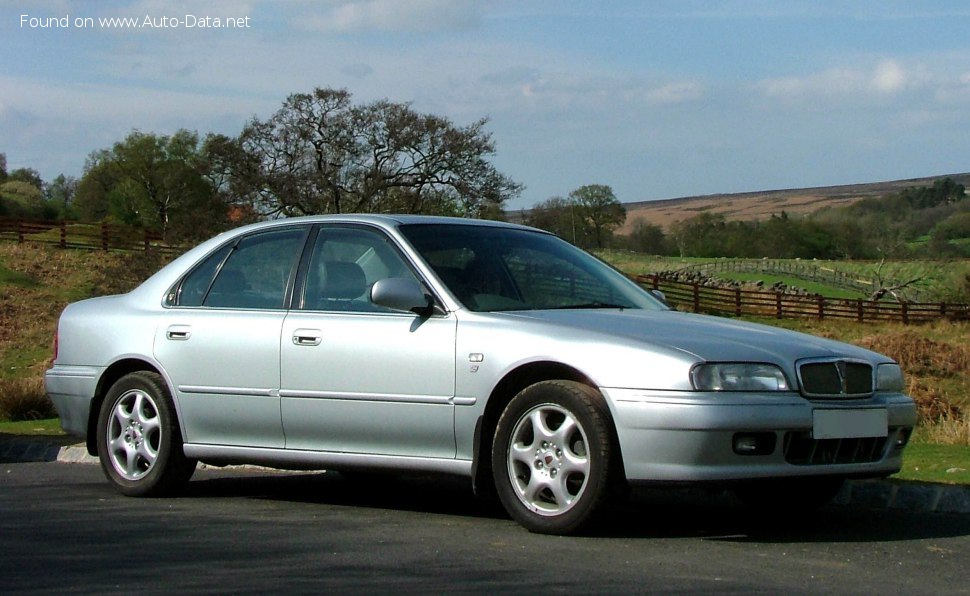
The Rover 600 (RH) 620 Si (131 Hp) represents a pivotal moment in the history of the British automotive manufacturer, Rover Group. Launched in 1993 and continuing in production until 1999, the 600 series was Rover’s attempt to establish a foothold in the competitive executive compact/mid-size sedan segment, primarily aimed at the European market. This model distinguished itself from many of its predecessors through a strategic partnership with Honda, leveraging the platform and numerous mechanical components of the fifth-generation Honda Accord. This collaboration sought to combine Rover’s traditional British styling and refinement with Honda’s well-regarded reliability and engineering expertise, a critical move for the brand amidst increasing global competition. The 620 Si variant, powered by a 131 horsepower engine, was positioned as a balanced offering, delivering respectable performance alongside a comfortable and upscale driving experience.
Rover 600 (RH) 620 Si: A Fusion of British Style and Japanese Engineering
The Rover 600 project arose from British Leyland’s (later Rover Group) need for a modern, competitive D-segment vehicle. Facing financial constraints and a reputation for questionable reliability, Rover sought a partner to share development costs and benefit from established engineering prowess. Honda, already supplying engines to Rover, proved to be the ideal collaborator. The resulting 600 series was essentially a Rover-styled reskin of the Honda Accord, sharing its platform, suspension, and many powertrain components. This approach allowed Rover to rapidly introduce a new model without the massive investment required for a completely independent design. The 620 Si, as the higher-performance trim level, aimed to attract buyers seeking a more engaging driving experience within the executive sedan class.
Engine & Performance
The Rover 600 (RH) 620 Si (131 Hp) is powered by a 2.0-liter (1997 cm³ or 121.86 cu. in.) naturally aspirated inline-four gasoline engine, designated the F20Z1. This engine benefited directly from the Honda collaboration, offering a smooth and reliable power delivery. Producing 131 horsepower at 5400 rpm and 131.29 lb.-ft. (178 Nm) of torque at 4800 rpm, the 620 Si provided adequate performance for its class. The engine incorporated a multi-port fuel injection system and an overhead camshaft (OHC) valvetrain with four valves per cylinder, optimizing combustion efficiency and throttle response.
Power is transmitted to the front wheels through a well-regarded 5-speed manual transmission. This drivetrain configuration enabled the Rover 600 (RH) 620 Si (131 Hp) to accelerate from 0 to 60 mph in 9.7 seconds (0-100 km/h in 10.2 seconds), reaching a top speed of 124.27 mph (200 km/h). These figures were competitive within its segment, offering a blend of sportiness and practicality for both daily commutes and longer journeys. Fuel economy was rated at a combined 26.7 US mpg (8.8 l/100 km), a respectable figure for a non-turbocharged 2.0-liter sedan from the mid-1990s, aided by its relatively low curb weight of 2799.87 lbs (1270 kg). The car’s weight-to-power ratio of 9.7 kg/Hp further demonstrates a well-engineered balance for its target market.
Design & Features
The Rover 600 (RH) adopted a traditional four-door sedan body style, designed to project an understated elegance that combined British design sensibilities with Japanese practicality. The interior accommodated five passengers and was designed to provide a comfortable and refined environment. Exterior dimensions – a length of 182.87 inches (4645 mm), a width of 67.52 inches (1715 mm), and a height of 54.33 inches (1380 mm) – contributed to its executive sedan proportions, providing a substantial presence without being overly large. A 107.09-inch (2720 mm) wheelbase ensured a stable ride and generous interior space, particularly for rear occupants.
The Rover 600 (RH) 620 Si (131 Hp) featured an advanced suspension system for its time, utilizing a double wishbone configuration at both the front and rear. This sophisticated setup, inherited from the Honda Accord, delivered a superior balance of ride comfort and handling precision, differentiating it from competitors still employing simpler MacPherson strut designs. Braking was handled by ventilated discs at the front and solid discs at the rear, enhanced by an Anti-lock Braking System (ABS) for improved safety. The rack and pinion steering, equipped with hydraulic power assistance, provided precise feedback and ease of maneuverability. The vehicle rode on 185/65 R15 H tires, offering a good compromise between grip and ride comfort. Trunk capacity was 14.3 cu. ft. (405 liters), providing ample storage space for luggage, making it suitable for both family and executive use.
Technical Specifications
| Category | Specification |
| Brand | Rover |
| Model | 600 |
| Generation | 600 (RH) |
| Type (Engine) | 620 Si (131 Hp) |
| Start of Production | 1993 |
| End of Production | 1999 |
| Powertrain Architecture | Internal Combustion engine |
| Body Type | Sedan |
| Seats | 5 |
| Doors | 4 |
| Fuel Consumption (combined) | 8.8 l/100 km (26.7 US mpg) |
| Fuel Type | Petrol (Gasoline) |
| Acceleration 0-60 mph | 9.7 sec |
| Maximum Speed | 124.27 mph (200 km/h) |
| Power | 131 Hp @ 5400 rpm |
| Torque | 131.29 lb.-ft. (178 Nm) @ 4800 rpm |
| Engine Layout | Front, Transverse |
| Engine Model/Code | F20Z1 |
| Engine Displacement | 1997 cm³ (121.86 cu. in.) |
| Number of Cylinders | 4 |
| Engine Configuration | Inline |
| Cylinder Bore | 3.35 in. (85 mm) |
| Piston Stroke | 3.46 in. (88 mm) |
| Compression Ratio | 9.5:1 |
| Number of Valves per Cylinder | 4 |
| Fuel Injection System | Multi-port manifold injection |
| Engine Aspiration | Naturally aspirated engine |
| Valvetrain | OHC |
| Engine Oil Capacity | 5.18 US qt (4.9 l) |
| Coolant Capacity | 7.4 US qt (7 l) |
| Kerb Weight | 2799.87 lbs (1270 kg) |
| Max. Weight | 4012.41 lbs (1820 kg) |
| Max Load | 1212.54 lbs (550 kg) |
| Trunk (boot) Space – Minimum | 14.3 cu. ft. (405 l) |
| Fuel Tank Capacity | 17.17 US gal (65 l) |
| Length | 182.87 in. (4645 mm) |
| Width | 67.52 in. (1715 mm) |
| Height | 54.33 in. (1380 mm) |
| Wheelbase | 107.09 in. (2720 mm) |
| Front Track | 58.07 in. (1475 mm) |
| Rear (Back) Track | 58.27 in. (1480 mm) |
| Drivetrain Architecture | Front wheel drive. Internal Combustion engine. |
| Drive Wheel | Front wheel drive |
| Number of Gears and Type of Gearbox | 5 gears, manual transmission |
| Front Suspension | Double wishbone |
| Rear Suspension | Double wishbone |
| Front Brakes | Ventilated discs |
| Rear Brakes | Disc |
| Assisting Systems | ABS (Anti-lock braking system) |
| Steering Type | Steering rack and pinion |
| Power Steering | Hydraulic Steering |
| Tires Size | 185/65 R15 H |
Legacy and Market Impact
The Rover 600 (RH) 620 Si (131 Hp) established a unique position in the European market. Its primary competitors included the Ford Mondeo, Vauxhall Vectra (Opel Vectra), Volkswagen Passat, and Peugeot 406. The 600 series differentiated itself through its blend of traditional British luxury aesthetics, featuring wood trim and leather options, combined with the inherent reliability of Honda engineering. This combination appealed to buyers seeking a distinctive and characterful alternative to the more conservative German or mainstream European offerings without compromising dependability.
The Rover 600’s reputation was significantly bolstered by its Honda underpinnings. The F20Z1 engine, transmission, and suspension components were known for their durability and smooth operation, addressing previous concerns about Rover’s build quality. This strategic alliance was crucial for Rover, enabling it to offer a competitive product in a segment where quality and refinement were paramount. While not a high-volume seller compared to some rivals, the 600 series played a vital role in enhancing Rover’s brand image and providing a more modern, capable vehicle in its lineup during a challenging period for the British automotive industry. It helped bridge the gap between Rover’s traditional image and the demands of the modern car market, leaving a legacy as a comfortable, well-engineered, and subtly stylish executive sedan that offered a compelling value proposition to those seeking a distinctive choice.
