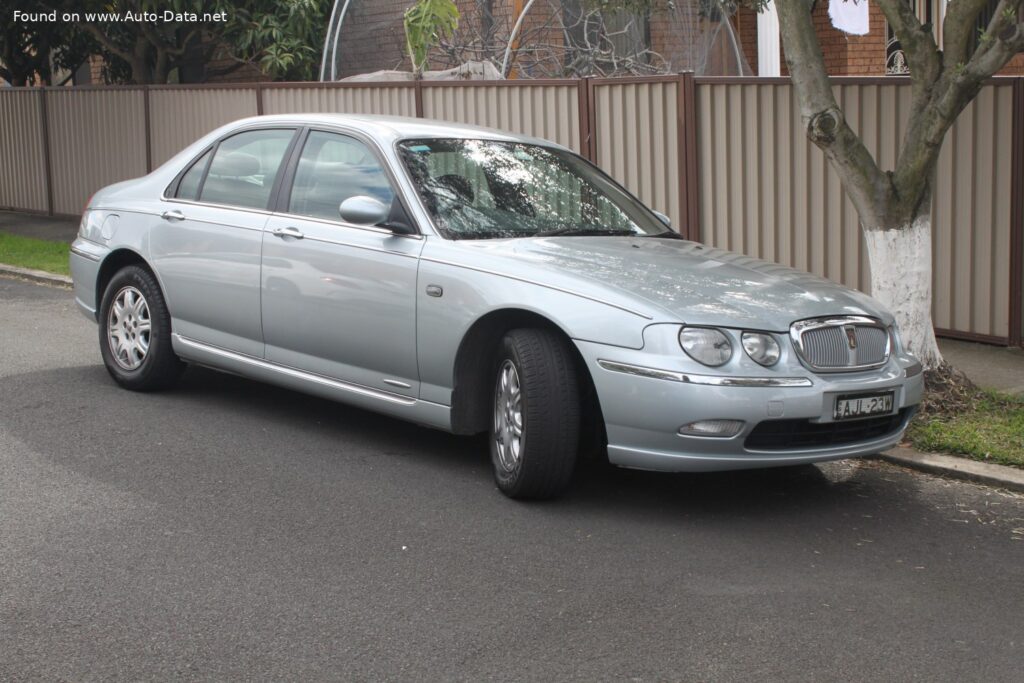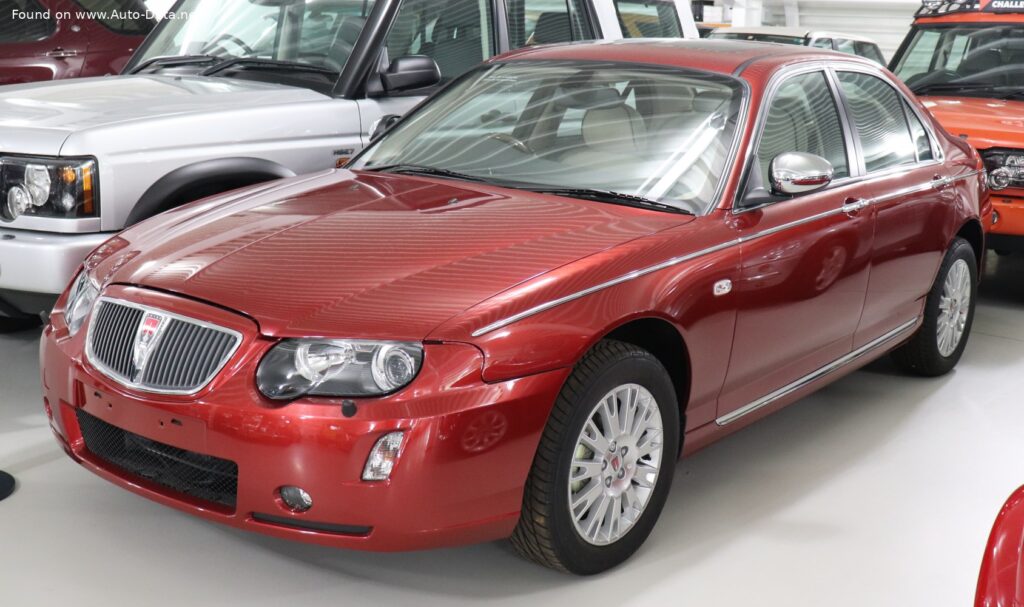
The Rover 75 (facelift 2004) represents the final iteration of a distinctive executive sedan produced by the British manufacturer Rover. Launched in 2004 as an update to the critically acclaimed original 75, this model aimed to refresh its appeal in the competitive European D-segment before the unfortunate collapse of MG Rover Group in 2005. Positioned as a mid-size vehicle, the Rover 75 sought to blend traditional British luxury and craftsmanship with modern engineering, a legacy largely influenced by its development under BMW ownership. While never officially sold in the United States market, the Rover 75 carved out a unique niche in Europe and other global markets as an elegant, comfortable, and somewhat retro-styled alternative to its German and Japanese rivals. This particular variant, equipped with the 1.8-liter (120 HP) gasoline engine, served as an accessible entry point into the Rover 75 lineup, offering a balance of performance and efficiency for its time.
Rover 75 (Facelift 2004): A Detailed Overview
The Rover 75, particularly the 2004 facelift, stands as a poignant example of British automotive engineering during a period of significant industry change. Developed largely under BMW’s ownership, the 75 aimed to recapture the essence of traditional Rover luxury while incorporating contemporary technology. Its failure to achieve substantial sales volume, coupled with the eventual demise of MG Rover, has cemented its status as a collector’s item and a symbol of a bygone era of British motoring. The facelifted model, introduced in 2004, represented a final attempt to bolster sales with subtle styling revisions and refinements.
Engine & Performance
Under the hood of the Rover 75 (facelift 2004) 1.8 resided Rover’s 1.8-liter (1,796 cm3 or 109.6 cu. in.) 18K4F inline-four gasoline engine. This naturally aspirated, DOHC (Double Overhead Camshaft) unit featured a multi-port fuel injection system and four valves per cylinder, a configuration designed for smooth power delivery and reasonable fuel economy. The engine produced 120 horsepower at 5500 rpm and a peak torque of 118.01 lb.-ft. at 4000 rpm. While not intended for high-performance driving, this powertrain provided adequate power for the sedan, prioritizing refinement and a relaxed driving experience consistent with the Rover brand’s reputation.
Power was transferred to the front wheels via a five-speed manual transmission, a common configuration for European sedans of this class. This combination enabled the 1.8-liter Rover 75 to accelerate from 0 to 60 mph in 10.9 seconds, reaching a top speed of 121.17 mph. Fuel efficiency was respectable for its time, achieving a combined cycle rating of 30.2 US mpg (7.8 liters per 100 km). The vehicle met the Euro 3 emission standard, demonstrating its environmental considerations for the early 2000s. The engine’s weight-to-power ratio was 11.7 kg per HP (85.7 HP per tonne), indicating a balanced approach to performance characteristics rather than prioritizing outright speed.
Design & Features
The Rover 75 (facelift 2004) retained the distinctive and somewhat retro styling that characterized the model since its 1998 introduction. The facelift incorporated subtle yet effective changes, including a revised front grille, updated headlamps, and reprofiled bumpers, aiming to modernize the car’s appearance while preserving its classic British aesthetic. The body style remained a four-door sedan, comfortably accommodating five passengers. Its dimensions – a length of 186.97 inches and a width of 70 inches (77.56 inches including mirrors) – contributed to its executive presence on the road.
The interior of the Rover 75 was renowned for its luxurious and traditional cabin. High-quality materials, often including real wood trim, chrome accents, and plush upholstery, created an inviting and upscale atmosphere. The emphasis was on comfort and refinement, with well-padded seats and a quiet interior designed to minimize road noise. Standard features for the era included power steering with a hydraulic rack and pinion system and an Anti-lock Braking System (ABS) for enhanced safety. The suspension comprised an independent McPherson strut system with coil springs and an anti-roll bar at the front, paired with an independent multi-link spring suspension with a stabilizer at the rear, tuned to provide a comfortable ride. Braking was handled by ventilated discs at the front and solid discs at the rear. The vehicle typically rode on 15-inch or 16-inch wheels, with tire sizes ranging from 195/65 R15 to 215/55 R16, depending on the trim level. Practicality was also considered, with a trunk capacity ranging from 15.26 cu. ft. (432 liters) to a maximum of 23.8 cu. ft. (674 liters) with the rear seats folded, and a fuel tank capacity of 17.17 US gallons (65 liters) providing a reasonable cruising range.
Technical Specifications
| General Information | |
| Brand | Rover |
| Model | 75 |
| Generation | 75 (facelift 2004) |
| Type (Engine) | 1.8 (120 Hp) |
| Start of Production | 2004 |
| End of Production | 2005 |
| Powertrain Architecture | Internal Combustion engine |
| Body type | Sedan |
| Seats | 5 |
| Doors | 4 |
| Performance Specs | |
| Fuel Consumption (Urban) | 10.6 l/100 km (22.2 US mpg) |
| Fuel Consumption (Extra Urban) | 6.1 l/100 km (38.6 US mpg) |
| Fuel Consumption (Combined) | 7.8 l/100 km (30.2 US mpg) |
| CO2 Emissions | 184 g/km |
| Fuel Type | Petrol (Gasoline) |
| Acceleration 0 – 60 mph | 10.9 sec |
| Maximum Speed | 195 km/h (121.17 mph) |
| Emission Standard | Euro 3 |
| Weight-to-Power Ratio | 11.7 kg/Hp (85.7 Hp/tonne) |
| Weight-to-Torque Ratio | 8.8 kg/Nm (114.3 Nm/tonne) |
| Engine Specs | |
| Power | 120 Hp @ 5500 rpm |
| Power per Liter | 66.8 Hp/l |
| Torque | 160 Nm @ 4000 rpm (118.01 lb.-ft. @ 4000 rpm) |
| Engine Layout | Front, Transverse |
| Engine Model/Code | 18K4F |
| Engine Displacement | 1796 cm3 (109.6 cu. in.) |
| Number of Cylinders | 4 |
| Engine Configuration | Inline |
| Cylinder Bore | 80 mm (3.15 in.) |
| Piston Stroke | 89.3 mm (3.52 in.) |
| Compression Ratio | 10.5:1 |
| Number of Valves per Cylinder | 4 |
| Fuel Injection System | Multi-port manifold injection |
| Engine Aspiration | Naturally aspirated engine |
| Valvetrain | DOHC |
| Engine Oil Capacity | 4.5 l (4.76 US qt) |
| Coolant Capacity | 6.2 l (6.55 US qt) |
| Space, Volume and Weights | |
| Kerb Weight | 1400-1515 kg (3086.47 – 3340 lbs.) |
| Max. Weight | 1940 kg (4276.97 lbs.) |
| Max Load | 425-540 kg (936.96 – 1190.5 lbs.) |
| Trunk (Boot) Space – Minimum | 432 l (15.26 cu. ft.) |
| Trunk (Boot) Space – Maximum | 674 l (23.8 cu. ft.) |
| Fuel Tank Capacity | 65 l (17.17 US gal) |
| Dimensions | |
| Length | 4749 mm (186.97 in.) |
| Width | 1778 mm (70 in.) |
| Width Including Mirrors | 1970 mm (77.56 in.) |
| Height | 1393 mm (54.84 in.) |
| Wheelbase | 2746 mm (108.11 in.) |
| Drivetrain, Brakes and Suspension Specs | |
| Drivetrain Architecture | The Internal combustion engine (ICE) drives the front wheels of the vehicle. |
| Drive Wheel | Front wheel drive |
| Number of Gears and Type of Gearbox | 5 gears, manual transmission |
| Front Suspension | Independent, type McPherson with coil spring and anti-roll bar |
| Rear Suspension | Independent multi-link spring suspension with stabilizer |
| Front Brakes | Ventilated discs |
| Rear Brakes | Disc |
| Assisting Systems | ABS (Anti-lock braking system) |
| Steering Type | Steering rack and pinion |
| Power Steering | Hydraulic Steering |
| Tires Size | 195/65 R15; 205/60 R15; 215/55 R16 |
Legacy and Market Impact
The Rover 75 (facelift 2004) occupied a distinctive position in the European automotive landscape. It competed against mainstream D-segment rivals like the Ford Mondeo, Vauxhall/Opel Vectra, and Volkswagen Passat, but offered a more luxurious and traditionally British alternative. Despite its appealing qualities, the Rover 75 struggled to gain significant market share, hampered by quality control issues and the financial instability of MG Rover. The car’s discontinuation with the collapse of the company has led to a growing collector base, recognizing it as a unique and historically significant vehicle representing the final chapter of independent British automotive manufacturing.