
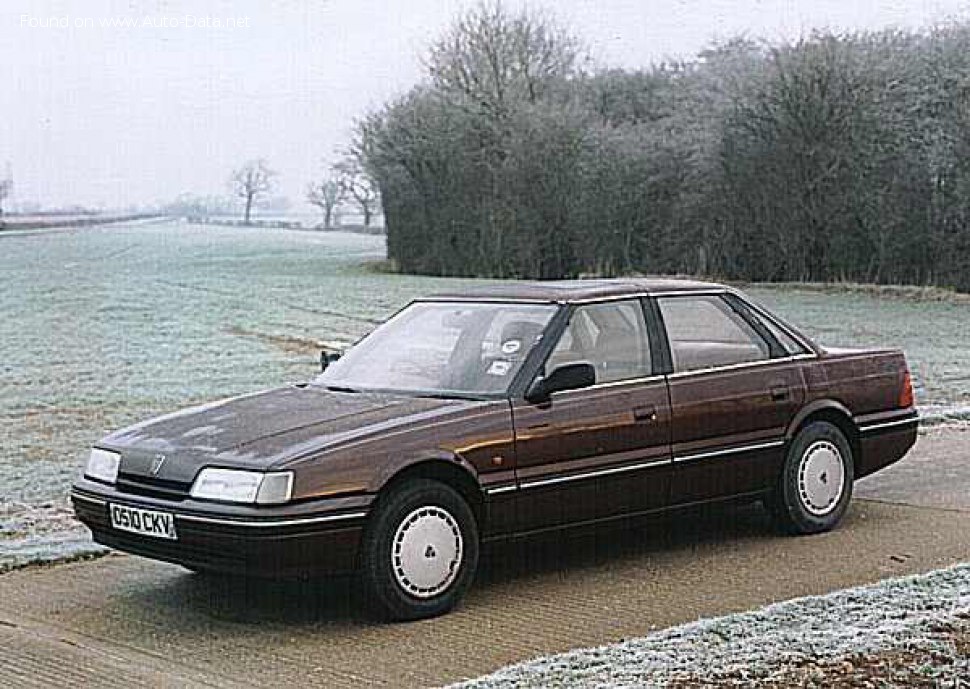
The Rover 800 series, and specifically the 820 I/SI (RS) variant, represents a pivotal moment in the history of the British automotive manufacturer, Rover. Introduced in 1992 as a comprehensive refresh of the original 800 series (internally designated R17, succeeding the XX generation), the RS generation aimed to revitalize Rover’s flagship executive sedan. While the Rover 800 had a limited presence in North America under the Sterling brand, the 820 I/SI (RS) was primarily designed for and sold in Europe and other right-hand drive markets, embodying a fusion of traditional British luxury and contemporary engineering for its era.
Rover 800 820 I/SI (RS): A British Executive Sedan
Positioned within the competitive European executive car segment, the Rover 800 820 I/SI (RS) sought to deliver a refined driving experience, a comfortable interior, and distinctive styling. It directly challenged established German and European manufacturers, appealing to buyers seeking a sophisticated, well-appointed vehicle that differentiated itself from mainstream competitors. The 820 I/SI (RS), equipped with the 2.0-liter M16i engine, proved popular due to its balance of performance and efficiency, attracting both individual buyers and fleet customers.
Engine & Performance
The Rover 800 820 I/SI (RS) is powered by the M16i engine, a testament to Rover’s in-house engineering capabilities during a period of significant change for the company. This 2.0-liter (1994 cm3 or 121.68 cu. in.) inline-four engine is naturally aspirated and features a Double Overhead Camshaft (DOHC) valvetrain with four valves per cylinder. This configuration, combined with a multi-port fuel injection system, allows the engine to produce 136 horsepower at 6000 rpm.
Peak torque of 184 Nm (135.71 lb.-ft.) is delivered at 2500 rpm, contributing to the engine’s smooth and tractable nature in everyday driving. This torque characteristic provides responsive performance at lower engine speeds, making the car suitable for both urban driving and relaxed highway cruising. Power is transferred to the front wheels through a 5-speed manual transmission, a common and reliable setup for vehicles in this class during the 1990s.
Performance figures include a 0 to 60 mph acceleration time of approximately 9.7 seconds, and a 0-100 km/h sprint in 10.2 seconds. The car has a maximum speed of 125.52 mph (202 km/h). While not a sports sedan, these figures were competitive for an executive car of its size and engine displacement, offering sufficient performance for comfortable long-distance travel. Fuel economy is rated at a combined 8.2 liters per 100 kilometers, equivalent to approximately 28.7 US mpg, a reasonable figure for a vehicle of its weight and age.
Design & Features
The “RS” generation of the Rover 800 represents a significant visual departure from its predecessor. The original 800 was a product of a joint venture with Honda (and sold as the Acura Legend in North America), but the RS facelift was an entirely in-house Rover design. Key changes included a more rounded, less angular aesthetic, a revised front fascia with a more prominent grille and updated headlamps, and a redesigned rear end. These modifications aimed to give the car a more contemporary and distinctly British appearance, moving away from its Honda-derived styling.
The Rover 800 820 I/SI (RS) is exclusively available as a four-door sedan, offering seating for five passengers. Its generous dimensions – a length of 192.2 inches (4882 mm) and a wheelbase of 108.9 inches (2766 mm) – ensure a spacious and comfortable cabin. The interior is designed with an emphasis on traditional British luxury, often featuring wood veneer trim, plush upholstery, and a comprehensive array of features for its time. Standard amenities typically include power windows, central locking, and a quality audio system, reflecting its executive positioning.
Safety features for the era include the Anti-lock Braking System (ABS), standard on many I/SI trim levels, providing enhanced control during heavy braking. The car utilizes a robust suspension system, with a double wishbone setup at the front and coil springs at the rear, contributing to its comfortable ride quality. Braking is provided by ventilated discs at the front and solid discs at the rear, offering effective stopping power for a vehicle weighing 2943.17 lbs (1335 kg).
Technical Specifications: Rover 800 820 I/SI (RS) (136 Hp)
| Category | Specification |
| General Information | |
| Brand | Rover |
| Model | 800 |
| Generation | 800 (RS) |
| Type (Engine) | 820 I/SI (RS) (136 Hp) |
| Start of Production | 1992 |
| End of Production | 1999 |
| Powertrain Architecture | Internal Combustion engine |
| Body Type | Sedan |
| Seats | 5 |
| Doors | 4 |
| Performance Specifications | |
| Fuel Consumption (combined) | 8.2 l/100 km |
| Fuel Type | Petrol (Gasoline) |
| Acceleration 0 – 60 mph | 9.7 sec |
| Acceleration 0 – 100 km/h | 10.2 sec |
| Maximum Speed | 202 km/h |
| Weight-to-Power Ratio | 9.8 kg/Hp |
| Weight-to-Torque Ratio | 7.3 kg/Nm |
| Engine Specifications | |
| Power | 136 Hp @ 6000 rpm |
| Power per Litre | 68.2 Hp/l |
| Torque | 184 Nm @ 2500 rpm |
| Engine Layout | Front, Transverse |
| Engine Model/Code | M16i |
| Engine Displacement | 1994 cm3 |
| Number of Cylinders | 4 |
| Engine Configuration | Inline |
| Cylinder Bore | 84.45 mm |
| Piston Stroke | 89 mm |
| Compression Ratio | 10:1 |
| Number of Valves per Cylinder | 4 |
| Fuel Injection System | Multi-port manifold injection |
| Engine Aspiration | Naturally aspirated engine |
| Valvetrain | DOHC |
| Space, Volume, and Weights | |
| Kerb Weight | 1335 kg |
| Max. Weight | 1910 kg |
| Trunk (boot) Space – minimum | 445 l |
| Fuel Tank Capacity | 68 l |
| Dimensions | |
| Length | 4882 mm |
| Width | 1730 mm |
| Height | 1393 mm |
| Wheelbase | 2766 mm |
| Drivetrain, Brakes, and Suspension | |
| Drivetrain Architecture | Front-wheel drive, Internal Combustion Engine |
| Front Suspension | Double wishbone |
| Rear Suspension | Coil spring |
The Rover 800 820 I/SI (RS) played a vital role in Rover’s attempt to maintain a foothold in the executive car market during the 1990s. In Europe, it faced strong competition from established rivals like the Ford Granada/Scorpio and BMW 5-Series. While it didn’t achieve the sales figures of its German competitors, the 800 established a niche as a distinctly British alternative, praised for its comfortable ride and traditional interior. The RS facelift modernized the car’s image and offered a compelling package for those who valued a softer, more luxurious driving experience. Despite facing challenges related to build quality perceptions and increasing competition, the Rover 800 820 I/SI (RS) remains a significant vehicle in automotive history as the last flagship executive sedan from an independent Rover, representing a time when British manufacturers still aimed to compete at the highest levels of the passenger car market.
