
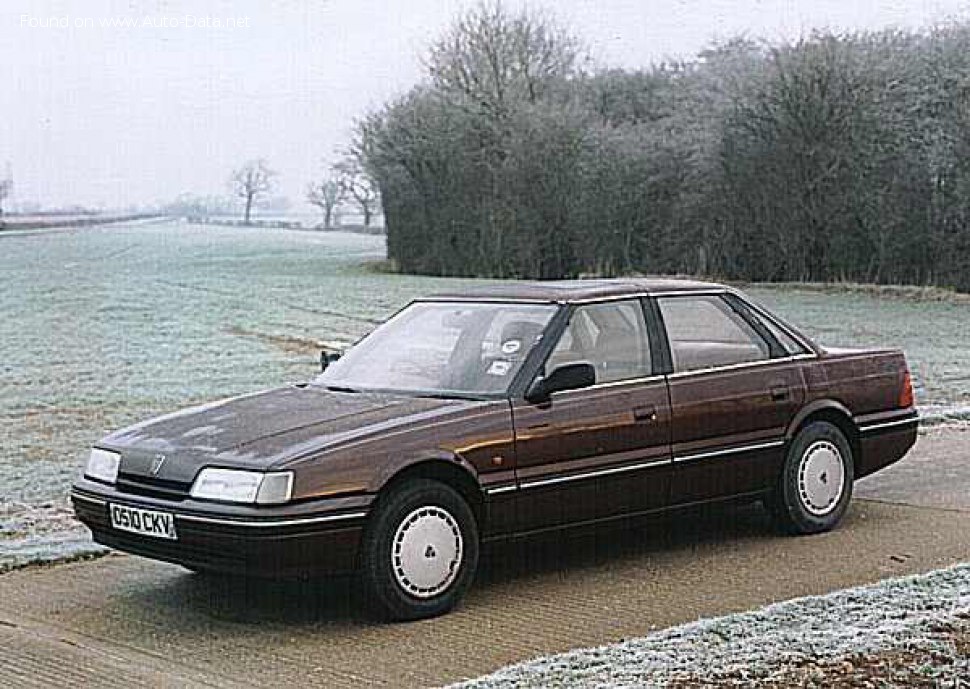
The Rover 800 825 SI/Sterling (XS) (167 Hp) represents a significant chapter in the history of the British automaker Rover Group. Introduced in 1986, this executive sedan marked the first major outcome of a collaborative venture between Rover and Honda, sharing its platform with the first-generation Honda Legend. Designed to revitalize Rover’s presence in the competitive luxury car segment, the 800 series was marketed in Europe and, notably, in North America under the Sterling brand. The Rover 800 aimed to blend traditional British luxury with the renowned reliability of Japanese engineering.
The Rover 800: A British-Japanese Collaboration
The “XS” designation refers to the project code for the initial generation of the Rover 800. The 825 SI and Sterling trims distinguished the different levels of luxury and equipment available. The 825 SI was a well-equipped executive car, while the Sterling represented the top of the range, often featuring more opulent interiors and advanced features for the time. The Rover 800 825 SI/Sterling (XS) was engineered to deliver comfort, refinement, and a sophisticated driving experience, positioning it as a competitor to established German and Swedish luxury vehicles.
Engine & Performance
Powering the Rover 800 825 SI/Sterling (XS) (167 Hp) was a Honda-sourced powertrain, a key element of its appeal and reliability. The engine, designated C25A, was a 2.5-liter (2494 cc) naturally aspirated V6 gasoline engine. This engine was a direct result of the Rover-Honda partnership, providing a smooth, refined, and capable performance for an executive sedan of the era. Producing a peak output of 167 horsepower, the C25A engine offered respectable acceleration and cruising speeds suitable for both European motorways and American interstates.
The V6 configuration inherently provided excellent balance and reduced vibration, enhancing the car’s luxurious feel. It was typically paired with either a five-speed manual or a four-speed automatic transmission, with the automatic being more common in the higher trim levels and the North American Sterling models. The front-wheel-drive layout, another aspect of the Honda collaboration, offered predictable handling and good traction in various conditions, a departure from Rover’s traditional rear-wheel-drive large sedans. While not designed as a sports sedan, the 825 SI/Sterling provided a comfortable and composed ride, prioritizing passenger comfort and quietness over aggressive handling. The naturally aspirated engine delivered a linear power curve, making it a pleasant and reliable unit for both daily commutes and long-distance journeys.
Design & Features
The Rover 800’s design, particularly the sedan body style of the 825 SI/Sterling, combined European executive car styling with the clean, aerodynamic forms favored by Honda. The overall aesthetic was modern and understated for the late 1980s, aiming for a sophisticated rather than ostentatious appearance. Its sleek profile, flush glass, and contemporary grille gave it a distinctive identity, although its connection to the Honda Legend was apparent in its proportions and roofline. The sedan body type prioritized practicality and passenger space, offering a spacious cabin and a generous trunk capacity, essential for its target demographic.
The interiors of the Rover 800 825 SI and Sterling models were designed to evoke traditional British luxury. The Sterling, in particular, was known for its opulent cabin, featuring extensive use of genuine wood trim, often burr walnut, and high-quality leather upholstery. Standard features for these upper trims included power windows, power mirrors, central locking, and an advanced climate control system for the time. Higher-end models like the Sterling also commonly included electric seat adjustment, a premium audio system, and cruise control. Safety features, while not as comprehensive as those found in modern vehicles, included standard seatbelts for all occupants and a robust body structure designed to meet the safety standards of the period. The ergonomic layout and comfortable seating ensured a refined and pleasant environment for both driver and passengers, solidifying its position as a true executive vehicle.
Technical Specifications
| Brand | Rover |
| Model | 800 |
| Generation | 800 |
| Type (Engine) | 825 SI/Sterling (XS) (167 Hp) |
| Start of Production | 1986 |
| End of Production | 1988 |
| Powertrain Architecture | Internal Combustion Engine (Front-Wheel Drive) |
| Body Type | Sedan |
| Fuel Type | Petrol (Gasoline) |
| Power | 167 Hp |
| Engine Model/Code | C25A |
| Engine Aspiration | Naturally aspirated engine |
| Engine Oil Capacity | 4.5 liters (4.76 US quarts | 3.96 UK quarts) |
| Coolant Capacity | 10 liters (10.57 US quarts | 8.8 UK quarts) |
Legacy and Market Impact
The Rover 800 series, and specifically the 825 SI/Sterling, occupies a significant place in Rover’s history, representing both a peak of ambition and a complex period for the British automaker. In Europe, the 800 was considered a viable competitor to executive sedans from BMW (5-series), Mercedes-Benz (E-Class), and Volvo (740/760). Its combination of British luxury and Japanese engineering offered a compelling package, helping Rover to overcome its previous reputation for inconsistent build quality.
The car’s role in the North American market, where it was sold as the Sterling 825 and later 827, was particularly noteworthy. Launched with high expectations, the Sterling aimed to capture a share of the lucrative luxury import market. While initially praised for its styling, comfortable ride, and luxurious interior, its reputation suffered from early reliability issues, particularly with electrical systems and trim quality, which contrasted with the reliability of its Honda Legend counterpart. This perception hindered its long-term success in the U.S., despite subsequent improvements.
Despite its mixed results, the Rover 800 825 SI/Sterling (XS) (167 Hp) played a crucial role in sustaining the Rover brand during a challenging time for the British automotive industry. It demonstrated Rover’s ability to produce a competitive executive car and highlighted the benefits of international collaboration. The car’s legacy is one of a determined effort to redefine British luxury for a modern era, blending heritage with innovation. Today, early 800 series models, particularly well-preserved Sterling examples, are appreciated by enthusiasts for their distinctive styling, comfortable ride, and as a reminder of a unique partnership that shaped British automotive history.
