
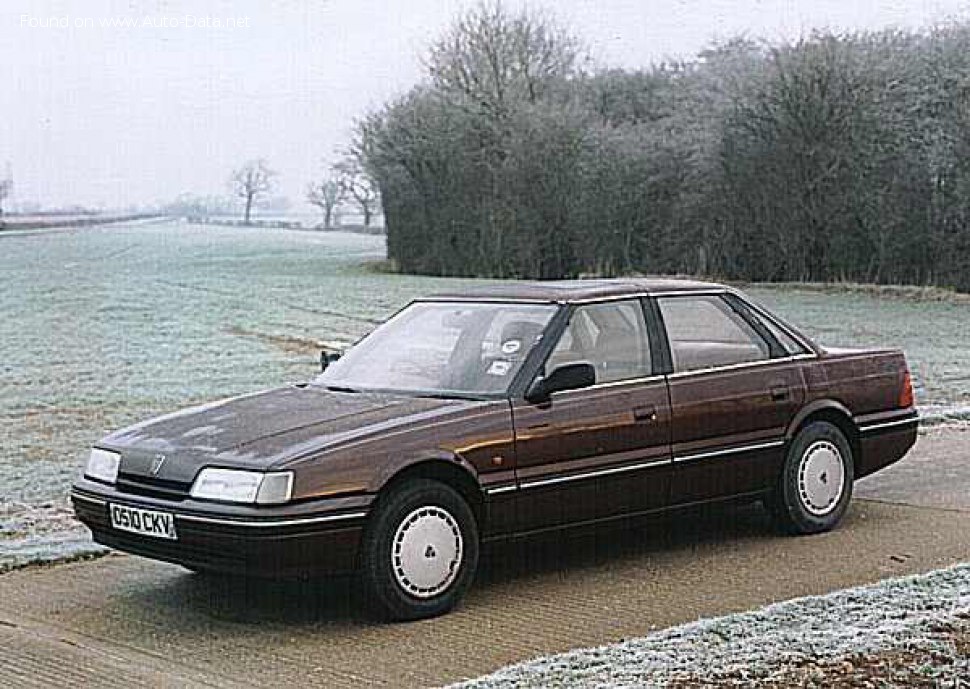
The Rover 800 825 SI/Sterling (XS) CAT (150 Hp) represents a pivotal chapter in the history of the British automotive industry. Launched in 1986, this executive sedan was Rover Group’s first major collaboration with Honda, sharing its platform with the Acura Legend (known as the Honda Legend in most markets). The 825 SI/Sterling (XS) CAT, with its 150 horsepower engine, aimed to re-establish Rover’s presence in the competitive executive car segment, targeting buyers in Europe and making a notable attempt to enter the North American market under the Sterling brand.
The Rover 800: An Anglo-Japanese Executive Sedan
Positioned as a flagship model, the Rover 800 sought to revive Rover’s standing in the upper automotive market, a segment where it had faced challenges following the discontinuation of the P6 and SD1 models. The partnership with Honda was a strategic move, granting Rover access to modern platforms, powertrains, and manufacturing processes, while simultaneously providing Honda with a foothold in the European executive car market. The 825 SI and Sterling designations signified higher trim levels, emphasizing luxury and a more comprehensive feature set, making this variant a key representation of Rover’s ambitions during the late 1980s.
Engine & Performance
The Rover 800 825 SI/Sterling (XS) CAT (150 Hp) was powered by a naturally aspirated gasoline engine, the Honda-derived C25A V6. This 2.5-liter engine (sometimes referred to as 2.7 liters in later iterations, but specifically 2.5L for this model) was a sophisticated powerplant for its time, renowned for its smoothness and refinement. It produced 150 horsepower, a competitive figure against its European rivals in the mid-range executive class. The “CAT” designation indicates the inclusion of a catalytic converter, an increasingly standard emission control device, demonstrating Rover’s commitment to evolving environmental regulations.
The C25A engine was a 24-valve, single overhead camshaft (SOHC) V6, equipped with electronic fuel injection. Its naturally aspirated design delivered a linear power output, lacking the abrupt surge associated with turbocharging, which was less prevalent in executive sedans of that era. This contributed to a refined driving experience, ideal for long-distance travel and executive transport. While not a high-performance engine by modern standards, the 150 horsepower, combined with the car’s relatively light weight for its class, provided adequate acceleration and highway passing capabilities. The engine’s robust design and Honda’s reputation for reliability were significant selling points, particularly for a brand like Rover which had previously faced quality perception issues. The engine oil capacity was 4.5 liters (4.76 US quarts), and the cooling system held 10 liters (10.57 US quarts), typical for a V6 of its size.
Design & Features
The Rover 800 series, including the 825 SI/Sterling (XS) CAT (150 Hp), featured a contemporary sedan body style reflecting the design trends of the late 1980s. Its styling marked a departure from the angular design of the preceding SD1, embracing a smoother, more aerodynamic profile. The initial design, often attributed to Roy Axe, aimed for international appeal. While sharing its underpinnings with the Honda Legend, the Rover 800 boasted distinct exterior styling, particularly at the front and rear, giving it a unique British identity. Sterling variants, targeted at the US market, often included enhanced trim, more chrome accents, and a higher level of standard equipment to compete with established luxury brands.
The interior of the Rover 800 prioritized comfort and luxury. Higher trim levels like the SI and Sterling offered plush seating, often upholstered in leather, extensive wood veneer trim, and a comprehensive array of convenience features considered advanced for the time. These included power windows, central locking, air conditioning, a premium audio system, and power-adjustable seats. Safety features, while not as extensive as modern vehicles, included anti-lock braking systems (ABS) on some models, and a robust chassis designed to meet contemporary crash standards. The overall impression was one of understated elegance and comfort, aiming to deliver a premium experience comparable to offerings from German and Swedish competitors. The spacious cabin provided ample room for four adults, making it suitable for both executive duties and family travel.
Technical Specifications
| Category | Specification |
| Brand | Rover |
| Model | 800 |
| Generation | 800 (XS) |
| Type (Engine) | 825 SI/Sterling (XS) CAT (150 Hp) |
| Start of Production | 1986 |
| End of Production | 1991 |
| Powertrain Architecture | Internal Combustion Engine |
| Body type | Sedan |
| Fuel Type | Petrol (Gasoline) |
| Power | 150 Horsepower |
| Engine Model/Code | C25A |
| Engine Aspiration | Naturally aspirated engine |
| Engine Oil Capacity | 4.5 liters (4.76 US quarts) |
| Coolant Capacity | 10 liters (10.57 US quarts) |
| Drivetrain | Internal Combustion engine |
Legacy & Market Impact
The Rover 800, particularly the 825 SI/Sterling (XS) CAT (150 Hp), holds a significant place in automotive history as the last large executive car developed by a mass-market British manufacturer. Its legacy is complex, marked by both ambition and challenges. In Europe, the Rover 800 competed with established rivals like the Ford Granada/Scorpio, Vauxhall Carlton/Opel Omega, and entry-level BMW (5 Series) and Mercedes-Benz (E-Class) models. It was generally well-received for its comfortable ride, refined engines, and well-appointed interiors, especially compared to its more utilitarian competitors.
The Rover 800’s most ambitious market venture was its launch in the United States as the Sterling. This rebadged version aimed to compete with luxury imports like BMW, Mercedes-Benz, Saab, and Acura. While initially promising, the Sterling struggled in the US market. Early quality control issues, particularly with electrical systems and interior trim, damaged its reputation despite the underlying Honda reliability of its powertrain. This perception of unreliability, combined with a relatively high price point and intense competition, led to poor sales and Sterling’s withdrawal from the US market in 1991, coinciding with the end of production for this generation of the Rover 800.
Despite its mixed fortunes, the Rover 800 represented a bold attempt by Rover to modernize and compete internationally. The collaboration with Honda provided valuable technological and manufacturing insights that would influence future Rover products. Today, the first-generation Rover 800, especially the well-equipped SI and Sterling variants with the Honda V6, is appreciated for its distinctive Anglo-Japanese heritage, comfortable ride, and its role as a testament to a bygone era of British automotive ambition. It remains a fascinating example of a brand attempting to reinvent itself through strategic partnerships, leaving behind a legacy that continues to spark discussion among automotive historians and enthusiasts.
