
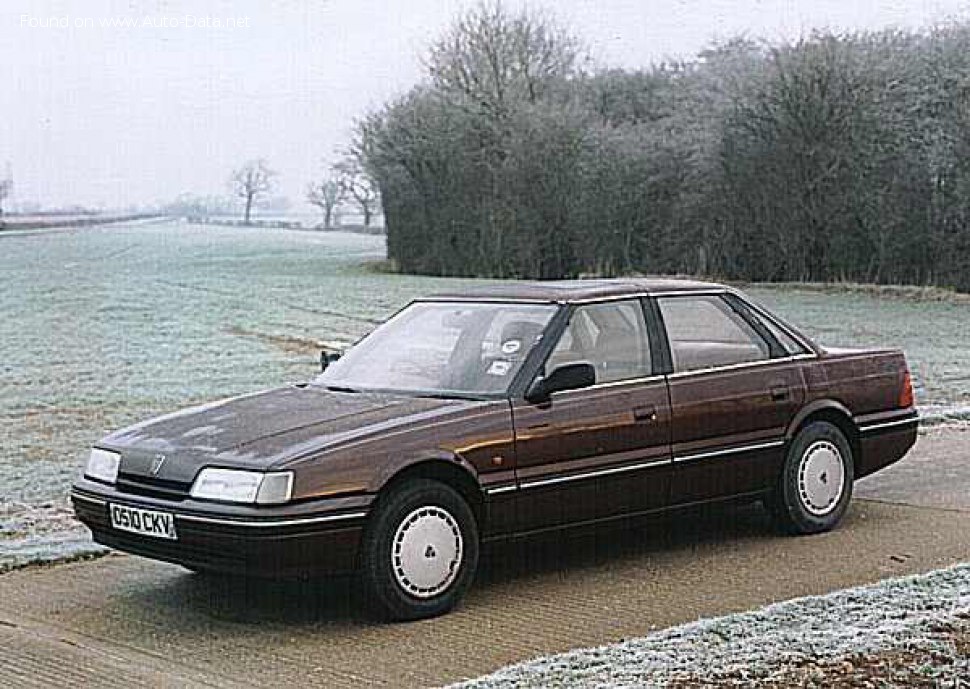
The Rover 800 827 SI/Sterling (XS) represents a pivotal moment in the history of the British automaker Rover, marking its ambitious entry into the executive car segment during the late 1980s and early 1990s. Launched in 1986 and specifically the 827 SI/Sterling (XS) variant produced between 1988 and 1991, this model embodied Rover’s aspirations for luxury, performance, and modern engineering. While primarily aimed at the European market, it was also sold in North America under the Sterling brand, attempting to compete with established luxury imports. The Rover 800 series, internally known as “Project XX” and later the XS generation, was a significant collaboration with Honda, blending British design sensibilities with Japanese reliability and technology.
Rover 800 827 SI/Sterling (XS): A Collaborative Effort
Positioned as a sophisticated four-door sedan, the Rover 800 827 SI/Sterling (XS) sought to combine traditional British comfort and styling with the advanced powertrain technology sourced from Honda. This model was crucial in Rover’s strategy to move beyond its reputation for conventional designs and embrace contemporary automotive standards, offering a compelling package for discerning buyers in a highly competitive segment. The collaboration with Honda was particularly important, as it allowed Rover to access cutting-edge engine technology and manufacturing processes that it might not have been able to develop independently.
Engine & Performance: The Honda C27A-V6
The heart of the Rover 800 827 SI/Sterling (XS)’s appeal was its powertrain, a direct result of the Anglo-Japanese partnership. The vehicle was powered by Honda’s renowned C27A-V6 engine, a 2.7-liter (2675 cm³ or 163.24 cu. in.) naturally aspirated gasoline unit. This V6 configuration, featuring Double Overhead Camshafts (DOHC) and four valves per cylinder (24 valves total), was considered a sophisticated and high-tech choice for its era, known for its smooth operation and robust performance.
The C27A-V6 engine produced 177 horsepower at 6000 rpm, delivering a power-per-liter figure of 66.2 horsepower per liter. Torque output stood at 228 Nm (168.16 lb.-ft.), available at 4500 rpm. This power was efficiently transferred to the front wheels via a precise 5-speed manual transmission, offering a surprisingly engaging driving experience for an executive sedan. The 827 SI/Sterling was capable of accelerating from 0 to 60 mph in 8.2 seconds (0-100 km/h in 8.6 seconds) and reaching a top speed of 136.08 mph (219 km/h). These figures placed it competitively within its class, offering both spirited acceleration and comfortable cruising ability.
Fuel efficiency, while not a primary selling point, was adequate for a V6 engine of its time. The combined fuel economy was rated at 26.1 US mpg (9 l/100 km), with urban consumption at 19.1 US mpg (12.3 l/100 km) and extra-urban at 31.8 US mpg (7.4 l/100 km). The engine featured a multi-port manifold injection system, ensuring precise fuel delivery and optimal combustion, contributing to its refined performance characteristics. The front, transverse engine layout also contributed to efficient packaging and a well-balanced front-wheel-drive architecture.
Design & Features: British Elegance and Modern Comfort
The Rover 800 827 SI/Sterling (XS) presented itself as a sophisticated four-door sedan, a body type synonymous with executive transport. Its design was a contemporary interpretation of British elegance, characterized by clean lines, a relatively low stance, and a purposeful grille that subtly hinted at its heritage. With a length of 192.2 inches, a width of 68.11 inches, and a height of 54.84 inches, coupled with a generous wheelbase of 108.9 inches, the vehicle offered substantial interior space for five occupants, a key attribute for its market segment.
Inside, the 800 series, particularly in its SI and Sterling trims, was appointed with a focus on comfort and luxury. The Sterling models in the US were typically lavishly equipped with leather upholstery, wood trim, and a comprehensive list of power accessories. The trunk space of 15.72 cu. ft. (445 liters) provided ample room for luggage, reinforcing its suitability for long-distance travel and executive duties.
Mechanically, the 827 SI/Sterling incorporated several advanced features for its time to enhance ride quality and safety. The front suspension utilized a double-wishbone setup, known for its superior control over wheel movement, contributing to precise handling and a comfortable ride. The rear featured a coil spring suspension. Braking was handled by ventilated discs at the front and solid discs at the rear, complemented by an Anti-lock Braking System (ABS), a significant safety feature in the late 1980s. Steering was a hydraulic rack and pinion system, providing direct feedback and ease of maneuverability. The car rode on 195/65 R15 tires, balancing grip with ride comfort.
Technical Specifications
| Category | Specification |
| General Information | |
| Brand | Rover |
| Model | 800 |
| Generation | 800 (XS) |
| Variant | 827 SI/Sterling (177 Hp) |
| Production Start | 1988 |
| Production End | 1991 |
| Powertrain Architecture | Internal Combustion Engine |
| Body Type | Sedan |
| Seats | 5 |
| Doors | 4 |
| Performance Specs | |
| Fuel Consumption (Urban) | 12.3 l/100 km (19.1 US mpg) |
| Fuel Consumption (Extra Urban) | 7.4 l/100 km (31.8 US mpg) |
| Fuel Consumption (Combined) | 9 l/100 km (26.1 US mpg) |
| Fuel Type | Petrol (Gasoline) |
| Acceleration 0-60 mph | 8.2 sec |
| Acceleration 0-100 km/h | 8.6 sec |
| Maximum Speed | 219 km/h (136.08 mph) |
| Weight-to-Power Ratio | 7.9 kg/Hp (126.4 Hp/tonne) |
| Weight-to-Torque Ratio | 6.1 kg/Nm (162.9 Nm/tonne) |
| Engine Specs | |
| Power | 177 Hp @ 6000 rpm |
| Power per Liter | 66.2 Hp/l |
| Torque | 228 Nm @ 4500 rpm (168.16 lb.-ft. @ 4500 rpm) |
| Engine Layout | Front, Transverse |
| Engine Model/Code | C27A-V6 |
| Engine Displacement | 2675 cm³ (2.7 Liters / 163.24 cu. in.) |
| Number of Cylinders | 6 |
| Engine Configuration | V-engine |
| Cylinder Bore | 87 mm (3.43 in) |
| Piston Stroke | 75 mm (2.95 in) |
| Compression Ratio | 9.45:1 |
| Number of Valves per Cylinder | 4 |
| Fuel Injection System | Multi-port manifold injection |
| Engine Aspiration | Naturally aspirated |
| Valvetrain | DOHC |
| Engine Oil Capacity | 4.5 l (4.76 US qt) |
| Coolant Capacity | 8.6 l (9.09 US qt) |
| Space, Volume & Weights | |
| Kerb Weight | 1400 kg (3086.47 lbs) |
| Max. Weight | 1930 kg (4254.92 lbs) |
| Max Load | 530 kg (1168.45 lbs) |
| Trunk (Boot) Space – Minimum | 445 l (15.72 cu. ft.) |
| Fuel Tank Capacity | 68 l (17.96 US gal) |
| Dimensions | |
| Length | 4882 mm (192.2 in) |
| Width | 1730 mm (68.11 in) |
| Height | 1393 mm (54.84 in) |
| Wheelbase | 2766 mm (108.9 in) |
| Front Track | 1487 mm (58.54 in) |
| Rear Track | 1450 mm (57.09 in) |
| Drivetrain, Brakes & Suspension | |
| Drivetrain Architecture | Internal Combustion Engine drives the front wheels |
| Drive Wheel | Front-wheel drive |
| Number of Gears & Gearbox Type | 5 gears, Manual transmission |
| Front Suspension | Double wishbone |
| Rear Suspension | Coil spring |
| Front Brakes | Ventilated discs |
| Rear Brakes | Disc |
| Assisting Systems | ABS (Anti-lock braking system) |
| Steering Type | Steering rack and pinion |
| Power Steering | Hydraulic Steering |
| Tires Size | 195/65 R15 |
Legacy & Market Impact
The Rover 800 827 SI/Sterling (XS) holds a unique place in automotive history, representing a significant chapter in Rover’s efforts to modernize and compete internationally. In Europe, it competed with the Ford Granada/Scorpio, Vauxhall Carlton/Opel Omega, Saab 9000, and Volvo 760/960, and was generally well-regarded for its comfortable ride, spacious interior, and the refinement of its Honda-sourced V6 engine.
However, its North American journey as the “Sterling” was more challenging. Despite initial positive reception praising its opulent interior and styling, the Sterling brand encountered quality and reliability issues, particularly with electrical systems and interior trim, which tarnished its reputation. This led to declining sales and the eventual withdrawal of the Sterling brand from the US market in the early 1990s.
Despite its struggles in some markets, the Rover 800 827 SI/Sterling (XS) remains historically significant as a testament to the Anglo-Japanese automotive collaboration of the era. It showcased Rover’s ambition to blend traditional British luxury with modern engineering and reliable powertrains. For enthusiasts and collectors, these models, particularly those equipped with the Honda V6, are appreciated for their distinctive character, comfortable ride, and now, their relative rarity. The Rover 800 series, and the 827 SI/Sterling in particular, stands as a fascinating example of a manufacturer striving to redefine its identity and market position during a period of intense global competition.
