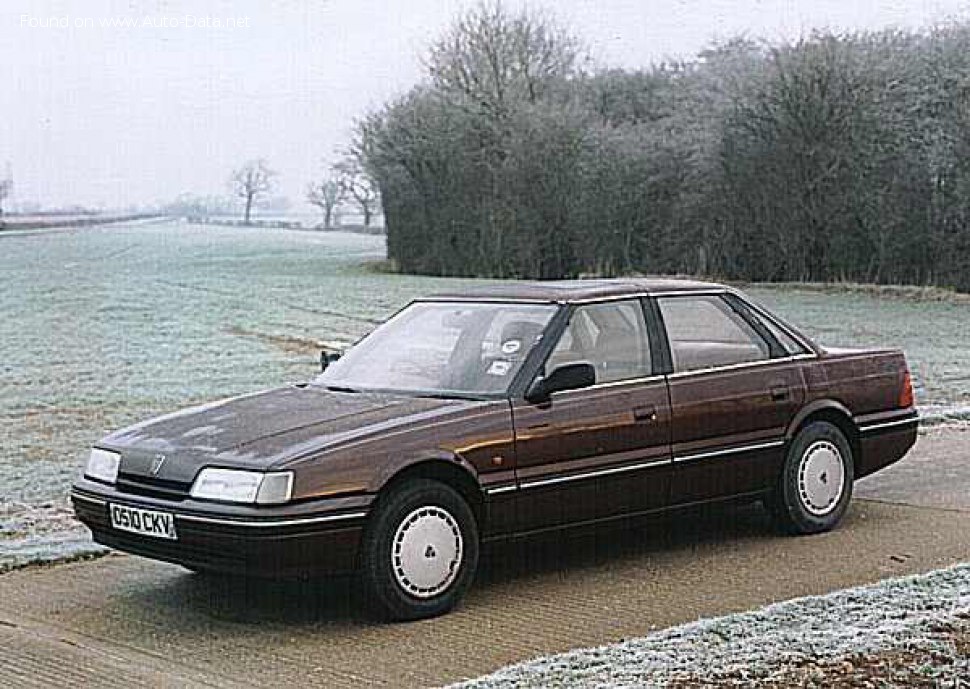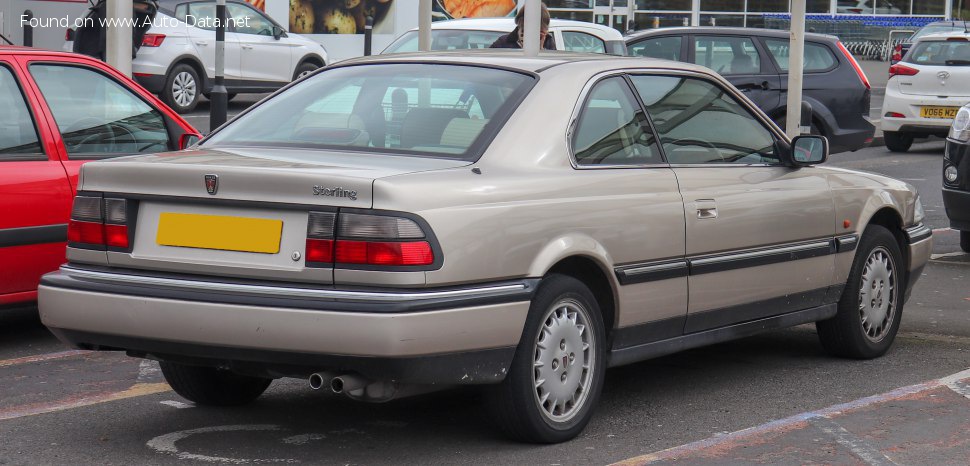
The Rover 800 Coupe 820i (136 Hp) Automatic represents a distinctive chapter in the history of the British automotive industry, serving as Rover’s flagship two-door grand tourer during the 1990s. Launched in 1992, the Coupe variant was a significant departure from the more utilitarian sedan and fastback models of the Rover 800 series, aiming squarely at the executive coupe market primarily in Europe and the United Kingdom. While never officially sold in the United States, the Rover 800 Coupe embodied a blend of traditional British luxury and contemporary engineering, offering a unique proposition to buyers seeking an elegant and comfortable driving experience. This particular model, the 820i with its 136 horsepower engine and automatic transmission, focused on refinement and ease of use, rather than outright sporting prowess, making it a compelling choice for long-distance cruising.
Rover 800 Coupe: A British Executive Grand Tourer
The Rover 800 series, introduced in 1986, was intended to replace the aging Rover SD1 and compete with established executive cars like the Ford Granada and Opel/Vauxhall Senator. The Coupe, arriving in 1992, was a more focused and stylish iteration of the 800, designed to appeal to buyers seeking a more personal and luxurious experience. It represented Rover’s attempt to recapture some of the prestige associated with earlier British grand tourers, offering a blend of comfort, style, and reasonable performance. The 820i trim level, equipped with the 2.0-liter engine and automatic transmission, was positioned as the entry point to the Coupe range, prioritizing smooth operation and relaxed cruising over outright speed.
Engine & Performance: The M16i Powertrain
The Rover 800 Coupe 820i Automatic is powered by Rover’s M16i engine, a 2.0-liter (1994 cm³) naturally aspirated inline-four cylinder unit. This engine utilizes a Double Overhead Camshaft (DOHC) valvetrain with four valves per cylinder, a relatively advanced configuration for its time, contributing to efficient combustion and a smooth power delivery. The engine’s 10:1 compression ratio, coupled with a multi-port fuel injection system, allows it to produce 136 horsepower at 6000 rpm. Crucially for a grand tourer, the M16i delivers 135.71 lb.-ft. of torque at 2500 rpm, providing ample pulling power at lower engine speeds and enhancing the car’s relaxed driving character.
The engine is mounted transversely at the front of the vehicle, driving the front wheels through a 4-speed automatic transmission. This combination prioritizes ease of use and comfort over sporty handling. The 820i Coupe achieves a 0 to 60 mph acceleration time of approximately 11.8 seconds and a top speed of 121.17 mph. Fuel economy is rated at a combined 31.4 US mpg (7.5 l/100 km), which was competitive for a vehicle of its size and class during the 1990s. The 17.96 US gallon fuel tank provides a substantial cruising range, further enhancing its suitability for long journeys.
Design & Features: A Stylish Grand Tourer
The design of the Rover 800 Coupe was a deliberate departure from simply applying a two-door body style to the existing sedan. From the A-pillar rearward, the Coupe features unique body panels, resulting in a more flowing and elegant silhouette. Its sleek lines, pillarless side windows, and gently sloping roofline contribute to a sophisticated aesthetic reminiscent of classic British luxury coupes. The car’s substantial dimensions – 192.2 inches in length and 68.11 inches in width – give it a commanding presence on the road, firmly positioning it within the executive segment.
Despite its two-door configuration, the Rover 800 Coupe offers surprising practicality. It provides seating for five occupants, a relatively uncommon feature for a coupe of this era. The interior is spacious and well-appointed, reflecting the car’s executive status. The trunk offers a generous 16.07 cubic feet of space, making it suitable for extended trips with luggage. Standard features typically include power windows, central locking, and a premium audio system. Safety features, such as an Anti-lock Braking System (ABS), were also included, providing enhanced control during emergency braking. Hydraulic power steering and a rack and pinion setup contribute to a comfortable and predictable driving experience, aligning with the car’s grand touring aspirations.
Technical Specifications: Rover 800 Coupe 820i (136 Hp) Automatic
| Category | Specification |
| General Information | |
| Brand | Rover |
| Model | 800 |
| Generation | 800 Coupe |
| Type (Engine) | 820i (136 Hp) Automatic |
| Production Start | 1992 |
| Production End | 1999 |
| Powertrain Architecture | Internal Combustion Engine |
| Body Type | Coupe |
| Seats | 5 |
| Doors | 2 |
| Performance Specs | |
| Fuel Consumption (Urban) | 13.4 l/100 km (17.6 US mpg) |
| Fuel Consumption (Extra Urban) | 6.3 l/100 km (37.3 US mpg) |
| Fuel Consumption (Combined) | 7.5 l/100 km (31.4 US mpg) |
| Fuel Type | Petrol (Gasoline) |
| Acceleration 0-60 mph | 11.8 seconds |
| Maximum Speed | 195 km/h (121.17 mph) |
| Weight-to-power ratio | 9.9 kg/Hp (21.8 lbs/Hp) |
| Weight-to-torque ratio | 7.3 kg/Nm (16.1 lbs/lb.-ft.) |
| Engine Specs | |
| Power | 136 Hp @ 6000 rpm |
| Power per liter | 68.2 Hp/l |
| Torque | 184 Nm @ 2500 rpm (135.71 lb.-ft. @ 2500 rpm) |
| Engine Layout | Front, Transverse |
| Engine Model/Code | M16i |
| Engine Displacement | 1994 cm³ (2.0 liters / 121.68 cu. in.) |
| Number of Cylinders | 4 |
| Engine Configuration | Inline |
| Cylinder Bore | 84.45 mm (3.32 inches) |
| Piston Stroke | 89 mm (3.5 inches) |
| Compression Ratio | 10:1 |
| Valves per Cylinder | 4 |
| Fuel Injection System | Multi-port manifold injection |
| Engine Aspiration | Naturally aspirated |
| Valvetrain | DOHC |
| Engine Oil Capacity | 4.5 l (4.76 US quarts) |
| Coolant Capacity | 10 l (10.57 US quarts) |
| Space, Volume and Weights | |
| Curb Weight | 1345 kg (2965.22 lbs.) |
| Max. Weight (GVWR) | 1910 kg (4210.83 lbs.) |
| Max Load | 565 kg (1245.61 lbs.) |
| Trunk (Boot) Space – Minimum | 455 l (16.07 cu. ft.) |
| Fuel Tank Capacity | 68 l (17.96 US gallons) |
| Dimensions | |
| Length | 4882 mm (192.2 inches) |
| Width | 1730 mm (68.11 inches) |
| Height | 1393 mm (54.84 inches) |
| Wheelbase | 2766 mm (108.9 inches) |
| Front Track | 1487 mm (58.54 inches) |
| Rear Track | 1450 mm (57.09 inches) |
| Drivetrain, Brakes and Suspension Specs | |
| Drivetrain Architecture | Internal combustion engine drives front wheels |
| Drive Wheel | Front wheel drive |
| Number of Gears & Type | 4 gears, automatic transmission |
| Front Suspension | Double wishbone |
| Rear Suspension | Coil spring |
| Front Brakes | Ventilated discs |
| Rear Brakes | Disc |
| Assisting Systems | ABS (Anti-lock braking system) |
| Steering Type | Steering rack and pinion |
| Power Steering | Hydraulic Steering |
| Tire Size | 195/65 R15 |
| Wheel Rims Size | 6J x 15 |
Legacy & Market Impact of the Rover 800 Coupe
The Rover 800 Coupe occupies a significant position in Rover’s history, particularly as the brand faced challenges during the 1990s. It competed with European executive coupes like the Ford Granada Coupe, Vauxhall Senator Coupe, and aimed to challenge entry-level BMW and Mercedes-Benz models. Its appeal stemmed from its classic styling, comfortable interior, and a driving experience focused on refinement. While sales didn’t match its German rivals, the 800 Coupe attracted a loyal following, especially in the UK.
The 800 Coupe was viewed as a bold statement from Rover, demonstrating its ability to create a stylish and luxurious vehicle. Its production coincided with a critical period for Rover, leading to its acquisition by BMW. As such, the 800 Coupe represents one of the last truly “British” executive cars before significant industry changes. Today, it’s recognized as a modern classic, valued for its unique styling, comfortable ride, and relative rarity. It stands as a testament to Rover’s ambition and design capabilities, offering a glimpse into British luxury motoring of the late 20th century.