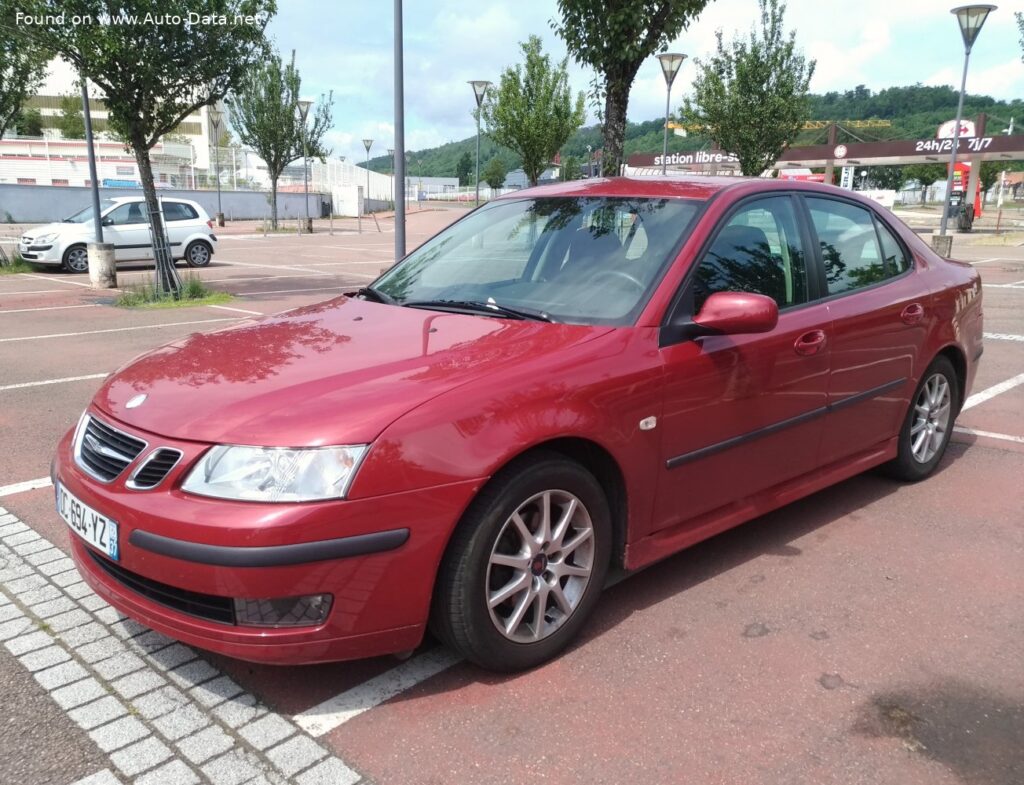
The Saab 9-3 Sedan II 2.0 i 16V t (150 Hp) represents a significant iteration in Saab’s mid-size offering, produced between 2005 and 2007. This model, part of the second generation of the 9-3 sedan, aimed to blend Scandinavian design principles with a focus on driver engagement and safety. While Saab as a brand held a relatively niche position in the American market, the 9-3 competed with established European sedans like the BMW 3 Series, Audi A4, and Volvo S60, offering a distinctive alternative. The 2.0 i 16V t variant, equipped with a turbocharged engine, was positioned as a balance between performance and fuel efficiency within the 9-3 lineup.
Saab 9-3 Sedan II: A Detailed Overview
The 9-3 Sedan II built upon the foundation laid by its predecessor, introducing revised styling, improved interior refinement, and updated mechanical components. Saab, known for its innovative engineering and commitment to safety, continued these traditions in the second-generation 9-3. The car’s design reflected a modern aesthetic while retaining the brand’s signature Scandinavian minimalism. The 2.0 i 16V t model specifically targeted buyers seeking a responsive and economical driving experience, making it a popular choice in European markets.
Engine & Performance
At the heart of the Saab 9-3 Sedan II 2.0 i 16V t lies a 1.998-liter (121.93 cubic inches) inline-four cylinder engine. This engine, designated the B207E, utilizes a turbocharger and intercooler to boost power output to 150 horsepower at 5500 rpm and 240 Newton-meters (177.01 lb.-ft.) of torque at 2000 rpm. The turbocharging system provides a noticeable increase in performance, offering strong acceleration and responsive throttle response. Power delivery is managed through a five-speed manual transmission, driving the front wheels. Acceleration from 0 to 100 km/h (0-62 mph) takes 9.5 seconds, while 0 to 60 mph is achieved in approximately 9 seconds. The vehicle boasts a maximum speed of 210 km/h (130.49 mph). The engine’s specific output is 75.1 horsepower per liter, demonstrating a good level of efficiency for a turbocharged engine of this era. The weight-to-power ratio of 9.6 kg/Hp and a weight-to-torque ratio of 6 kg/Nm contribute to a reasonably agile driving experience.
Design & Features
The Saab 9-3 Sedan II is a four-door, five-seat sedan characterized by its clean lines and aerodynamic profile. The exterior design incorporates Saab’s signature wraparound windshield and a distinctive front grille. The interior prioritizes functionality and ergonomics, with a driver-focused layout and comfortable seating. Safety was a key consideration in the 9-3’s design, and the vehicle is equipped with an Anti-lock Braking System (ABS) as standard. The car’s dimensions are as follows: length 4635 mm (182.48 in), width 1762 mm (69.37 in), and height 1466 mm (57.72 in). The wheelbase measures 2675 mm (105.31 in), providing a stable platform for handling. Trunk space is a practical 425 liters (15.01 cubic feet). The 9-3’s design aimed to balance practicality with a touch of Scandinavian sophistication, appealing to buyers who valued both form and function.
Technical Specifications
| Brand | Saab |
| Model | 9-3 |
| Generation | 9-3 Sedan II |
| Type (Engine) | 2.0 i 16V t (150 Hp) |
| Start of production | 2005 |
| End of production | 2007 |
| Powertrain Architecture | Internal Combustion engine |
| Body type | Sedan |
| Seats | 5 |
| Doors | 4 |
| Fuel consumption (urban) | 11.7 l/100 km (20.1 US mpg / 24.1 UK mpg) |
| Fuel consumption (extra urban) | 6.1 l/100 km (38.6 US mpg / 46.3 UK mpg) |
| Fuel Type | Petrol (Gasoline) |
| Acceleration 0 – 100 km/h | 9.5 sec |
| Acceleration 0 – 62 mph | 9.5 sec |
| Acceleration 0 – 60 mph | 9 sec |
| Maximum speed | 210 km/h (130.49 mph) |
| Weight-to-power ratio | 9.6 kg/Hp |
| Weight-to-torque ratio | 6 kg/Nm |
| Power | 150 Hp @ 5500 rpm |
| Torque | 240 Nm @ 2000 rpm (177.01 lb.-ft. @ 2000 rpm) |
| Engine layout | Front, Transverse |
| Engine Model/Code | B207E |
| Engine displacement | 1998 cm3 (121.93 cu. in.) |
| Number of cylinders | 4 |
| Engine configuration | Inline |
| Cylinder Bore | 86 mm (3.39 in.) |
| Piston Stroke | 86 mm (3.39 in.) |
| Compression ratio | 9.5:1 |
| Number of valves per cylinder | 4 |
| Fuel injection system | Multi-port manifold injection |
| Engine aspiration | Turbocharger, Intercooler |
| Valvetrain | DOHC |
| Engine oil capacity | 6 l (6.34 US qt | 5.28 UK qt) |
| Coolant | 7.5 l (7.93 US qt | 6.6 UK qt) |
| Kerb Weight | 1440 kg (3174.66 lbs.) |
| Max. weight | 1970 kg (4343.11 lbs.) |
| Max load | 530 kg (1168.45 lbs.) |
| Trunk (boot) space – minimum | 425 l (15.01 cu. ft.) |
| Fuel tank capacity | 62 l (16.38 US gal | 13.64 UK gal) |
| Length | 4635 mm (182.48 in.) |
| Width | 1762 mm (69.37 in.) |
| Height | 1466 mm (57.72 in.) |
| Wheelbase | 2675 mm (105.31 in.) |
| Front track | 1524 mm (60 in.) |
| Rear (Back) track | 1506 mm (59.29 in.) |
| Drivetrain Architecture | Front wheel drive |
| Number of gears and type of gearbox | 5 gears, manual transmission |
| Front suspension | Spring Strut |
| Rear suspension | Coil spring |
| Front brakes | Ventilated discs |
| Rear brakes | Disc |
| Assisting systems | ABS (Anti-lock braking system) |
| Steering type | Steering rack and pinion |
| Power steering | Hydraulic Steering |
| Tires size | 215/60 R15 |
| Wheel rims size | 15 |
The Saab 9-3 Sedan II 2.0 i 16V t, while no longer in production due to Saab’s bankruptcy in 2011, remains a compelling example of Scandinavian automotive engineering. Its blend of performance, safety, and distinctive design continues to appeal to enthusiasts and collectors alike.