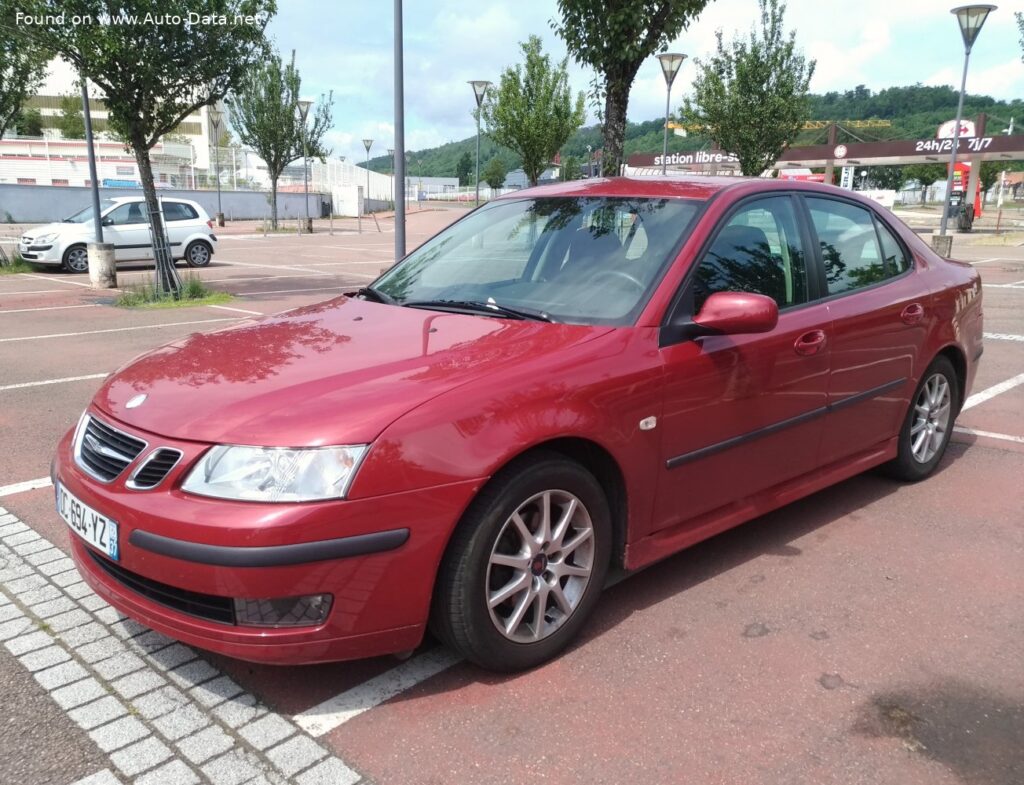
The Saab 9-3 Sedan II 2.8T V6 (250 Hp), produced between 2005 and 2007, represents a significant iteration in Saab’s lineage of compact executive cars. This generation, the second for the 9-3 sedan, aimed to blend Scandinavian design principles with a focus on performance and safety. While Saab as a brand ultimately faced challenges, the 9-3 Sedan II, particularly the 2.8T V6 variant, offered a compelling package for drivers seeking a unique alternative to mainstream European and Japanese competitors. It was primarily sold in Europe, and to a lesser extent, in North America and Australia, appealing to those who valued individuality and a more driver-focused experience.
Saab 9-3 Sedan II 2.8T V6: An Overview
The 9-3 Sedan II occupied the compact executive car segment, competing with models like the BMW 3 Series, Audi A4, and Mercedes-Benz C-Class. However, Saab distinguished itself through its distinctive styling, emphasis on safety, and turbocharged engine options. The 2.8T V6 model, equipped with a 2.8-liter turbocharged V6 engine, was the performance flagship of the sedan range, offering a substantial power output and a refined driving experience. This model year saw refinements to the original 9-3 design, improving both aesthetics and functionality.
Engine & Performance
The heart of the Saab 9-3 Sedan II 2.8T V6 is its 2.8-liter V6 engine, designated the B284R. This engine produces 250 horsepower at 5500 rpm and 350 Nm (258.15 lb.-ft.) of torque between 2000 and 2750 rpm. The engine utilizes a twin-scroll turbocharger and an intercooler to enhance performance and efficiency. Power is delivered to the front wheels via a six-speed manual transmission. This configuration allows for brisk acceleration, with a 0-100 km/h (0-62 mph) time of 6.7 seconds and a 0-60 mph time of approximately 6.4 seconds. The car boasts a maximum speed of 250 km/h (155.34 mph). The engine’s power-to-weight ratio is 6.4 kg/Hp, and the torque-to-weight ratio is 4.6 kg/Nm, contributing to its responsive driving characteristics. The engine displacement is 2792 cm3 (170.38 cu. in.), with a bore of 89 mm (3.5 in.) and a stroke of 74.8 mm (2.94 in.).
Design & Features
The Saab 9-3 Sedan II features a four-door sedan body style with seating for five passengers. Its exterior design is characterized by clean lines, a distinctive front grille, and a wraparound rear window – hallmarks of Saab’s design language. The interior prioritizes ergonomics and functionality, with a driver-focused cockpit and comfortable seating. Safety was a key consideration in the 9-3’s design, and the 2.8T V6 model included features such as ABS (Anti-lock Braking System) and ventilated disc brakes on all four wheels. The car’s dimensions are as follows: length 4635 mm (182.48 in.), width 1762 mm (69.37 in.), height 1466 mm (57.72 in.), and wheelbase 2675 mm (105.31 in.). Trunk space is a practical 425 liters (15.01 cu. ft.). The fuel tank capacity is 58 liters (15.32 US gal).
Technical Specifications
| Brand | Saab |
| Model | 9-3 |
| Generation | 9-3 Sedan II |
| Type (Engine) | 2.8T V6 (250 Hp) |
| Start of production | 2005 |
| End of production | 2007 |
| Powertrain Architecture | Internal Combustion engine |
| Body type | Sedan |
| Seats | 5 |
| Doors | 4 |
| Fuel consumption (urban) | 15.4 l/100 km (15.3 US mpg, 18.3 UK mpg, 6.5 km/l) |
| Fuel consumption (extra urban) | 7.1 l/100 km (33.1 US mpg, 39.8 UK mpg, 14.1 km/l) |
| Fuel consumption (combined) | 10.2 l/100 km (23.1 US mpg, 27.7 UK mpg, 9.8 km/l) |
| CO2 emissions | 245 g/km |
| Fuel Type | Petrol (Gasoline) |
| Acceleration 0 – 100 km/h | 6.7 sec |
| Acceleration 0 – 62 mph | 6.7 sec |
| Acceleration 0 – 60 mph | 6.4 sec |
| Maximum speed | 250 km/h (155.34 mph) |
| Emission standard | Euro 4 |
| Weight-to-power ratio | 6.4 kg/Hp |
| Weight-to-torque ratio | 4.6 kg/Nm |
| Power | 250 Hp @ 5500 rpm |
| Torque | 350 Nm @ 2000-2750 rpm (258.15 lb.-ft. @ 2000-2750 rpm) |
| Engine layout | Front, Transverse |
| Engine Model/Code | B284R |
| Engine displacement | 2792 cm3 (170.38 cu. in.) |
| Number of cylinders | 6 |
| Engine configuration | V-engine |
| Cylinder Bore | 89 mm (3.5 in.) |
| Piston Stroke | 74.8 mm (2.94 in.) |
| Compression ratio | 9.5:1 |
| Number of valves per cylinder | 4 |
| Fuel injection system | Multi-port manifold injection |
| Engine aspiration | Twin-scroll turbo, Intercooler |
| Valvetrain | DOHC |
| Engine oil capacity | 6 l (6.34 US qt | 5.28 UK qt) |
| Coolant | 9.6 l (10.14 US qt | 8.45 UK qt) |
| Kerb Weight | 1605 kg (3538.42 lbs.) |
| Max. weight | 2060 kg (4541.52 lbs.) |
| Max load | 455 kg (1003.1 lbs.) |
| Trunk (boot) space – minimum | 425 l (15.01 cu. ft.) |
| Fuel tank capacity | 58 l (15.32 US gal | 12.76 UK gal) |
| Max. roof load | 100 kg (220.46 lbs.) |
| Length | 4635 mm (182.48 in.) |
| Width | 1762 mm (69.37 in.) |
| Width including mirrors | 2038 mm (80.24 in.) |
| Height | 1466 mm (57.72 in.) |
| Wheelbase | 2675 mm (105.31 in.) |
| Front track | 1524 mm (60 in.) |
| Rear (Back) track | 1506 mm (59.29 in.) |
| Front overhang | 965 mm (37.99 in.) |
| Rear overhang | 995 mm (39.17 in.) |
| Minimum turning circle | 11.4 m (37.4 ft.) |
| Drivetrain Architecture | Front wheel drive |
| Number of gears and type of gearbox | 6 gears, manual transmission |
| Front suspension | Independent type McPherson, Transverse stabilizer |
| Rear suspension | Independent multi-link suspension, Transverse stabilizer |
| Front brakes | Ventilated discs |
| Rear brakes | Ventilated discs |
| Assisting systems | ABS (Anti-lock braking system) |
| Steering type | Steering rack and pinion |
| Power steering | Hydraulic Steering |
| Tires size | 235/45 R17 |
| Wheel rims size | 7.5J x 17 |
The Saab 9-3 Sedan II 2.8T V6, despite the eventual fate of the Saab brand, remains a noteworthy vehicle. It represents a blend of Scandinavian design, turbocharged performance, and a commitment to safety, offering a unique driving experience for those who appreciated its distinctive character.