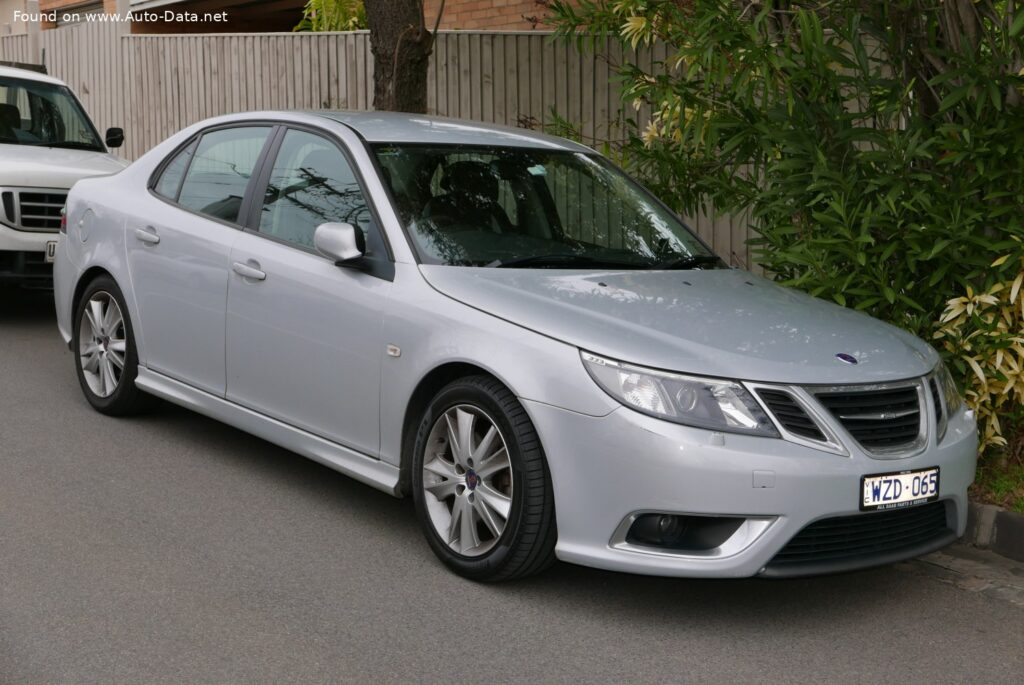
The Saab 9-3 Sedan II, particularly the facelifted version introduced in 2007, represents a pivotal point in the Swedish automaker’s history. Positioned within the compact executive car segment, the 9-3 aimed to blend Scandinavian design principles with a sporty driving experience. This generation, produced from 2007 to 2010, offered a range of engines, with the 1.8t Biopower Sentronic model being a notable variant, especially in European markets. The “Biopower” designation indicates the engine’s capability to run on both gasoline and ethanol fuel, reflecting a growing emphasis on alternative fuels during that period. While Saab faced financial difficulties and eventual closure in 2011, the 9-3 Sedan II remains a testament to the brand’s innovative spirit and unique approach to automotive engineering.
Saab 9-3 Sedan II (Facelift 2007) 1.8t Biopower: An Overview
The 2007 facelift of the Saab 9-3 Sedan II brought subtle but significant changes to the vehicle’s exterior and interior. These updates were intended to refresh the model and enhance its appeal in a competitive market. The 1.8t Biopower variant, equipped with an automatic transmission (Sentronic), was specifically designed to cater to drivers seeking a balance between performance and fuel efficiency, with the added benefit of utilizing renewable ethanol fuel. This model was primarily sold in Europe, where ethanol availability and government incentives encouraged the adoption of flexible-fuel vehicles. The 9-3 competed with established rivals such as the Audi A4, BMW 3 Series, and Mercedes-Benz C-Class, offering a distinctive alternative with its focus on safety, comfort, and a unique driving character.
Engine & Performance
The heart of the Saab 9-3 Sedan II 1.8t Biopower is a 1.8-liter inline-four cylinder engine, designated the B207E. This engine produces 175 horsepower at 5500 rpm and 265 Nm (195.45 lb.-ft.) of torque at 2500 rpm. The “Biopower” functionality allows the engine to operate on gasoline, ethanol (up to 85% ethanol content), or any blend of the two. This flexibility provides drivers with the option to reduce their reliance on fossil fuels and potentially lower their emissions. The engine utilizes a turbocharger and intercooler to enhance performance, delivering a respectable power-to-weight ratio of 8.2 kg/Hp. Acceleration from 0 to 100 km/h (0-62 mph) takes 9.4 seconds, while 0-60 mph is achieved in approximately 8.9 seconds. The vehicle boasts a maximum speed of 210 km/h (130.49 mph). The Sentronic automatic transmission, with five gears, provides smooth and convenient gear changes, contributing to a comfortable driving experience.
Design & Features
The Saab 9-3 Sedan II maintains the brand’s signature Scandinavian design aesthetic, characterized by clean lines, a focus on functionality, and a distinctive front grille. The facelifted model features revised headlights, a redesigned front bumper, and updated taillights, giving it a more modern appearance. The sedan body style offers a practical and spacious interior, accommodating five passengers comfortably. Key features include a well-appointed cabin with comfortable seating, a user-friendly infotainment system (for its time), and a range of safety features. Safety was a core tenet of Saab’s engineering philosophy, and the 9-3 incorporates features such as ABS (Anti-lock Braking System), ventilated front disc brakes, and disc brakes on the rear axle. The vehicle’s dimensions are 4635 mm (182.48 in) in length, 1762 mm (69.37 in) in width, and 1466 mm (57.72 in) in height, with a wheelbase of 2675 mm (105.31 in). Trunk space is a useful 425 liters (15.01 cu. ft.).
Technical Specifications
| Brand | Saab |
| Model | 9-3 |
| Generation | 9-3 Sedan II (facelift 2007) |
| Type (Engine) | 1.8t Biopower (175 Hp) Sentronic |
| Start of production | June, 2007 |
| End of production | December, 2010 |
| Powertrain Architecture | Internal Combustion engine |
| Body type | Sedan |
| Seats | 5 |
| Doors | 4 |
| Fuel consumption (urban) | 15.5 l/100 km (15.2 US mpg, 18.2 UK mpg) |
| Fuel consumption (extra urban) | 8.5 l/100 km (27.7 US mpg, 33.2 UK mpg) |
| Fuel consumption (combined) | 11.1 l/100 km (21.2 US mpg, 25.4 UK mpg) |
| Fuel Type | Petrol (Gasoline) |
| Acceleration 0 – 100 km/h | 9.4 sec |
| Acceleration 0 – 62 mph | 9.4 sec |
| Acceleration 0 – 60 mph | 8.9 sec |
| Maximum speed | 210 km/h (130.49 mph) |
| Emission standard | Euro 4 |
| Weight-to-power ratio | 8.2 kg/Hp |
| Weight-to-torque ratio | 5.4 kg/Nm |
| Power | 175 Hp @ 5500 rpm |
| Torque | 265 Nm @ 2500 rpm (195.45 lb.-ft. @ 2500 rpm) |
| Engine layout | Front, Transverse |
| Engine Model/Code | B207E |
| Engine displacement | 1796 cm3 (109.6 cu. in.) |
| Number of cylinders | 4 |
| Engine configuration | Inline |
| Cylinder Bore | 80.5 mm (3.17 in.) |
| Piston Stroke | 88.2 mm (3.47 in.) |
| Compression ratio | 10.5:1 |
| Number of valves per cylinder | 4 |
| Fuel injection system | Multi-port manifold injection |
| Engine aspiration | Turbocharger, Intercooler |
| Valvetrain | DOHC |
| Engine oil capacity | 6 l (6.34 US qt | 5.28 UK qt) |
| Coolant | 7.5 l (7.93 US qt | 6.6 UK qt) |
| Kerb Weight | 1440 kg (3174.66 lbs.) |
| Max. weight | 1970 kg (4343.11 lbs.) |
| Max load | 530 kg (1168.45 lbs.) |
| Trunk (boot) space – minimum | 425 l (15.01 cu. ft.) |
| Fuel tank capacity | 62 l (16.38 US gal | 13.64 UK gal) |
| Length | 4635 mm (182.48 in.) |
| Width | 1762 mm (69.37 in.) |
| Height | 1466 mm (57.72 in.) |
| Wheelbase | 2675 mm (105.31 in.) |
| Front track | 1524 mm (60 in.) |
| Rear (Back) track | 1506 mm (59.29 in.) |
| Drivetrain Architecture | Front wheel drive |
| Number of gears and type of gearbox | 5 gears, automatic transmission |
| Front suspension | Spring Strut |
| Rear suspension | Coil spring |
| Front brakes | Ventilated discs |
| Rear brakes | Disc |
| Steering type | Steering rack and pinion |
| Power steering | Hydraulic Steering |
| Tires size | 215/60 R15 |
| Wheel rims size | 15 |