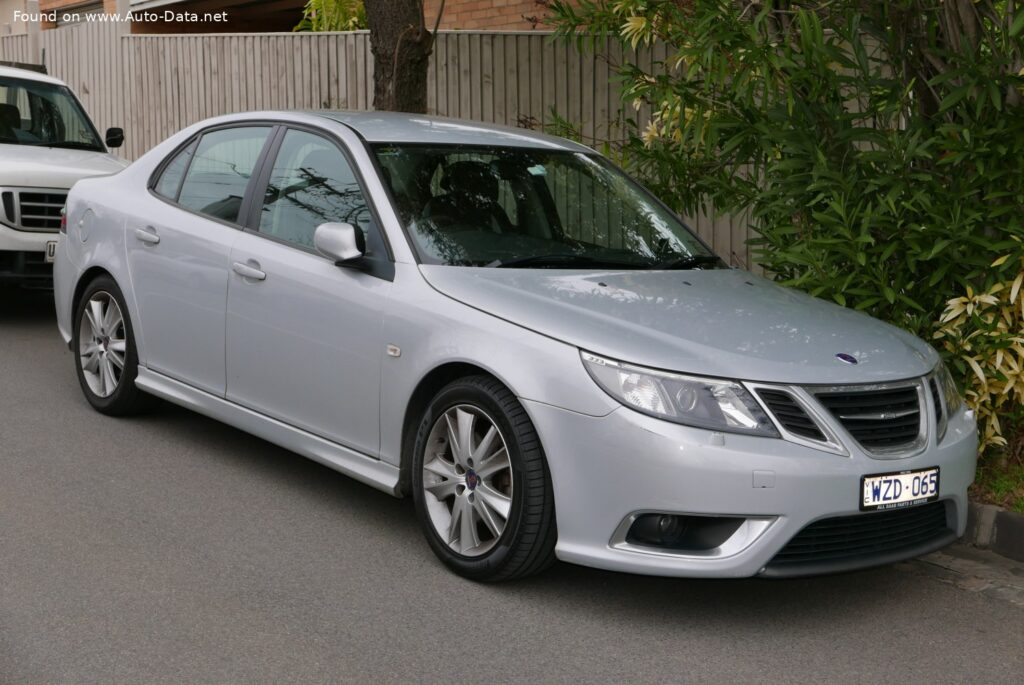
The Saab 9-3 Sedan II, specifically the facelifted version introduced in 2007, represents a significant evolution of Saab’s compact executive car. Positioned as a competitor to vehicles like the BMW 3 Series, Audi A4, and Volvo S60, the 9-3 aimed to deliver a unique blend of Scandinavian design, innovative safety features, and engaging driving dynamics. The 2.0t Biopower variant, producing 200 horsepower, was a key offering, particularly in European markets where it leveraged the benefits of flexible-fuel capability. This model was produced from June 2007 to December 2010, marking a period of refinement for the 9-3 platform before Saab’s eventual financial difficulties.
Saab 9-3 Sedan II (2007-2010): A Detailed Overview
The 9-3 Sedan II facelift brought subtle but important changes to the original 9-3 design, launched in 2002. These updates included revised front and rear styling, an upgraded interior, and enhancements to the engine lineup. The 2.0t Biopower model was particularly noteworthy for its ability to run on both gasoline and ethanol (up to 85% ethanol content), offering drivers a more environmentally friendly and potentially cost-effective fuel option. While Saab was primarily known for its innovative engineering and safety, the 9-3 aimed to broaden the brand’s appeal with a more contemporary and accessible vehicle.
Engine & Performance
The heart of the 9-3 2.0t Biopower is a 1.985-liter (121.13 cubic inches) inline-four cylinder engine. This engine utilizes a turbocharger and intercooler to boost power output to 200 horsepower at 5500 rpm and 280 Nm (206.52 lb.-ft.) of torque at 2200 rpm. The “Biopower” designation signifies the engine’s capability to operate on gasoline or a blend of gasoline and ethanol. When running on E85 fuel, power output could be increased, although specific figures varied depending on market and calibration. The engine features multi-port fuel injection and a double overhead camshaft (DOHC) valvetrain with four valves per cylinder. This configuration delivers a good balance of performance and efficiency. Acceleration from 0 to 60 mph was approximately 7.5 seconds, and the vehicle had a top speed of 230 km/h (142.92 mph). The engine’s weight-to-power ratio of 7.2 kg/Hp and weight-to-torque ratio of 5.1 kg/Nm contributed to its responsive driving feel.
Design & Features
The Saab 9-3 Sedan II is a four-door, five-seat sedan characterized by its distinctive Scandinavian design language. The 2007 facelift refined the front fascia with a new grille, headlights, and bumper. The interior was also updated with improved materials and a more ergonomic layout. Key features included available leather upholstery, automatic climate control, and a premium audio system. Safety was a core tenet of the Saab brand, and the 9-3 was equipped with standard ABS (Anti-lock Braking System) and a robust chassis designed to protect occupants in the event of a collision. The trunk offered a practical 425 liters (15.01 cubic feet) of storage space. The vehicle’s dimensions – 4635 mm (182.48 in) in length, 1762 mm (69.37 in) in width, and 1466 mm (57.72 in) in height – positioned it squarely within the compact executive sedan segment. The 9-3’s design, while understated, was intended to convey a sense of sophistication and functionality.
Technical Specifications
| Brand | Saab |
| Model | 9-3 |
| Generation | 9-3 Sedan II (facelift 2007) |
| Type (Engine) | 2.0t Biopower (200 Hp) |
| Start of production | June, 2007 |
| End of production | December, 2010 |
| Powertrain Architecture | Internal Combustion engine |
| Body type | Sedan |
| Seats | 5 |
| Doors | 4 |
| Fuel consumption (urban) | 14.4 l/100 km (16.3 US mpg, 19.6 UK mpg, 6.9 km/l) |
| Fuel consumption (extra urban) | 7.8 l/100 km (30.2 US mpg, 36.2 UK mpg, 12.8 km/l) |
| Fuel consumption (combined) | 10.3 l/100 km (22.8 US mpg, 27.4 UK mpg, 9.7 km/l) |
| Fuel Type | Petrol (Gasoline) |
| Acceleration 0 – 100 km/h | 7.9 sec |
| Acceleration 0 – 62 mph | 7.9 sec |
| Acceleration 0 – 60 mph | 7.5 sec |
| Maximum speed | 230 km/h (142.92 mph) |
| Emission standard | Euro 4 |
| Weight-to-power ratio | 7.2 kg/Hp, 138.9 Hp/tonne |
| Weight-to-torque ratio | 5.1 kg/Nm, 194.4 Nm/tonne |
| Power | 200 Hp @ 5500 rpm |
| Power per litre | 100.8 Hp/l |
| Torque | 280 Nm @ 2200 rpm (206.52 lb.-ft. @ 2200 rpm) |
| Engine layout | Front, Transverse |
| Engine Model/Code | B207M |
| Engine displacement | 1985 cm3 (121.13 cu. in.) |
| Number of cylinders | 4 |
| Engine configuration | Inline |
| Cylinder Bore | 90 mm (3.54 in.) |
| Piston Stroke | 78 mm (3.07 in.) |
| Compression ratio | 8.8:1 |
| Number of valves per cylinder | 4 |
| Fuel injection system | Multi-port manifold injection |
| Engine aspiration | Turbocharger, Intercooler |
| Valvetrain | DOHC |
| Engine oil capacity | 6 l (6.34 US qt | 5.28 UK qt) |
| Coolant | 7.5 l (7.93 US qt | 6.6 UK qt) |
| Kerb Weight | 1440 kg (3174.66 lbs.) |
| Max. weight | 1970 kg (4343.11 lbs.) |
| Max load | 530 kg (1168.45 lbs.) |
| Trunk (boot) space – minimum | 425 l (15.01 cu. ft.) |
| Fuel tank capacity | 62 l (16.38 US gal | 13.64 UK gal) |
| Length | 4635 mm (182.48 in.) |
| Width | 1762 mm (69.37 in.) |
| Height | 1466 mm (57.72 in.) |
| Wheelbase | 2675 mm (105.31 in.) |
| Front track | 1524 mm (60 in.) |
| Rear (Back) track | 1506 mm (59.29 in.) |
| Drivetrain Architecture | The Internal combustion engine (ICE) drives the front wheels of the vehicle. |
| Drive wheel | Front wheel drive |
| Number of gears and type of gearbox | 6 gears, manual transmission |
| Front suspension | Spring Strut |
| Rear suspension | Coil spring |
| Front brakes | Ventilated discs |
| Rear brakes | Disc |
| Assisting systems | ABS (Anti-lock braking system) |
| Steering type | Steering rack and pinion |
| Power steering | Hydraulic Steering |
| Tires size | 215/60 R15 |
| Wheel rims size | 15 |
The Saab 9-3 Sedan II (2007-2010) 2.0t Biopower, while ultimately produced during a challenging period for the brand, remains a compelling example of Saab’s commitment to innovation and driver-focused engineering. Its blend of performance, efficiency, and Scandinavian design continues to appeal to enthusiasts and collectors today.