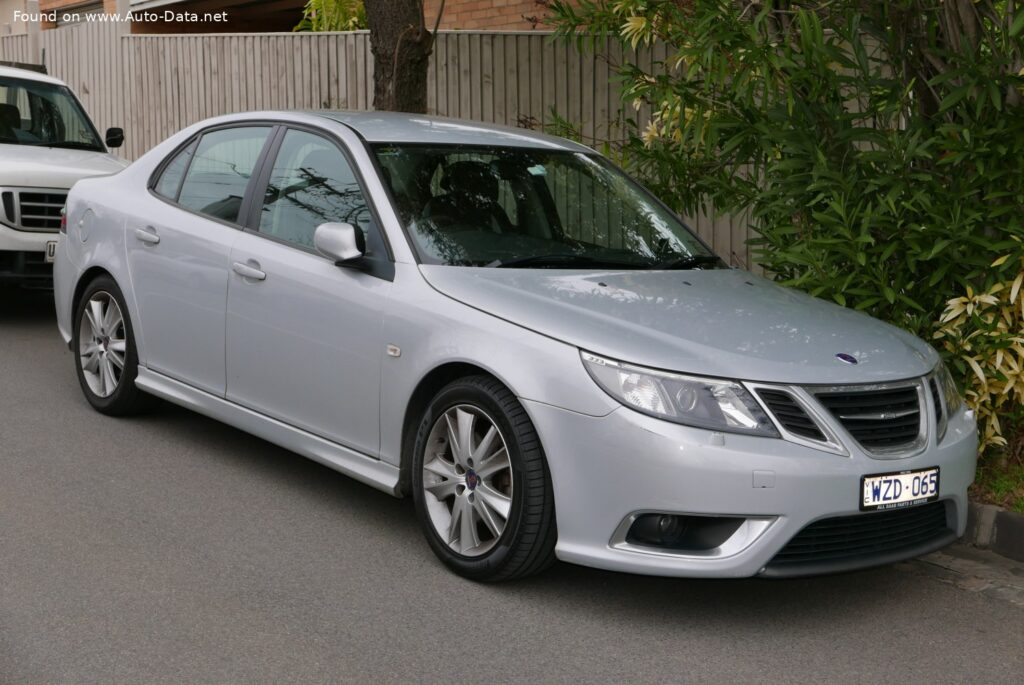
The Saab 9-3 Sedan II, specifically the facelifted version introduced in 2007, represents a significant evolution of Saab’s compact executive car. Produced from 2008 to 2009, this generation aimed to blend Scandinavian design principles with a focus on performance and safety. The 2.8T V6 XWD variant, equipped with a 280 horsepower engine and all-wheel drive, was positioned as a premium offering within the 9-3 lineup, appealing to drivers seeking a refined and capable sedan. While Saab faced financial difficulties during this period, the 9-3 continued to offer a unique driving experience and a loyal following.
Saab 9-3 Sedan II (2007-2009): A Detailed Overview
The 9-3 Sedan II facelift brought subtle but important changes to the original design, enhancing its aesthetic appeal and aerodynamic efficiency. This iteration of the 9-3 was primarily sold in Europe and other international markets, as Saab had ceased direct sales in the United States prior to this generation. It competed with vehicles like the Audi A4, BMW 3 Series, and Mercedes-Benz C-Class, offering a distinctive alternative with its emphasis on driver comfort and innovative features.
Engine & Performance
The heart of the 2.8T V6 XWD is a 2.8-liter V6 engine, designated the B284R, producing 280 horsepower at 5300 rpm and 400 Newton-meters (295 lb-ft) of torque between 1900 and 4500 rpm. This engine utilizes twin-scroll turbocharging and an intercooler to maximize power output and responsiveness. The power-to-liter ratio is an impressive 100.3 hp/l. The engine is transversely mounted in the front of the vehicle. Power is delivered to all four wheels via Saab’s XWD (Cross Wheel Drive) system, which employs an electronically controlled clutch to distribute torque between the front and rear axles as needed. This system enhances traction and stability, particularly in adverse weather conditions. Acceleration from 0 to 100 km/h (0-62 mph) takes 6.2 seconds, while the 0-60 mph sprint is achieved in a calculated 5.9 seconds. The vehicle has a top speed of 250 km/h (155.34 mph).
Design & Features
The Saab 9-3 Sedan II maintains the brand’s signature Scandinavian design language, characterized by clean lines, a wraparound cabin, and a focus on functionality. The facelifted model features revised front and rear styling, including updated headlights, taillights, and bumpers. The interior is designed with driver comfort in mind, offering supportive seats and a logically laid-out dashboard. Key features include available leather upholstery, automatic climate control, and a premium audio system. Safety was a paramount concern for Saab, and the 9-3 is equipped with ABS (Anti-lock Braking System) and a robust chassis designed to protect occupants in the event of a collision. The sedan body style offers practicality with a trunk capacity of 425 liters (15.01 cubic feet). The XWD system contributes to enhanced handling and stability, making the 9-3 a capable and enjoyable vehicle to drive.
Technical Specifications
| Brand | Saab |
| Model | 9-3 |
| Generation | 9-3 Sedan II (facelift 2007) |
| Type (Engine) | 2.8T V6 (280 Hp) XWD |
| Start of production | 2008 |
| End of production | 2009 |
| Powertrain Architecture | Internal Combustion engine |
| Body type | Sedan |
| Seats | 5 |
| Doors | 4 |
| Fuel consumption (urban) | 15.9 l/100 km (14.8 US mpg, 17.8 UK mpg, 6.3 km/l) |
| Fuel consumption (extra urban) | 7.5 l/100 km (31.4 US mpg, 37.7 UK mpg, 13.3 km/l) |
| Fuel consumption (combined) | 10.6 l/100 km (22.2 US mpg, 26.6 UK mpg, 9.4 km/l) |
| CO2 emissions | 254 g/km |
| Fuel Type | Petrol (Gasoline) |
| Acceleration 0-100 km/h | 6.2 sec |
| Acceleration 0-62 mph | 6.2 sec |
| Acceleration 0-60 mph | 5.9 sec |
| Maximum speed | 250 km/h (155.34 mph) |
| Emission standard | Euro 4 |
| Weight-to-power ratio | 6.2 kg/Hp, 160.9 Hp/tonne |
| Weight-to-torque ratio | 4.4 kg/Nm, 229.9 Nm/tonne |
| Power | 280 Hp @ 5300 rpm |
| Power per litre | 100.3 Hp/l |
| Torque | 400 Nm @ 1900-4500 rpm (295.02 lb.-ft. @ 1900-4500 rpm) |
| Engine layout | Front, Transverse |
| Engine Model/Code | B284R |
| Engine displacement | 2792 cm3 (170.38 cu. in.) |
| Number of cylinders | 6 |
| Engine configuration | V-engine |
| Cylinder Bore | 89 mm (3.5 in.) |
| Piston Stroke | 74.8 mm (2.94 in.) |
| Compression ratio | 9.5:1 |
| Number of valves per cylinder | 4 |
| Fuel injection system | Multi-port manifold injection |
| Engine aspiration | Twin-scroll turbo, Intercooler |
| Valvetrain | DOHC |
| Engine oil capacity | 6 l (6.34 US qt | 5.28 UK qt) |
| Coolant | 9.6 l (10.14 US qt | 8.45 UK qt) |
| Kerb Weight | 1740 kg (3836.04 lbs.) |
| Max. weight | 2200 kg (4850.17 lbs.) |
| Max load | 460 kg (1014.13 lbs.) |
| Trunk (boot) space (minimum) | 425 l (15.01 cu. ft.) |
| Fuel tank capacity | 61 l (16.11 US gal | 13.42 UK gal) |
| Max. roof load | 100 kg (220.46 lbs.) |
| Permitted trailer load (with brakes) | 1600 kg (3527.4 lbs.) |
| Permitted trailer load (without brakes) | 750 kg (1653.47 lbs.) |
| Length | 4647 mm (182.95 in.) |
| Width | 1762 mm (69.37 in.) |
| Width including mirrors | 2038 mm (80.24 in.) |
| Height | 1450 mm (57.09 in.) |
| Wheelbase | 2675 mm (105.31 in.) |
| Front track | 1524 mm (60 in.) |
| Rear track | 1506 mm (59.29 in.) |
| Front overhang | 981 mm (38.62 in.) |
| Rear overhang | 991 mm (39.02 in.) |
| Ride height (ground clearance) | 150 mm (5.91 in.) |
| Minimum turning circle | 11.7 m (38.39 ft.) |
| Drivetrain Architecture | All wheel drive (4×4). ICE drives front wheels, rear wheels driven by clutch. |
| Number of gears | 6 |
| Gearbox type | Manual transmission |
| Front suspension | Independent, McPherson with coil spring and anti-roll bar |
| Rear suspension | Independent multi-link spring suspension with stabilizer |
| Front brakes | Ventilated discs, 314 mm |
| Rear brakes | Ventilated discs, 292 mm |
| Steering type | Steering rack and pinion |
| Power steering | Hydraulic |
| Tires size | 235/45 R17; 225/45 R18; 235/45 R18; 235/40 R19 |
| Wheel rims size | 7.5J x 17; 7.5J x 18; 8J x 19 |
Despite its relatively short production run, the Saab 9-3 Sedan II 2.8T V6 XWD remains a compelling vehicle for enthusiasts. Its combination of performance, Scandinavian design, and advanced features makes it a unique and desirable offering in the compact executive segment.