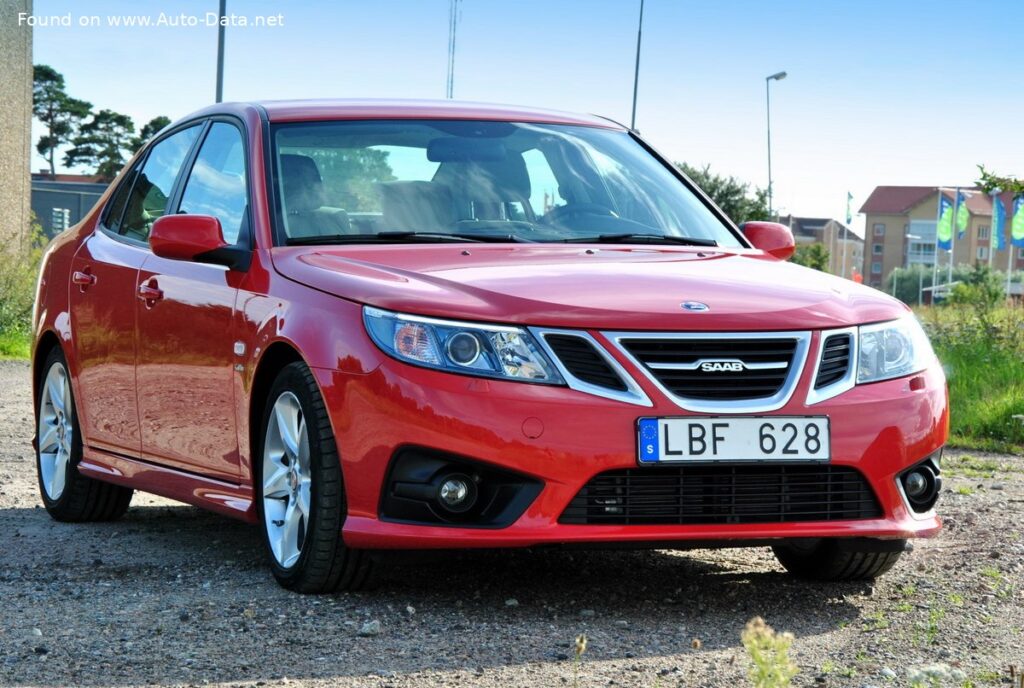
The Saab 9-3 Sedan II Griffin, specifically the 2.0t BioPower variant produced in 2011, represents a late-stage evolution of a model line that defined Saab’s commitment to Scandinavian design and innovative engineering. Positioned within the compact executive car segment, the 9-3 aimed to blend practicality, performance, and a unique driving experience. This facelifted version, produced briefly before Saab’s bankruptcy in December 2011, incorporated subtle styling updates and continued the brand’s focus on bioethanol compatibility, offering a degree of environmental consciousness alongside spirited performance. The 9-3, throughout its lifespan, was never a high-volume seller in the United States, but it cultivated a dedicated following among enthusiasts who appreciated its distinctive character and engineering approach.
Saab 9-3 Sedan II Griffin: A Detailed Overview
The 9-3 Sedan II Griffin (facelift 2011) was a crucial model for Saab, representing a refinement of the second-generation 9-3 platform. Introduced in 2007, the second generation aimed to modernize the 9-3 and broaden its appeal. The 2011 facelift brought revised front-end styling, interior enhancements, and updates to the engine range. The 2.0t BioPower model was particularly noteworthy for its ability to run on gasoline, E85 ethanol, or any blend thereof, offering flexibility and potentially reduced emissions. This model was primarily sold in European markets, where bioethanol fuel infrastructure was more developed, and Saab sought to position itself as a forward-thinking, environmentally responsible brand.
Engine & Performance
The heart of the 2011 Saab 9-3 2.0t BioPower is a 1.998-liter (121.93 cubic inches) inline-four cylinder engine. This engine, designated the B207H, produces 163 horsepower at 4,000-6,000 rpm and 320 Nm (236.02 lb.-ft.) of torque between 1,750 and 3,500 rpm. The engine utilizes direct fuel injection and a twin-scroll turbocharger with an intercooler to enhance both power and efficiency. The “BioPower” designation signifies the engine’s capability to operate on up to 100% E85 ethanol, which allows for increased power output in some configurations (though this specific model is rated for 163 hp on either fuel). Power is delivered to the front wheels via a six-speed Sentronic automatic transmission. Performance figures include a 0-100 km/h (0-62 mph) acceleration time of 9.4 seconds and a 0-60 mph time of 8.9 seconds, with a maximum speed of 210 km/h (130.49 mph). The engine’s power-to-weight ratio is 8.7 kg/Hp, and the torque-to-weight ratio is 4.4 kg/Nm.
Design & Features
The Saab 9-3 Sedan II Griffin is a four-door, five-seater sedan characterized by its clean lines and understated elegance. The 2011 facelift brought subtle changes to the front fascia, including a revised grille and headlights, giving the car a more contemporary appearance. Inside, the 9-3 offered a driver-focused cockpit with comfortable seating and a well-laid-out dashboard. Key features included ABS (Anti-lock Braking System), electric power steering, and a range of available options such as leather upholstery, premium audio systems, and parking sensors. Safety was a priority, with the 9-3 incorporating features designed to protect occupants in the event of a collision. The trunk offers 461 liters (16.28 cubic feet) of storage space. The car’s dimensions are: length 4668 mm (183.78 in), width 1762 mm (69.37 in) including mirrors 2038 mm (80.24 in), height 1486 mm (58.5 in), and wheelbase 2675 mm (105.31 in).
Technical Specifications
| Brand | Saab |
| Model | 9-3 |
| Generation | 9-3 Sedan II Griffin (facelift 2011) |
| Type (Engine) | 2.0t BioPower (163 Hp) Sentronic |
| Start of production | 2011 |
| End of production | December, 2011 |
| Powertrain Architecture | Internal Combustion engine |
| Body type | Sedan |
| Seats | 5 |
| Doors | 4 |
| Fuel consumption (economy) – urban (NEDC) | 11.9 l/100 km (19.8 US mpg, 23.7 UK mpg, 8.4 km/l) |
| Fuel consumption (economy) – extra urban (NEDC) | 5.7 l/100 km (41.3 US mpg, 49.6 UK mpg, 17.5 km/l) |
| Fuel consumption (economy) – combined (NEDC) | 7.9 l/100 km (29.8 US mpg, 35.8 UK mpg, 12.7 km/l) |
| CO2 emissions (NEDC) | 185 g/km |
| Fuel Type | Petrol / Ethanol – E85 |
| Acceleration 0 – 100 km/h | 9.4 sec |
| Acceleration 0 – 62 mph | 9.4 sec |
| Acceleration 0 – 60 mph | 8.9 sec |
| Maximum speed | 210 km/h (130.49 mph) |
| Emission standard | Euro 5 |
| Weight-to-power ratio | 8.7 kg/Hp, 115.2 Hp/tonne |
| Weight-to-torque ratio | 4.4 kg/Nm, 226.1 Nm/tonne |
| Power | 163 Hp @ 4000-6000 rpm |
| Torque | 320 Nm @ 1750-3500 rpm (236.02 lb.-ft. @ 1750-3500 rpm) |
| Engine layout | Front, Transverse |
| Engine Model/Code | B207H |
| Engine displacement | 1998 cm3 (121.93 cu. in.) |
| Number of cylinders | 4 |
| Engine configuration | Inline |
| Cylinder Bore | 86 mm (3.39 in.) |
| Piston Stroke | 86 mm (3.39 in.) |
| Number of valves per cylinder | 4 |
| Fuel injection system | Direct injection |
| Engine aspiration | Twin-scroll turbo, Intercooler |
| Valvetrain | DOHC |
| Engine oil capacity | 6 l (6.34 US qt | 5.28 UK qt) |
| Coolant | 7.5 l (7.93 US qt | 6.6 UK qt) |
| Kerb Weight | 1415-1565 kg (3119.54 – 3450.23 lbs.) |
| Max. weight | 2020 kg (4453.34 lbs.) |
| Max load | 455-605 kg (1003.1 – 1333.8 lbs.) |
| Trunk (boot) space – minimum | 461 l (16.28 cu. ft.) |
| Fuel tank capacity | 62 l (16.38 US gal | 13.64 UK gal) |
| Max. roof load | 100 kg (220.46 lbs.) |
| Permitted trailer load with brakes (12%) | 1600 kg (3527.4 lbs.) |
| Permitted trailer load without brakes | 750 kg (1653.47 lbs.) |
| Length | 4668 mm (183.78 in.) |
| Width | 1762 mm (69.37 in.) |
| Width including mirrors | 2038 mm (80.24 in.) |
| Height | 1486 mm (58.5 in.) |
| Wheelbase | 2675 mm (105.31 in.) |
| Front track | 1524 mm (60 in.) |
| Rear (Back) track | 1506 mm (59.29 in.) |
| Front overhang | 1002 mm (39.45 in.) |
| Rear overhang | 991 mm (39.02 in.) |
| Minimum turning circle (turning diameter) | 10.8 m (35.43 ft.) |
| Drive wheel | Front wheel drive |
| Number of gears and type of gearbox | 6 gears, automatic transmission Sentronic |
| Front suspension | Independent, type McPherson with coil spring and anti-roll bar |
| Rear suspension | Independent multi-link spring suspension with stabilizer |
| Front brakes | Ventilated discs, 296 mm |
| Rear brakes | Disc, 292 mm |
| Assisting systems | ABS (Anti-lock braking system) |
| Steering type | Steering rack and pinion |
| Power steering | Electric Steering |
| Tires size | 215/65 R16; 225/45 R17; 235/45 R17; 225/45 R18; 235/45 R18; 235/40 R19 |
| Wheel rims size | 6.5J x 16; 7J x 17; 7.5J x 17; 7.5J x 18; 8J x 19 |
The Saab 9-3 Sedan II Griffin 2.0t BioPower, despite its short production run, remains a compelling example of Saab’s engineering philosophy and design aesthetic. Its blend of performance, practicality, and bioethanol compatibility made it a unique offering in the compact executive car segment, and it continues to be appreciated by enthusiasts who value its distinctive character.