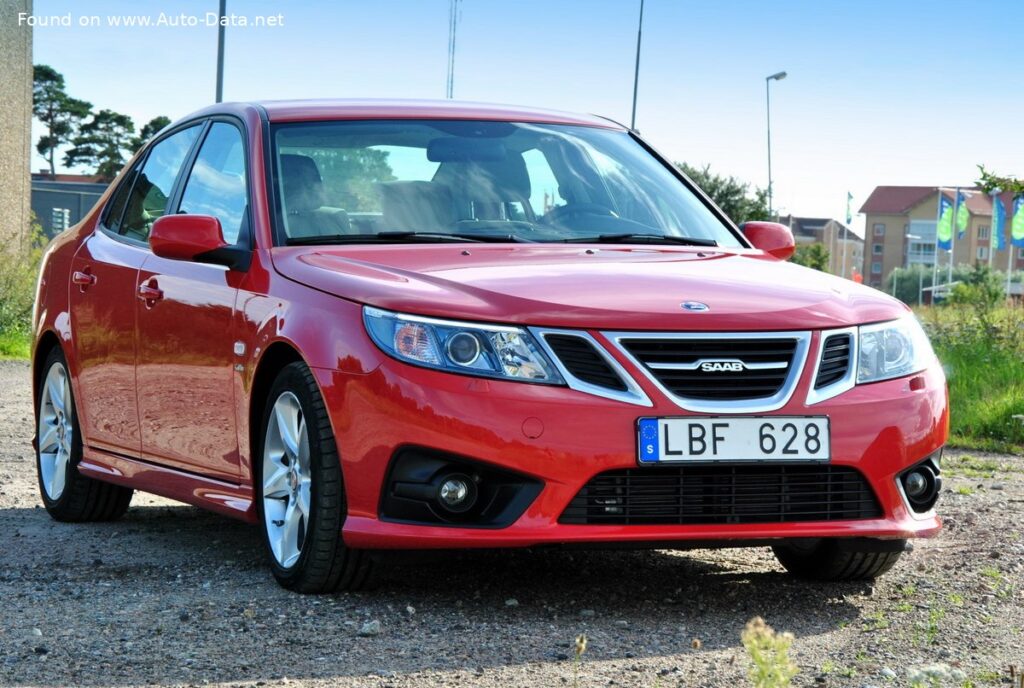
The Saab 9-3 Sedan II Griffin (facelift 2011) 2.0t BioPower represents a final refinement of Saab’s popular compact executive car before the brand’s unfortunate demise in December 2011. This iteration, primarily sold in Europe, aimed to balance performance, fuel efficiency, and Scandinavian design sensibilities. The 9-3 competed with vehicles like the Audi A4, BMW 3 Series, and Mercedes-Benz C-Class, though Saab carved out a niche with its distinctive styling and focus on driver experience. The “BioPower” designation indicates the engine’s capability to run on both gasoline and ethanol, or a blend of the two, offering a degree of flexibility and potential environmental benefit.
Saab 9-3 Sedan II Griffin (2011): A Detailed Overview
The 9-3 Sedan II Griffin facelift, introduced in 2011, featured subtle but noticeable updates to the exterior and interior. These changes included revised front and rear styling, updated interior trim, and enhancements to the car’s infotainment system. While Saab’s financial difficulties ultimately led to its closure, the 2011 9-3 represented a competent and well-rounded vehicle that showcased the brand’s engineering prowess.
Engine & Performance
The heart of the 9-3 Sedan II Griffin 2.0t BioPower is a 1.998-liter (121.93 cubic inches) inline-four cylinder engine. This engine utilizes direct fuel injection and a twin-scroll turbocharger with an intercooler to produce 220 horsepower at 5300 rpm and 350 Nm (258.15 lb.-ft.) of torque between 2000 and 4000 rpm. The BioPower capability allows the engine to operate on gasoline, E85 ethanol, or any mixture thereof. Utilizing E85 can increase power output, though it typically reduces fuel economy. The engine’s power-to-liter ratio is an impressive 110.1 hp/l. Power is delivered to the front wheels via a six-speed manual transmission. Performance figures include a 0-100 km/h (0-62 mph) acceleration time of 6.9 seconds and a 0-60 mph time of 6.6 seconds, with a maximum speed of 240 km/h (149.13 mph). The weight-to-power ratio of 6.5 kg/hp and weight-to-torque ratio of 4.1 kg/Nm contribute to the car’s responsive driving characteristics.
Design & Features
The Saab 9-3 Sedan II Griffin is a four-door, five-seat sedan characterized by its clean lines and understated elegance. The 2011 facelift brought a revised front grille, headlights, and bumper, along with updated taillights and a redesigned rear bumper. Inside, the cabin features a driver-focused layout with comfortable seating and a functional dashboard. Key features include ABS (Anti-lock Braking System), ventilated disc brakes on all four wheels (302mm front, 292mm rear), and an electric power steering system. The suspension utilizes an independent McPherson strut setup at the front and an independent multi-link setup at the rear, providing a balance between ride comfort and handling precision. Safety features were a priority, with the 9-3 incorporating a robust safety cell and a range of passive and active safety systems. Trunk space is a practical 461 liters (16.28 cubic feet). The car’s dimensions are 4668 mm (183.78 in) in length, 1762 mm (69.37 in) in width, and 1486 mm (58.5 in) in height, with a wheelbase of 2675 mm (105.31 in).
Technical Specifications
| Brand | Saab |
| Model | 9-3 |
| Generation | 9-3 Sedan II Griffin (facelift 2011) |
| Type (Engine) | 2.0t BioPower (220 Hp) |
| Start of production | 2011 |
| End of production | December, 2011 |
| Powertrain Architecture | Internal Combustion engine |
| Body type | Sedan |
| Seats | 5 |
| Doors | 4 |
| Fuel consumption (urban) | 9.8 l/100 km (24 US mpg, 28.8 UK mpg, 10.2 km/l) |
| Fuel consumption (extra urban) | 4.8 l/100 km (49 US mpg, 58.9 UK mpg, 20.8 km/l) |
| Fuel consumption (combined) | 6.7 l/100 km (35.1 US mpg, 42.2 UK mpg, 14.9 km/l) |
| CO2 emissions | 155 g/km |
| Fuel Type | Petrol / Ethanol – E85 |
| Acceleration 0 – 100 km/h | 6.9 sec |
| Acceleration 0 – 62 mph | 6.9 sec |
| Acceleration 0 – 60 mph | 6.6 sec |
| Maximum speed | 240 km/h (149.13 mph) |
| Emission standard | Euro 5 |
| Weight-to-power ratio | 6.5 kg/Hp |
| Weight-to-torque ratio | 4.1 kg/Nm |
| Power | 220 Hp @ 5300 rpm |
| Torque | 350 Nm @ 2000-4000 rpm (258.15 lb.-ft. @ 2000-4000 rpm) |
| Engine layout | Front, Transverse |
| Engine Model/Code | A20NFT |
| Engine displacement | 1998 cm3 (121.93 cu. in.) |
| Number of cylinders | 4 |
| Engine configuration | Inline |
| Cylinder Bore | 86 mm (3.39 in.) |
| Piston Stroke | 86 mm (3.39 in.) |
| Number of valves per cylinder | 4 |
| Fuel injection system | Direct injection |
| Engine aspiration | Twin-scroll turbo, Intercooler |
| Valvetrain | DOHC |
| Engine oil capacity | 6 l (6.34 US qt | 5.28 UK qt) |
| Coolant | 7.5 l (7.93 US qt | 6.6 UK qt) |
| Kerb Weight | 1420-1560 kg (3130.56 – 3439.21 lbs.) |
| Max. weight | 1990 kg (4387.2 lbs.) |
| Max load | 430-570 kg (947.99 – 1256.63 lbs.) |
| Trunk (boot) space | 461 l (16.28 cu. ft.) |
| Fuel tank capacity | 62 l (16.38 US gal | 13.64 UK gal) |
| Max. roof load | 100 kg (220.46 lbs.) |
| Permitted trailer load (braked) | 1600 kg (3527.4 lbs.) |
| Permitted trailer load (unbraked) | 750 kg (1653.47 lbs.) |
| Length | 4668 mm (183.78 in.) |
| Width | 1762 mm (69.37 in.) |
| Width including mirrors | 2038 mm (80.24 in.) |
| Height | 1486 mm (58.5 in.) |
| Wheelbase | 2675 mm (105.31 in.) |
| Front track | 1524 mm (60 in.) |
| Rear track | 1506 mm (59.29 in.) |
| Front overhang | 1002 mm (39.45 in.) |
| Rear overhang | 991 mm (39.02 in.) |
| Minimum turning circle | 10.8 m (35.43 ft.) |
| Drivetrain | Front wheel drive |
| Gearbox | 6 gears, manual transmission |
| Front suspension | Independent, McPherson with coil spring and anti-roll bar |
| Rear suspension | Independent multi-link spring suspension with stabilizer |
| Front brakes | Ventilated discs, 302 mm |
| Rear brakes | Ventilated discs, 292 mm |
| Tire size | 215/65 R16; 225/45 R17; 235/45 R17; 225/45 R18; 235/45 R18; 235/40 R19 |
| Wheel rims size | 6.5J x 16; 7J x 17; 7.5J x 17; 7.5J x 18; 8J x 19 |