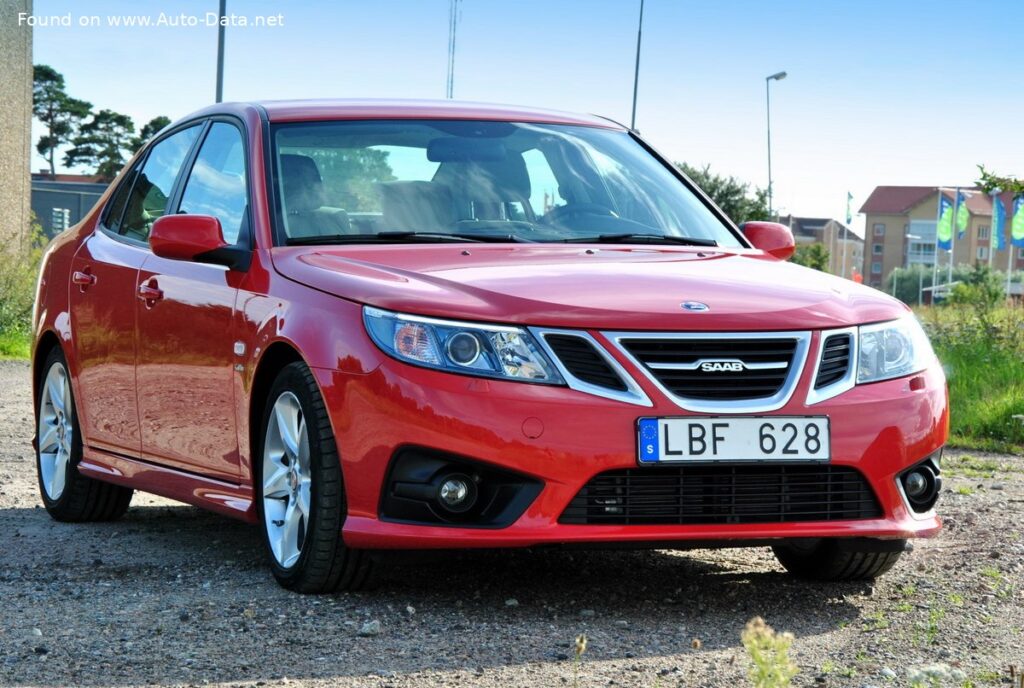
The Saab 9-3 Sedan II Griffin, specifically the 2011 facelifted model with the 2.0t BioPower engine, represents a pivotal point in the Swedish automaker’s history. Produced briefly before Saab’s eventual bankruptcy in December 2011, this iteration of the 9-3 aimed to blend Scandinavian design with performance and fuel efficiency. Positioned as a compact executive car, the 9-3 competed with models like the BMW 3 Series, Audi A4, and Volvo S60, though Saab cultivated a distinct identity appealing to drivers seeking individuality and a more unconventional driving experience. The BioPower designation signifies the engine’s capability to run on both gasoline and ethanol, or a blend of the two, a feature particularly relevant in markets with established ethanol infrastructure.
Saab 9-3 Sedan II Griffin: A Detailed Overview
The 9-3 Sedan II Griffin (facelift 2011) was a continuation of the second-generation 9-3, which debuted in 2007. The 2011 facelift brought subtle but noticeable changes to the exterior styling, including a revised front grille, headlights, and bumper. These updates aimed to modernize the car’s appearance and align it with Saab’s evolving design language. The interior received minor refinements as well, focusing on improved materials and ergonomics. However, the core appeal of the 9-3 remained its unique blend of comfort, safety, and engaging driving dynamics.
Engine & Performance
The heart of the 2011 Saab 9-3 2.0t BioPower is a 1.998-liter (121.93 cubic inches) inline-four cylinder engine. This engine, designated A20NFT, utilizes direct fuel injection and a twin-scroll turbocharger with an intercooler to produce 220 horsepower at 5300 rpm and 350 Nm (258.15 lb.-ft.) of torque between 2000 and 4000 rpm. The BioPower capability allows the engine to run on gasoline, E85 ethanol, or any mixture thereof. Utilizing E85 increases the engine’s output due to ethanol’s higher octane rating and cooling effect. Power is delivered to the front wheels via a six-speed Sentronic automatic transmission. Performance figures include a 0-100 km/h (0-62 mph) acceleration time of 8.6 seconds and a top speed of 235 km/h (146.02 mph). The engine’s power-to-weight ratio is 6.5 kg/Hp, and the torque-to-weight ratio is 4.1 kg/Nm.
Design & Features
The Saab 9-3 Sedan II Griffin is a four-door, five-seat sedan characterized by its clean lines and understated elegance. The design emphasizes aerodynamic efficiency and a driver-focused cockpit. Key features of the 2011 model include ventilated disc brakes on all four wheels, an anti-lock braking system (ABS), and electric power steering. The suspension system consists of an independent McPherson strut setup at the front and an independent multi-link setup at the rear, providing a balance between ride comfort and handling precision. Interior features focused on providing a comfortable and safe environment for both driver and passengers. Trunk space is a practical 461 liters (16.28 cubic feet). The car’s dimensions are 4668 mm (183.78 inches) in length, 1762 mm (69.37 inches) in width, and 1486 mm (58.5 inches) in height, with a wheelbase of 2675 mm (105.31 inches).
Technical Specifications
| Brand | Saab |
| Model | 9-3 |
| Generation | 9-3 Sedan II Griffin (facelift 2011) |
| Type (Engine) | 2.0t BioPower (220 Hp) Sentronic |
| Start of production | 2011 |
| End of production | December, 2011 |
| Powertrain Architecture | Internal Combustion engine |
| Body type | Sedan |
| Seats | 5 |
| Doors | 4 |
| Fuel consumption (urban) | 11.9 l/100 km (19.8 US mpg, 23.7 UK mpg, 8.4 km/l) |
| Fuel consumption (extra urban) | 5.7 l/100 km (41.3 US mpg, 49.6 UK mpg, 17.5 km/l) |
| Fuel consumption (combined) | 7.9 l/100 km (29.8 US mpg, 35.8 UK mpg, 12.7 km/l) |
| CO2 emissions | 185 g/km |
| Fuel Type | Petrol / Ethanol – E85 |
| Acceleration 0 – 100 km/h | 8.6 sec |
| Acceleration 0 – 62 mph | 8.6 sec |
| Acceleration 0 – 60 mph | 8.2 sec |
| Maximum speed | 235 km/h (146.02 mph) |
| Emission standard | Euro 5 |
| Weight-to-power ratio | 6.5 kg/Hp |
| Weight-to-torque ratio | 4.1 kg/Nm |
| Power | 220 Hp @ 5300 rpm |
| Torque | 350 Nm @ 2000-4000 rpm (258.15 lb.-ft. @ 2000-4000 rpm) |
| Engine layout | Front, Transverse |
| Engine Model/Code | A20NFT |
| Engine displacement | 1998 cm3 (121.93 cu. in.) |
| Number of cylinders | 4 |
| Engine configuration | Inline |
| Cylinder Bore | 86 mm (3.39 in.) |
| Piston Stroke | 86 mm (3.39 in.) |
| Number of valves per cylinder | 4 |
| Fuel injection system | Direct injection |
| Engine aspiration | Twin-scroll turbo, Intercooler |
| Valvetrain | DOHC |
| Engine oil capacity | 6 l (6.34 US qt | 5.28 UK qt) |
| Coolant | 7.5 l (7.93 US qt | 6.6 UK qt) |
| Kerb Weight | 1420-1560 kg (3130.56 – 3439.21 lbs.) |
| Max. weight | 2010 kg (4431.29 lbs.) |
| Max load | 450-590 kg (992.08 – 1300.73 lbs.) |
| Trunk (boot) space | 461 l (16.28 cu. ft.) |
| Fuel tank capacity | 62 l (16.38 US gal | 13.64 UK gal) |
| Max. roof load | 100 kg (220.46 lbs.) |
| Permitted trailer load (braked) | 1600 kg (3527.4 lbs.) |
| Permitted trailer load (unbraked) | 750 kg (1653.47 lbs.) |
| Length | 4668 mm (183.78 in.) |
| Width | 1762 mm (69.37 in.) |
| Width including mirrors | 2038 mm (80.24 in.) |
| Height | 1486 mm (58.5 in.) |
| Wheelbase | 2675 mm (105.31 in.) |
| Front track | 1524 mm (60 in.) |
| Rear track | 1506 mm (59.29 in.) |
| Front overhang | 1002 mm (39.45 in.) |
| Rear overhang | 991 mm (39.02 in.) |
| Minimum turning circle | 10.8 m (35.43 ft.) |
| Drivetrain | Front wheel drive |
| Gearbox | 6 gears, automatic transmission Sentronic |
| Front suspension | Independent, McPherson with coil spring and anti-roll bar |
| Rear suspension | Independent multi-link spring suspension with stabilizer |
| Front brakes | Ventilated discs, 302 mm |
| Rear brakes | Ventilated discs, 292 mm |
| Tire size | 215/65 R16; 225/45 R17; 235/45 R17; 225/45 R18; 235/45 R18; 235/40 R19 |
| Wheel rims size | 6.5J x 16; 7J x 17; 7.5J x 17; 7.5J x 18; 8J x 19 |
The 2011 Saab 9-3 2.0t BioPower, despite its short production run, remains a compelling example of Saab’s engineering prowess and commitment to innovation. Its blend of performance, efficiency, and Scandinavian design continues to appeal to enthusiasts and collectors alike, serving as a poignant reminder of a unique and influential automotive brand.